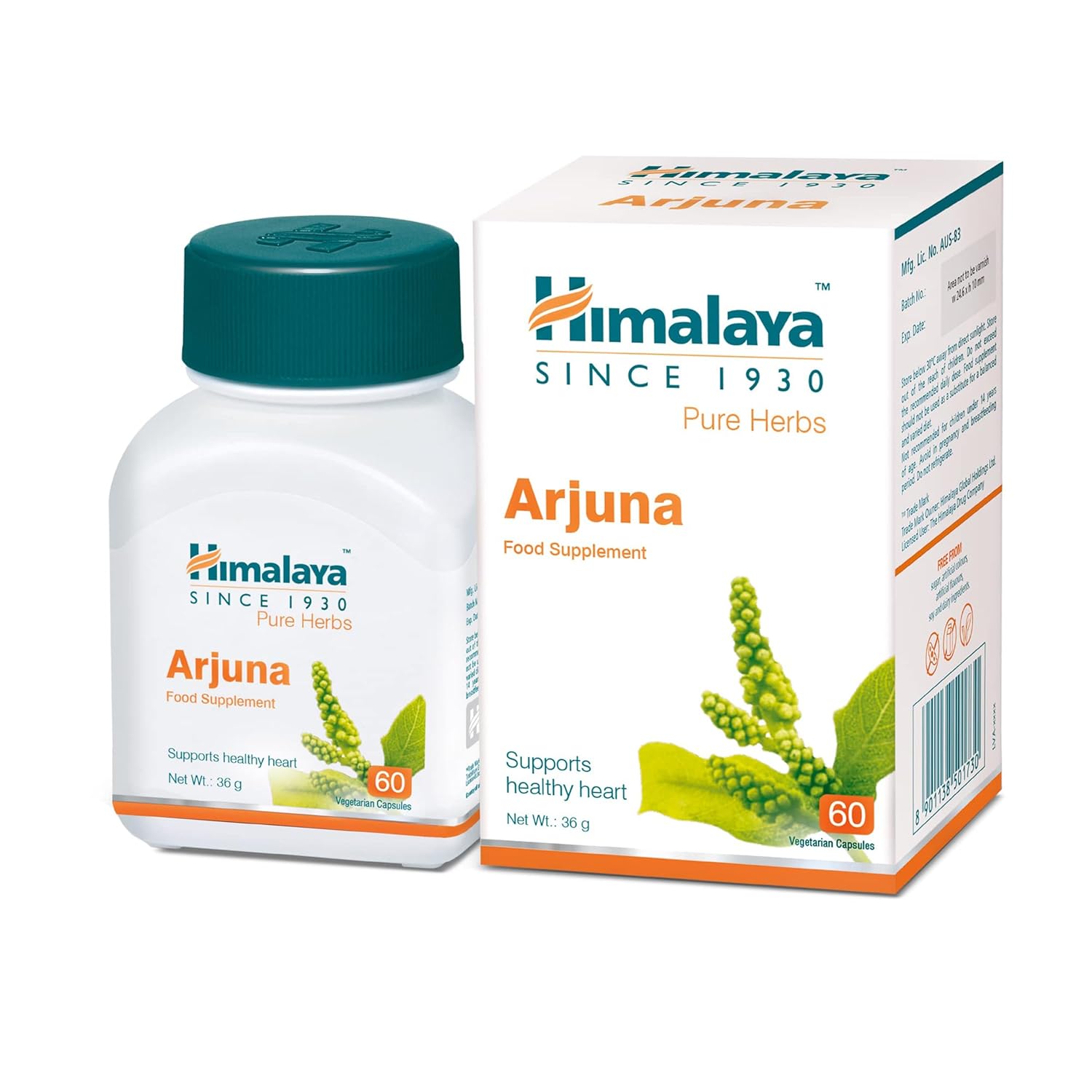
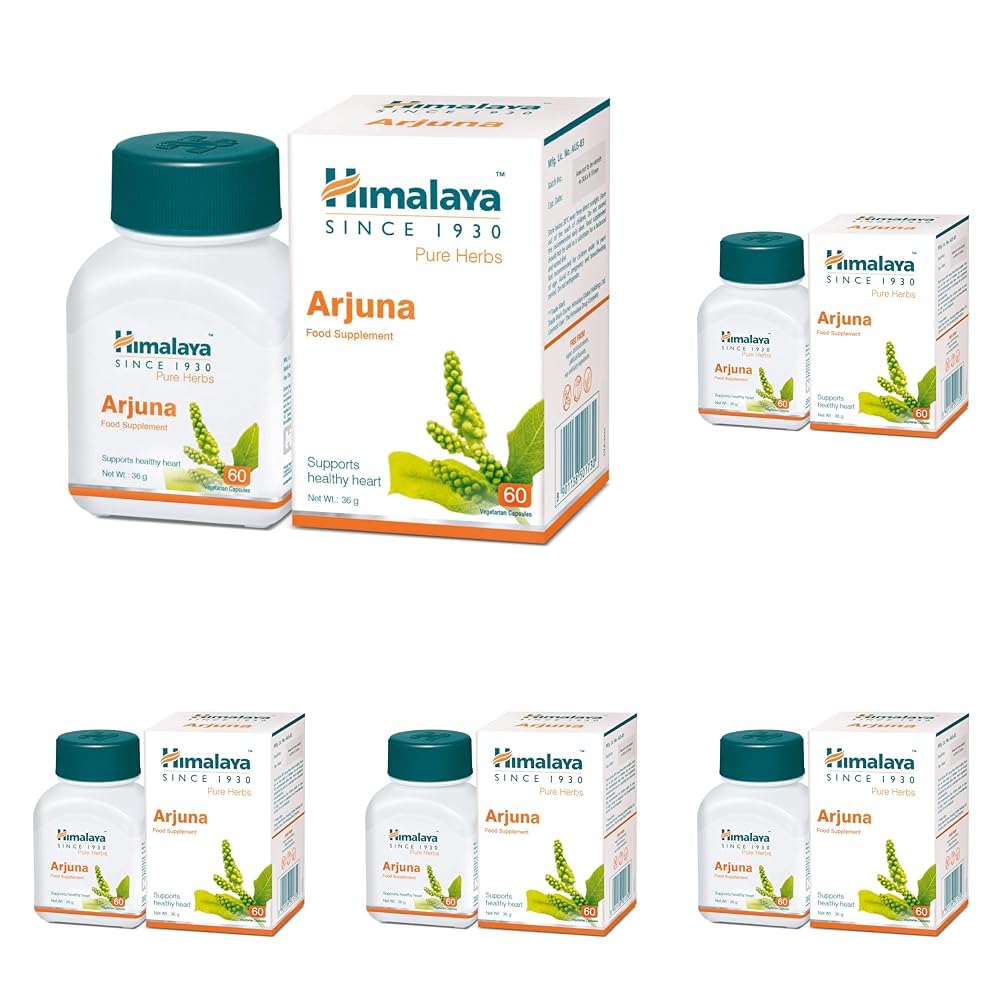




Himalaya Arjuna Tablets are 60 tablets made from the bark of Terminalia arjuna, the tall riverside tree that Ayurvedic texts have called arjuna for well over two thousand years. This is the standard Himalaya Wellness retail pack, sealed as it left the factory, shipped direct from India to your UK address.
At a glance
| Brand | Himalaya Wellness |
|---|---|
| Botanical name | Terminalia arjuna |
| Part used | Bark (in Sanskrit, twak) |
| Format | Tablets |
| Pack size | 60 tablets |
| Typical pack life | About one month at two tablets a day |
| Cost per tablet | Around 15p |
| Origin | Manufactured in India by Himalaya Wellness |
| Suitability | Suitable for vegetarians and vegans |
| Ships from | United Kingdom |
How to take it
The label direction is one tablet twice a day, after meals, with a glass of water. Take it with food rather than on an empty stomach — bark preparations sit more comfortably that way. If you are new to the herb, one tablet a day for the first week is a sensible way to start before moving to the full two.
Arjuna is traditionally taken as a course rather than occasionally, which is why the 60-tablet pack maps neatly onto a month. Most people who use it keep to a fixed time each day — after breakfast and after dinner — because that is far easier to remember than a loose intention to take it at some point.
Do not exceed the stated dose. This is a food supplement, not a medicine, and it is not intended to replace a varied diet or any treatment you have been prescribed. If you take prescription medication, are pregnant or breastfeeding, or are due to have surgery, speak to your GP or pharmacist before starting any herbal supplement.
Nutrition information
There is no authorised health claim on the GB Nutrition and Health Claims Register for Terminalia arjuna, and we therefore make none. Everything on this page describes the plant, its history and what is physically in the pack — not what it does in the body. Any UK retailer telling you otherwise is going beyond what the rules allow.
Arjuna is a plant material rather than a nutrient source. It is not a meaningful source of vitamins, minerals, protein or energy, and it does not carry a nutrition declaration of the sort you would find on a multivitamin.
In detail
The tree behind the tablet
Arjuna is a large deciduous tree of the Combretaceae family, common along riverbanks and dry watercourses across the Indian subcontinent, from the Himalayan foothills down through central India and into Sri Lanka. It can reach twenty-five metres, and it is easy to recognise: a smooth, pale grey-white bark that flakes away in broad sheets, which is precisely the part that is harvested.
Because the bark regenerates, harvesting is traditionally done by stripping mature trees in sections rather than felling them. The stripped bark is dried, cleaned of the outer scurf and milled. What ends up in a tablet is that milled bark, compressed with a small amount of binder.
What arjuna is called
You will see this herb written a dozen ways, which is part of why it can be hard to find. In Sanskrit it is arjuna or kakubha; in Hindi, arjun or arjun chhal (chhal meaning bark); in Bengali, arjun gachh; in Tamil, marudam; in Telugu, maddi; in Marathi, arjunsadada. English-language listings use arjuna, arjun, arjuna bark and white marudah. All of these refer to Terminalia arjuna. If you searched for “arjun chaal” and landed here, you are in the right place.
Tablets, capsules or loose bark powder
Arjuna reaches the UK in three formats and they are not interchangeable in practice. Loose bark powder (churna) is the most traditional and the cheapest per gram, but it is astringent and woody and most people find it genuinely unpleasant stirred into water. Capsules hide the taste but usually hold less material per unit. Tablets, as here, are compressed to a higher density than a capsule can hold, which is why a tablet pack tends to last longer per pound spent. The trade-off is that a tablet must be swallowed whole rather than opened.
About Himalaya Wellness
Himalaya has been making herbal products in India since 1930 and is one of the few Ayurvedic manufacturers with a genuinely global retail presence. Its single-herb range — arjuna, ashwagandha, brahmi, gokshura, neem and the rest — is standardised batch to batch, which is unusual in a category where the same herb from two suppliers can vary considerably. That consistency is the main reason Himalaya is the default recommendation for anyone buying a single Ayurvedic herb for the first time.
Buying this in the UK
We ship this pack from India directly to your UK address. Orders are dispatched within 24 to 72 hours and take 5 to 7 working days in transit, so most arrive 6 to 10 working days after you order. UK delivery is £4.99 flat, and free on orders over £100.
We are registered for UK VAT, so on orders up to £135 the VAT is charged at checkout and there is nothing further to pay when your parcel arrives. On orders above £135, import VAT, any duty and a carrier handling fee are payable by you on delivery — our shipping policy sets out exactly how that works.
What arrives is the sealed manufacturer retail pack with the batch number and expiry date printed on it, which is worth checking the moment it turns up.
Questions people ask
Is this genuine Himalaya Arjuna?
Yes. It is the sealed Himalaya Wellness retail pack with the manufacturer batch code and expiry date intact, sourced through the normal Indian retail supply chain, and shipped to you sealed. If a pack ever arrives unsealed or with the batch details obscured, tell us and we will replace it.
How long does one pack last?
Sixty tablets at the label direction of two a day is a thirty-day supply, so one pack is one month. At one tablet a day it lasts two months. If you are planning a longer run, buying two packs at once saves a second delivery.
What is arjuna, in plain terms?
It is the dried, milled bark of a large Indian tree, Terminalia arjuna, compressed into a tablet. It is a single-herb food supplement with nothing else added beyond the binder needed to hold the tablet together. It is not a formulation, not an extract concentrate and not a medicine.
Can I take arjuna alongside other Ayurvedic herbs?
People commonly do — arjuna sits alongside ashwagandha or triphala in a lot of traditional routines. Spacing them out across the day rather than swallowing everything at once is the usual approach. If you take prescription medicine of any kind, check with your GP or pharmacist before combining supplements, as herbal preparations can interact with prescribed drugs.
Do you ship arjuna anywhere in the UK?
Yes, to any UK address including Scotland, Wales, Northern Ireland and the Channel Islands. We ship from India, so allow 24 to 72 hours for dispatch and 5 to 7 working days in transit. Delivery is £4.99 flat and free on orders over £100. On orders up to £135 there is nothing to pay on delivery; above £135 import charges apply.
Suitability, storage and allergens
Suitable for vegetarians and vegans. Contains no gluten, dairy, egg, soy, nuts or added sugar. Store in a cool, dry place out of direct sunlight and keep the cap closed — bark preparations pick up moisture readily. Keep out of the reach of children. Use by the date printed on the pack.
Important information
Food supplement. Not a substitute for a varied, balanced diet and a healthy lifestyle. Do not exceed the recommended daily dose. Not recommended during pregnancy or breastfeeding, or for children, unless advised by a qualified healthcare professional. If you are taking prescription medication or have a diagnosed condition, seek medical advice before use. This product is not intended to diagnose, treat, cure or prevent any disease.


Reviews
There are no reviews yet.