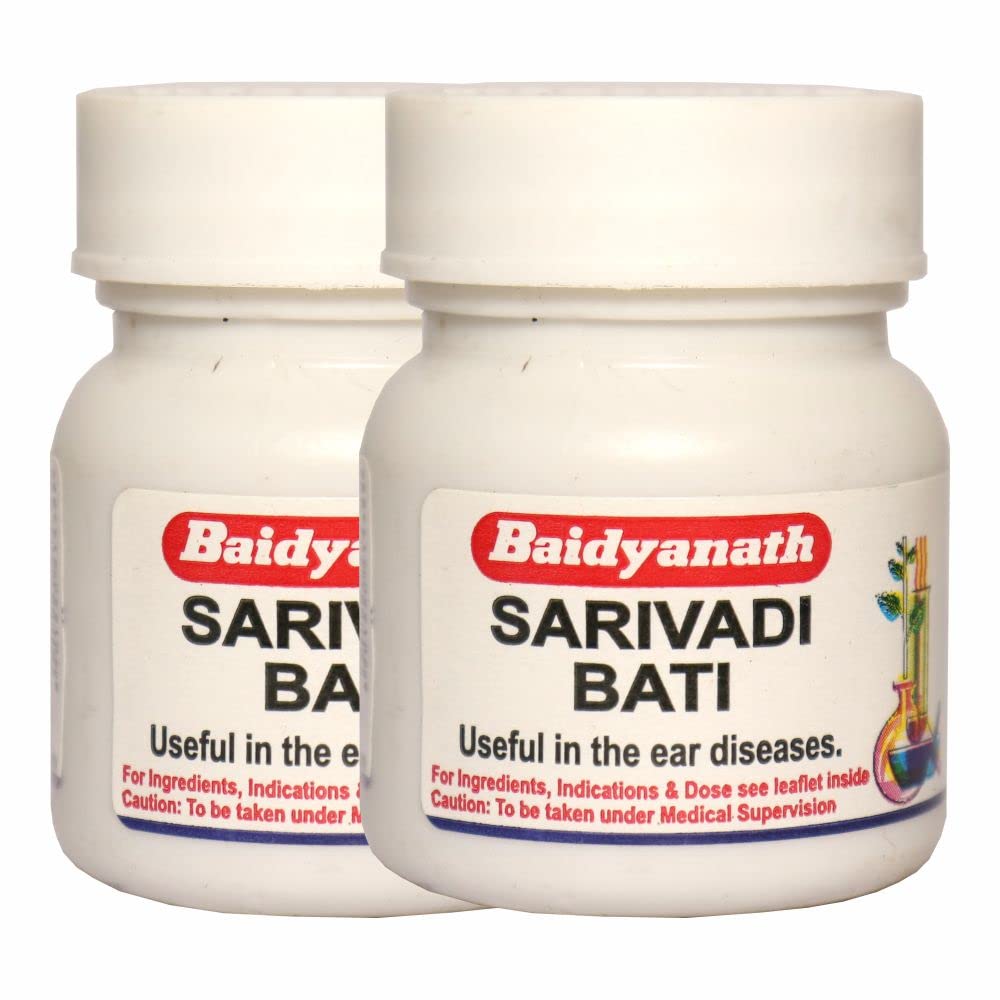
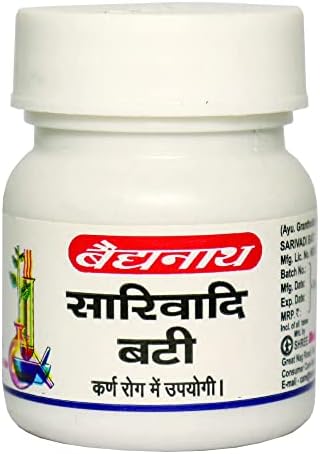
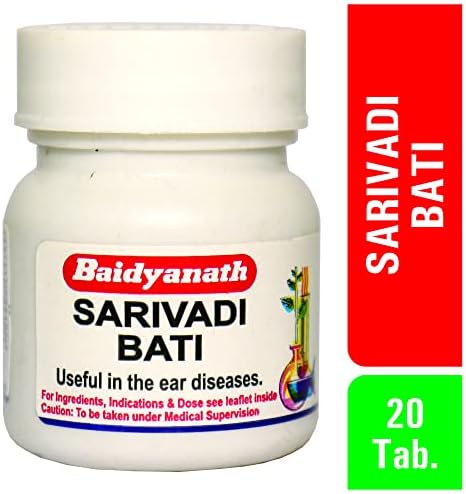
Baidyanath Sarivadi Bati is a classical Ayurvedic tablet formulation built around sariva (Hemidesmus indicus), the Indian sarsaparilla root known across north India as anantmool. Unlike a single-herb supplement, this is a multi-ingredient preparation whose recipe comes from the classical texts rather than from a modern product brief. Sixty tablets per pack, sealed as Baidyanath packed it, shipped direct from India to your UK address.
At a glance
| Brand | Baidyanath |
|---|---|
| Type | Classical multi-herb formulation (bati / vati) |
| Principal herb | Sariva — Hemidesmus indicus (anantmool) |
| Also spelled | Sarivadi Vati, Sariwadi Bati, Sarivadi Bati |
| Format | Tablets |
| Pack size | 60 tablets |
| Typical pack life | Two to four weeks at the usual label direction |
| Origin | Manufactured in India by Shree Baidyanath Ayurved Bhawan |
| Suitability | Suitable for vegetarians |
| Ships from | United Kingdom |
How to take it
The general label direction is one to two tablets twice a day with water, or as directed by an Ayurvedic practitioner. At two tablets twice daily a pack lasts a fortnight; at one twice daily, a month. Take with or after food unless your pack states otherwise.
Classical formulations of this kind are traditionally prescribed rather than self-selected, and practitioners commonly specify a dose and an anupana — the liquid the tablet is taken with, often warm water or milk. If you are working with a practitioner, follow what they have given you. If you are not, keep to the lower end of the label direction.
Do not exceed the stated dose. This is a food supplement in the UK, not a licensed medicine, and it does not replace anything you have been prescribed. If you are pregnant or breastfeeding, take prescription medication, or have a diagnosed condition, speak to your GP or pharmacist first.
Nutrition information
No ingredient in this formulation carries an authorised health claim on the GB Nutrition and Health Claims Register, and we make none. Classical Ayurvedic formulations are frequently listed overseas with statements about specific conditions; those statements are not permitted in Great Britain, and a product carrying them would be treated as an unlicensed medicine rather than a food supplement. This page therefore sets out what the formulation is, where it comes from and what is in it.
The tablets are plant material, not a nutrient source. They are not a meaningful source of vitamins, minerals, protein or energy and carry no nutrition declaration of the kind found on a multivitamin.
In detail
What a bati is
In Ayurvedic pharmacy a vati or bati is a tablet or pill made by grinding the specified herbs to a fine powder, binding them with a decoction or juice, and rolling and drying the mass. The naming convention is straightforward: the formulation is named after its principal ingredient plus adi, meaning “and others”. So Sariva + adi + bati means the tablet of sariva and the herbs that accompany it. Once you know that convention, a great many Ayurvedic product names decode themselves.
Sariva, the principal herb
Sariva is Hemidesmus indicus, a slender twining vine of the Apocynaceae family found across India and Sri Lanka. The root is the part used, and it has a strong, sweet, vanilla-like aroma that is unmistakable and quite unlike most Ayurvedic roots. It is called Indian sarsaparilla in English, though it is unrelated to true sarsaparilla (Smilax), and anantmool in Hindi — literally “endless root”, after the way it runs underground.
The other ingredients
Alongside sariva, the classical recipe brings in amla (Phyllanthus emblica), haritaki (Terminalia chebula) and baheda (Terminalia bellirica) — which together are triphala, the best-known combination in Ayurveda — plus mulethi (liquorice root), giloy (Tinospora cordifolia) and the warming aromatics clove, cinnamon and cardamom. Exact proportions are as printed on the manufacturer pack. It is a broad formulation rather than a targeted one, which is characteristic of the classical adi tablets.
About Baidyanath
Shree Baidyanath Ayurved Bhawan was founded in Calcutta in 1917 and is among the oldest and largest Ayurvedic manufacturers in India. Its catalogue is dominated by classical formulations made to the recipes in the traditional texts rather than by proprietary blends, and for many of these preparations Baidyanath is simply the reference version — the one against which others are compared. Packs carry a batch number and expiry date.
Buying this in the UK
We ship this pack from India directly to your UK address. Orders are dispatched within 24 to 72 hours and take 5 to 7 working days in transit, so most arrive 6 to 10 working days after you order. UK delivery is £4.99 flat, and free on orders over £100.
We are registered for UK VAT, so on orders up to £135 the VAT is charged at checkout and there is nothing further to pay when your parcel arrives. On orders above £135, import VAT, any duty and a carrier handling fee are payable by you on delivery — our shipping policy sets out exactly how that works.
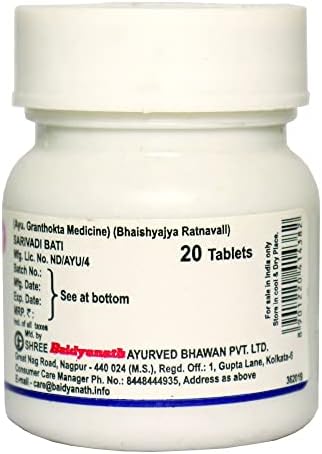
What arrives is the sealed manufacturer retail pack with the batch number and expiry date printed on it, which is worth checking the moment it turns up.
Questions people ask
What is Sarivadi Bati?
It is a classical Ayurvedic tablet formulation named after its principal ingredient, sariva (Hemidesmus indicus). The suffix adi means “and others”, so the name describes a tablet of sariva together with the accompanying herbs set out in the classical recipe. It is a food supplement in the UK, not a licensed medicine.
What ingredients does it contain?
Sariva (anantmool) as the principal herb, with amla, haritaki and baheda — the three fruits of triphala — plus mulethi, giloy, clove, cinnamon and cardamom. Exact quantities are printed on the manufacturer pack, which is the authoritative source for any particular batch.
Is it spelled Bati or Vati?
Both are correct and refer to the same thing. Vati is the Sanskrit transliteration; bati reflects the Bengali and eastern Hindi pronunciation, which is why Baidyanath, founded in Calcutta, uses it. You will also see Sariwadi Bati and Sarivadi Vati on other listings. All are the same formulation.
How do I take Sarivadi Bati?
The general label direction is one to two tablets twice a day with water, taken with or after food, so a 60-tablet pack lasts between two and four weeks. Classical formulations are usually prescribed by a practitioner with a specific dose and a specific liquid to take them with; follow theirs if you have one.
Do you ship this anywhere in the UK?
Yes, to any UK address including Scotland, Wales, Northern Ireland and the Channel Islands. We ship from India, so allow 24 to 72 hours for dispatch and 5 to 7 working days in transit. Delivery is £4.99 flat and free on orders over £100. On orders up to £135 there is nothing to pay on delivery; above £135 import charges apply.
Suitability, storage and allergens
Suitable for vegetarians. Contains liquorice root. Store in a cool, dry place away from direct sunlight with the container closed. Keep out of the reach of children. Use by the date printed on the pack. Check the manufacturer pack for the full ingredient list before use if you have any known plant sensitivities.
Important information
Food supplement. Not a substitute for a varied, balanced diet and a healthy lifestyle. Do not exceed the recommended daily dose. Contains liquorice; not recommended for people advised to avoid liquorice, and not for prolonged use at high intake. Not recommended during pregnancy or breastfeeding, or for children, unless advised by a qualified healthcare professional. If you take prescription medication or have a diagnosed condition, seek medical advice before use. This product is not intended to diagnose, treat, cure or prevent any disease.


Reviews
There are no reviews yet.