Quick answer: Heavy, painful or irregular periods are common, and they are also among the most under-treated problems in women’s health. Heat, gentle exercise and ibuprofen help most period pain. Heavy bleeding can be reduced substantially with treatments from a GP, and it often causes iron deficiency that is worth testing for. Irregular cycles usually have an identifiable cause. Ashoka, lodhra and shatavari are the classic Ayurvedic women’s herbs. They have a long tradition of use and very little clinical research, they should be avoided in pregnancy, and they are not a substitute for finding out why your periods have changed. See a GP if your periods affect your life, have changed, or come with bleeding between periods or after sex.
Key facts
- A cycle of 21 to 35 days is regular. The average is about 28 days.
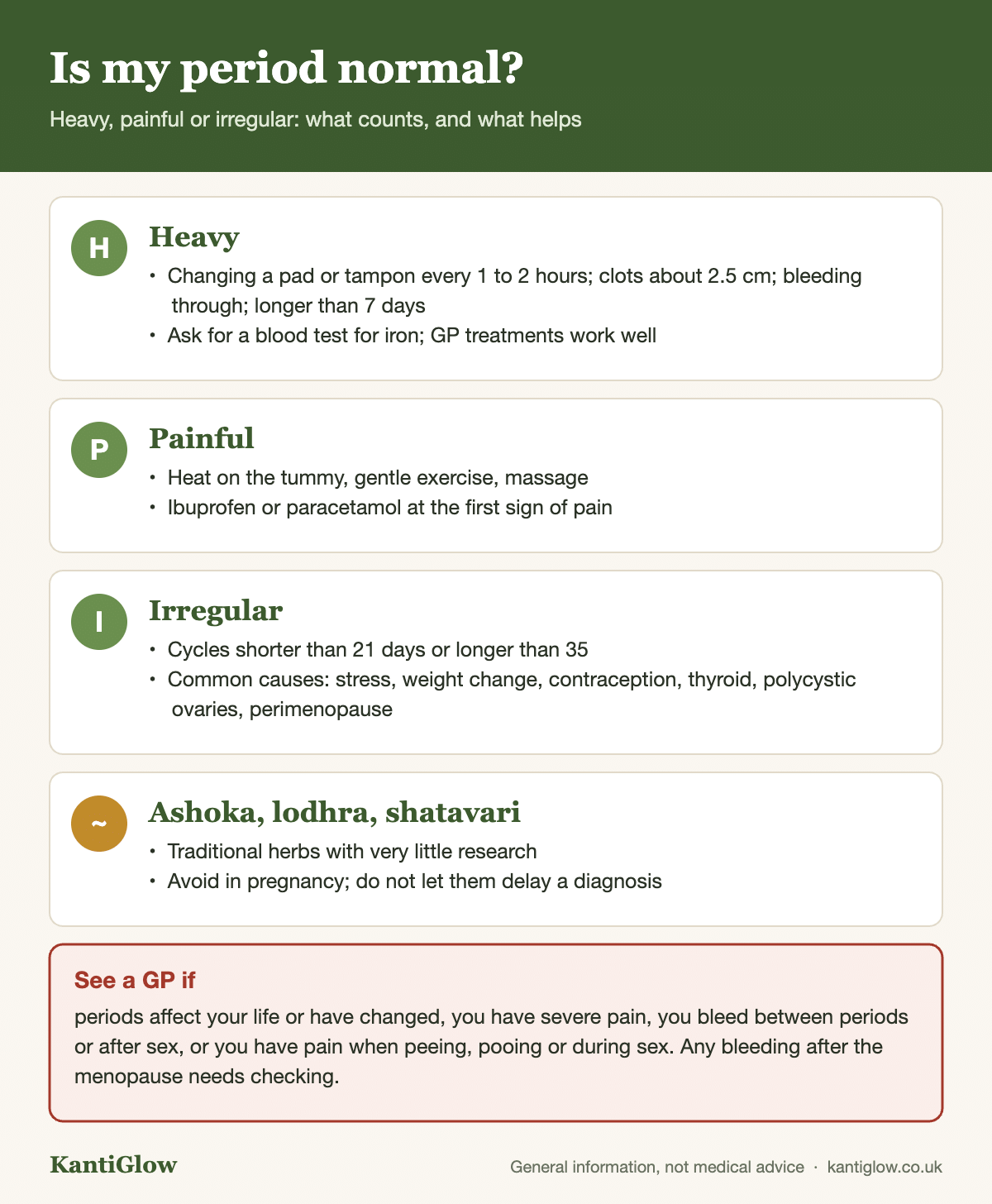
- Signs of heavy periods include changing a pad or tampon every 1 to 2 hours, clots about 2.5 cm across, bleeding through to clothes or bedding, and periods lasting more than 7 days.
- Heavy periods are a common cause of iron deficiency anaemia, which causes tiredness and breathlessness.
- A warm bath, a hot water bottle, tummy massage and gentle exercise ease period pain.
- GP treatments for heavy periods include the hormonal coil (IUS), the combined pill, tranexamic acid and anti-inflammatory painkillers.
- Bleeding between periods or after sex should always be checked.
What is normal, and what is not
| Usually normal | Worth seeing a GP | |
|---|---|---|
| Amount | Up to about 7 days of bleeding; manageable with regular products | Soaking a pad or tampon every 1 to 2 hours, doubling up products, large clots, bleeding through |
| Pain | Cramps for the first day or two that ease with heat or painkillers | Pain that stops daily activities, is getting worse, or occurs during sex or when peeing or pooing |
| Timing | Cycles of 21 to 35 days, varying by a few days | Cycles shorter than 21 or longer than 35 days, a change from your usual pattern, bleeding between periods |
Heavy periods
Why they happen. Often no cause is found, and heavy periods can be normal at certain life stages, such as the years before the menopause. Conditions that cause them include fibroids, endometriosis, adenomyosis, polycystic ovary syndrome (now also called PMOS), pelvic inflammatory disease and bleeding disorders. Some medicines, including some blood thinners, can too. Rarely, heavy bleeding is a sign of womb cancer.
What helps.
- Ask for a blood test. Iron deficiency is common with heavy periods and makes you tired, breathless and pale.
- Eat iron-rich foods every day: lentils, chickpeas, beans, dark green vegetables, dried apricots, fortified cereals, and red meat if you eat it, with vitamin C alongside. Keep tea and coffee away from those meals.
- GP treatments work well. The hormonal coil (IUS), the combined pill, tranexamic acid tablets taken during the period, and anti-inflammatory tablets such as mefenamic acid or naproxen. If these do not help, a specialist can offer further options.
- Track it. Note how many products you use and on which days. It makes the GP conversation easier.
Painful periods
Why they happen. The womb tightens to shed its lining. Pain that is severe, starts later in life or gets worse over time can be caused by endometriosis, adenomyosis, fibroids or pelvic inflammatory disease. A copper coil can make periods more painful in the first three to six months.
What helps.
- Heat: a hot water bottle or heat pad wrapped in a towel on your tummy, or a warm bath.
- Gentle exercise such as walking, yoga, swimming or cycling.
- Massaging your tummy and lower back.
- Ibuprofen or paracetamol. Ibuprofen tends to work better for cramps; take it with food and start as soon as pain begins.
- Cutting down on alcohol and stopping smoking.
- Ginger has a few small trials suggesting it eases period pain when taken in the first days of bleeding. As fresh ginger tea it is safe for most people.
Irregular periods
Common causes are puberty, the approach of the menopause, pregnancy, hormonal contraception, significant weight loss or gain, stress, very heavy exercise, polycystic ovary syndrome and thyroid problems. Treatment is often not needed, and when it is, it depends on the cause. See a GP if your pattern changes, if irregular periods come with weight gain, tiredness, extra facial hair or oily skin, or if you are having trouble getting pregnant. If there is any chance you could be pregnant, do a test.
Where ashoka, lodhra and shatavari fit
| Herb | Traditional use | What research shows | Cautions |
|---|---|---|---|
| Ashoka (Saraca asoca bark) | The best-known Ayurvedic herb for heavy and painful periods; the main ingredient of ashokarishta | Laboratory and animal studies. Human trials are few, small and mostly of multi-herb products | Avoid in pregnancy and when trying to conceive. Ashokarishta is a fermented liquid that contains alcohol and sugar |
| Lodhra (Symplocos racemosa bark) | Traditionally paired with ashoka for heavy bleeding | Almost no human research | Avoid in pregnancy. Can cause stomach upset |
| Shatavari (Asparagus racemosus root) | A general women’s tonic across life stages | A handful of small studies, not conclusive | Check first if you have a hormone-sensitive condition such as endometriosis, fibroids or a history of breast cancer. Avoid with asparagus allergy |
Three points matter more than the detail:
- None of these can be sold in the UK as regulating periods, reducing bleeding or balancing hormones. They are food supplements with a traditional history.
- They can delay a diagnosis. Fibroids, endometriosis, thyroid disease and anaemia all have effective treatments. A herb taken for six months in place of a GP visit is six months lost.
- Tell your GP or pharmacist if you take them, especially with hormonal contraception, blood thinners, or before any gynaecological procedure.
If you still wish to try one, choose a single-herb product, follow the label, keep a period diary for three cycles, and stop if nothing changes.
When to see a GP
See a GP if heavy periods are affecting your life or have gone on for some time, if you have severe pain, if your periods have become more painful, heavier or irregular, if you bleed between periods or after sex, or if you have pain when peeing, pooing or during sex. Get urgent advice from your GP or 111 if period pain is severe or worse than usual and painkillers have not helped. Any bleeding after the menopause needs checking.
Heavy painful periods: frequently asked questions
How heavy is too heavy?
Changing a pad or tampon every one to two hours, passing clots about 2.5 cm across, or bleeding through.
How long should a period last?
Up to about seven days.
What is a normal cycle length?
21 to 35 days.
Why are my periods suddenly heavier?
Fibroids, hormonal changes, a copper coil or approaching menopause are common reasons. See a GP.
Are blood clots normal?
Small ones are. Clots about 2.5 cm across are a sign of heavy bleeding.
Can heavy periods cause anaemia?
Yes. Ask for a blood test if you feel tired or breathless.
What can a GP do for heavy periods?
Offer the hormonal coil, the pill, tranexamic acid or anti-inflammatory tablets.
What is tranexamic acid?
A tablet taken during your period that reduces bleeding.
Does the hormonal coil help?
Yes. It is one of the most effective treatments for heavy periods.
Why are my periods so painful?
The womb contracts to shed its lining. Severe or worsening pain can have an underlying cause.
What is the best painkiller for period pain?
Ibuprofen usually works best. Paracetamol is an alternative.
Does a hot water bottle help?
Yes.
Does exercise help period pain?
Gentle exercise often eases it.
Does ginger help period pain?
A few small trials suggest it does.
Does magnesium help period cramps?
Evidence is limited.
Could it be endometriosis?
Possibly, if pain is severe, long-lasting, or occurs with sex or bowel movements. See a GP.
What are fibroids?
Non-cancerous growths in the womb that can cause heavy or painful periods.
What is adenomyosis?
A condition where the womb lining grows into its muscle wall, causing heavy, painful periods.
Why are my periods irregular?
Stress, weight change, contraception, polycystic ovary syndrome, thyroid problems or perimenopause.
Is it normal to miss a period?
Occasionally. Take a pregnancy test, and see a GP if you miss three in a row.
Can stress delay a period?
Yes.
What is PCOS or PMOS?
A common hormonal condition causing irregular periods, excess hair and acne. PMOS is its newer name.
Can thyroid problems affect periods?
Yes, both underactive and overactive thyroid can.
Do periods change before menopause?
Yes. They often become irregular, heavier or lighter in the 40s.
What is ashoka?
The bark of Saraca asoca, a traditional Ayurvedic herb for women.
Does ashoka reduce heavy bleeding?
That is its traditional use. Human evidence is very limited.
What is ashokarishta?
A fermented liquid preparation of ashoka bark that contains alcohol and sugar.
Is ashokarishta safe?
Avoid it in pregnancy, when trying to conceive and if you avoid alcohol. Check with a pharmacist if you take medication.
What is lodhra?
The bark of Symplocos racemosa, traditionally used with ashoka.
Does lodhra work?
There is almost no human research.
What is shatavari?
An Ayurvedic root used as a women’s tonic.
Does shatavari regulate periods?
That claim cannot be made. Evidence is limited.
Can I take these herbs with the pill?
Check with a pharmacist first.
Can I take them while trying to conceive?
Ashoka and lodhra are best avoided. Discuss with your GP.
Are they safe in pregnancy?
No. Avoid them.
Can teenagers take these herbs?
Not without medical advice.
Do herbs balance hormones?
There is no reliable evidence that they change hormone levels in a useful way.
Does turmeric help periods?
Small studies suggest it may ease premenstrual symptoms. Evidence is limited.
Should I take iron during my period?
Only if a blood test shows you need it.
Which foods help with heavy periods?
Iron-rich foods with vitamin C.
Is bleeding between periods normal?
It should always be checked.
Can I exercise during my period?
Yes.
Should I track my cycle?
Yes. It helps you and your GP see patterns.
When should I see a GP?
When periods affect your life, change, or come with bleeding between periods or after sex.
Sources
- NHS: Heavy periods
- NHS: Period pain
- NHS: Irregular periods
- NHS: Iron deficiency anaemia
- NHS: Herbal medicines
Shop the products in this guide
- Bio Resurge Ashoka (60) — £7.99
- Planet Ayurveda Ashoka Powder — £11.99
- Neutraved Lodhra Powder 100g — £6.99
- Organic India Shatavari — £7.99
- Dabur Shatavari (60) — £4.99
- Vyas Shatavari Churna 100g — £5.99
- Zeroharm Women’s Balance Shatavari & Ashwagandha — £24.99
- The Women’s Foundation Kit — £40.00
Batch lab-tested, shipped from India. Food supplements should not replace a varied, balanced diet and a healthy lifestyle.
This guide is general information, not medical advice. Herbal products are not intended to diagnose, treat or cure any condition. Speak to a GP about period problems, and to a pharmacist before taking a herbal product if you are pregnant, trying to conceive or take medication.