
Quick answer: About one in seven couples have difficulty conceiving, and male factors contribute in a large share of cases, so getting a semen test is as important as any test your partner has. Sperm take around three months to develop, which means changes you make now show up in a test about three months later. What helps is stopping smoking, drinking little or no alcohol, reaching a healthy weight, keeping the testicles cool, avoiding anabolic steroids and testosterone, and having sex every two to three days. Gokshura, kapikachhu and safed musli are traditional Ayurvedic men’s tonics. A few small studies exist, mainly for kapikachhu, but none is a fertility treatment, and kapikachhu has real interactions. See a GP after a year of trying, or six months if your partner is 36 or over.
Key facts
- More than 8 in 10 couples where the woman is under 40 conceive within a year of regular unprotected sex.
- See a GP after 1 year of trying, or sooner if the woman is 36 or over or you know of a possible problem.
- The main test is a semen analysis, which checks sperm number, movement and shape. An abnormal result is usually repeated after about 3 months.
- Alcohol, excess weight, smoking, tight underwear, some workplace chemicals and recreational drugs can all affect sperm.
- Anabolic steroids and testosterone treatment can stop sperm production.
- Zinc contributes to normal fertility and reproduction, and selenium to normal sperm formation. Those are authorised claims about nutrients, not about treating infertility.
Is it me?
It may be either of you, both, or neither. Fertility problems affect men and women about equally, and in roughly a quarter of couples no cause is found. A semen analysis is simple, painless and far less invasive than the tests women go through, so it makes sense to have it early.
What the test looks at: the volume of semen, how many sperm there are, how well they move, and their shape. One abnormal result does not settle anything. Illness, fever, stress and a hot few weeks can all lower a count temporarily, which is why the test is repeated.
Things that can lower sperm quality:
- Smoking, heavy drinking, cannabis, cocaine and anabolic steroids
- Being very overweight
- Heat: hot baths and saunas, tight underwear, a laptop on the lap, long hours of driving
- Some medicines, including testosterone, some antidepressants, and chemotherapy
- Past infections such as mumps or chlamydia, undescended testicles, and varicoceles (enlarged veins in the scrotum)
- Exposure to pesticides, solvents and heavy metals at work
- Stress, which also lowers sex drive
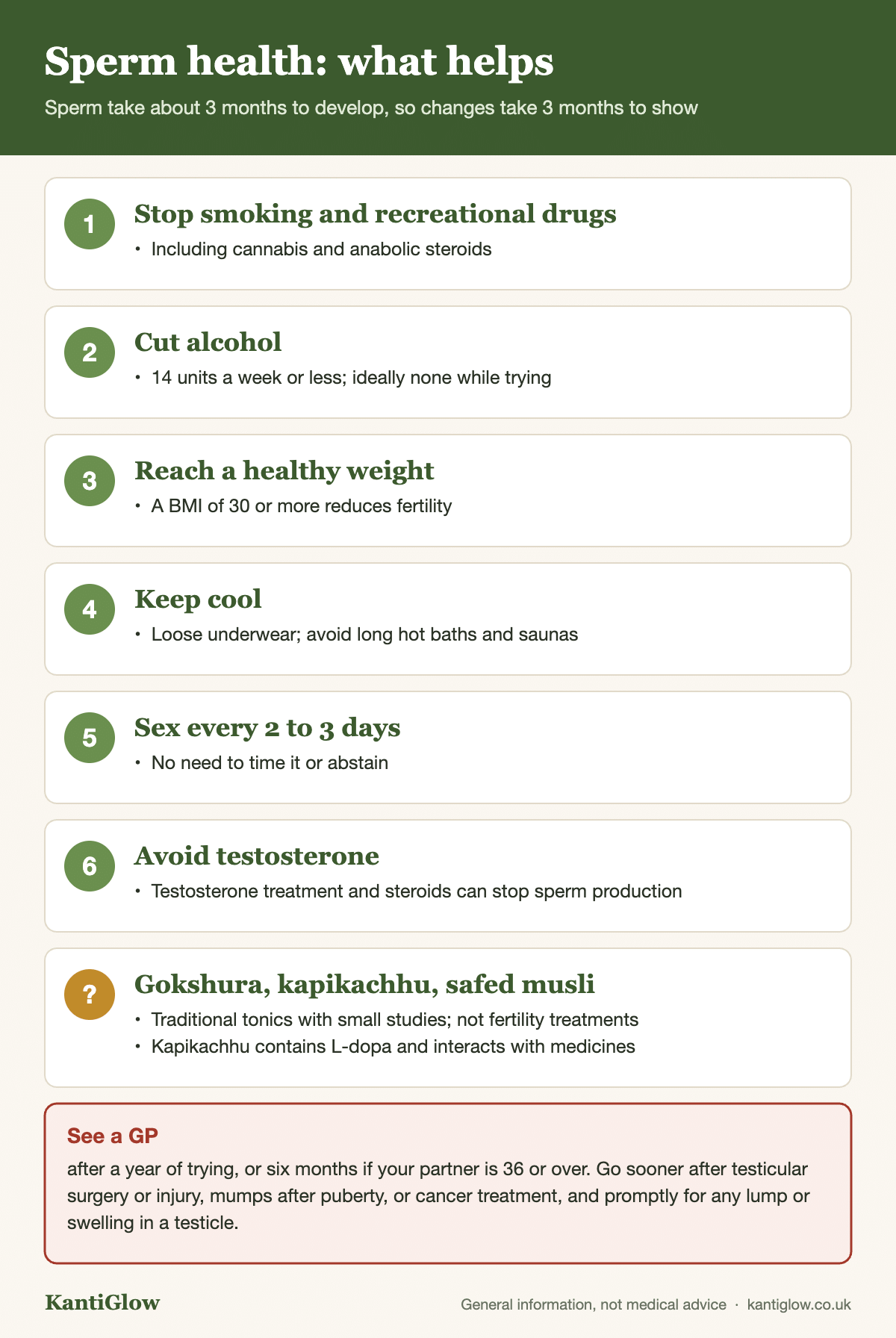
What improves sperm health
- Stop smoking, and avoid recreational drugs.
- Cut alcohol to 14 units a week or less, spread over three or more days. The safest approach while trying is not to drink.
- Reach a healthy weight. A BMI of 30 or more reduces fertility.
- Keep cool. Wear loose-fitting underwear and avoid long hot baths and saunas.
- Have sex every two to three days throughout the month. You do not need to time it or “save up”.
- Do not use testosterone, “TRT” or anabolic steroids. They shut down the body’s own sperm production. If you are on prescribed testosterone and want children, tell your doctor.
- Eat well and move. Plenty of fruit, vegetables, nuts, pulses and fish, and regular moderate exercise.
- Reduce chemical exposure at work where you can, and use protective equipment.
- Manage stress and protect your sleep.
- Give it three months before judging any change.
Your partner should take 400 micrograms of folic acid daily while trying and for the first 12 weeks of pregnancy.
Do fertility supplements work?
| Supplement | What we know |
|---|---|
| Zinc, selenium | Needed for normal sperm formation. Helpful if your diet is short of them; extra has not been shown to raise fertility |
| Antioxidant blends (vitamins C and E, CoQ10, carnitine) | Reviews of trials suggest they may improve sperm measures and possibly birth rates, but the evidence is low quality |
| Vitamin D | Take 10 micrograms a day in winter as general advice |
| Ashwagandha | A few small trials in men with fertility problems reported better semen measures. Not suitable for everyone |
| “Testosterone boosters” | No evidence for fertility. Avoid anything containing actual hormones |
Gokshura, kapikachhu and safed musli
| Gokshura | Kapikachhu | Safed musli | |
|---|---|---|---|
| Plant | Tribulus terrestris fruit | Mucuna pruriens seed (velvet bean) | Chlorophytum borivilianum root |
| Traditional use | Men’s tonic, urinary health | Men’s tonic, nervous system | Men’s strengthening tonic |
| Human research | Small studies with mixed results; trials in healthy men show no rise in testosterone | A few small Indian studies in infertile men reported improved sperm count and movement. Not confirmed in large independent trials | Almost none |
| Main cautions | Stomach upset. Check first with diabetes or blood pressure medicines and prostate conditions | Naturally contains L-dopa. Do not take with Parkinson’s medicines, some antidepressants (MAOIs) or antipsychotics, or if you have had psychosis, heart rhythm problems or melanoma. Can cause nausea, headache and palpitations | Little safety data. May lower blood sugar |
What this adds up to. Kapikachhu is the only one of the three with any human fertility data, and it is also the one with the most serious interactions. None of them is a treatment for male infertility, and in the UK none can be sold as improving sperm, testosterone or libido.
If you decide to try one:
- Tell your GP, particularly if you are being investigated for fertility problems.
- Choose one product, and follow the label.
- Give it three months alongside the lifestyle changes, then repeat the semen test if your doctor agrees.
- Do not put off seeing a GP while you wait for a supplement to work. Age matters for both partners, and some causes need medical or surgical treatment.
When to see a GP
See a GP if you have not conceived after a year of regular sex without contraception, or after six months if your partner is 36 or over. Go sooner if you have had surgery or an injury to the testicles, an undescended testicle, mumps after puberty, a sexually transmitted infection, cancer treatment, or problems with erections or ejaculation. See a GP promptly about a lump, swelling or ache in a testicle.
If a problem is found on two tests, you will be referred to a specialist. Treatments include surgery for some causes, and assisted conception such as IVF or ICSI.
Sperm health: frequently asked questions
How long does it normally take to conceive?
More than 8 in 10 couples under 40 conceive within a year.
When should we see a GP?
After a year of trying, or six months if the woman is 36 or over.
How common are male fertility problems?
Male factors contribute in a large share of couples with difficulty conceiving.
How is male fertility tested?
With a semen analysis.
What does a semen analysis measure?
Sperm number, movement and shape, and semen volume.
Can I test my sperm at home?
Home kits give a rough count only. A laboratory test is more complete.
What is a low sperm count?
A low number of sperm in the semen. Natural conception may still be possible.
Can a low sperm count improve?
Often, if a lifestyle cause is addressed.
How long does it take to improve sperm?
About three months, the time sperm take to develop.
Does smoking affect sperm?
Yes, including passive smoking.
Does alcohol affect sperm?
Heavy drinking does. The safest approach when trying is not to drink.
Does cannabis affect fertility?
It can reduce sperm count and movement.
Does weight affect sperm?
Yes. A BMI of 30 or over reduces fertility.
Does tight underwear matter?
Loose-fitting underwear is advised.
Do hot baths and saunas affect sperm?
Heat can lower sperm production temporarily.
Does a laptop on my lap matter?
It raises scrotal temperature. Use a desk.
Does cycling affect fertility?
Moderate cycling is fine. Very long hours in the saddle may have an effect.
Does stress affect sperm?
It can affect sex drive and, when severe, sperm production.
How often should we have sex?
Every two to three days.
Should I abstain to build up sperm?
No. Regular ejaculation keeps sperm quality higher.
Does age affect male fertility?
Yes, though more gradually than in women.
Does testosterone treatment affect fertility?
Yes. It can stop sperm production.
Do anabolic steroids cause infertility?
They can, sometimes for a long time after stopping.
Which foods help sperm?
A diet rich in fruit, vegetables, nuts, pulses and fish.
Does zinc increase sperm count?
Zinc is needed for normal fertility. Extra helps only if you are low.
Do antioxidant supplements work?
They may help a little. The evidence is low quality.
Does ashwagandha improve sperm?
Small trials suggest it may. It is not suitable for everyone.
What is gokshura?
The fruit of Tribulus terrestris, a traditional men’s tonic.
Does gokshura improve fertility?
Studies are small and mixed.
What is kapikachhu?
The seed of Mucuna pruriens, also called velvet bean or kaunch beej.
Does kapikachhu increase sperm count?
A few small studies reported improvement. Larger trials are lacking.
Is kapikachhu safe?
It contains L-dopa and interacts with several medicines. Check with a pharmacist.
Who should not take kapikachhu?
People on Parkinson’s medicines, MAOI antidepressants or antipsychotics, and anyone with a history of psychosis or heart rhythm problems.
What is safed musli?
The root of Chlorophytum borivilianum, a traditional strengthening tonic.
Does safed musli work?
There is almost no human research.
Can I take all three together?
Combination products exist, but one at a time shows you what helps and what causes side effects.
Does shilajit help fertility?
One small study suggested so. Use only purified, tested products.
Do these herbs raise testosterone?
Trials in healthy men generally show no meaningful rise.
Should my partner take anything?
Folic acid, 400 micrograms a day.
What is a varicocele?
Enlarged veins in the scrotum that can affect sperm. It can be treated.
What treatments are there for male infertility?
Treating any cause found, and assisted conception such as IVF or ICSI.
Is IVF available on the NHS?
Yes, subject to local criteria.
Can we still conceive naturally with a low count?
Often, yes.
Where can we get support?
Your GP, and charities such as Fertility Network UK.
Sources
- NHS: Low sperm count
- NHS: Infertility
- NHS: The “male menopause”
- NHS: Herbal medicines
- Great Britain nutrition and health claims register
Shop the products in this guide
- Himalaya Gokshura Capsules — £7.99
- Rasayanam Gokshura (Tribulus) 1000mg — £13.99
- Dhootapapeshwar Gokshuradi Guggulu — £6.99
- Pure Nutrition Kaunch Beej (Mucuna) — £13.99
- Safed Musli Extract 500mg — £13.99
- Pure Nutrition Safed Musli 500mg — £14.99
- Kali Musli Churna — £7.99
- Himalaya Speman Tablets (60) — £6.99
Batch lab-tested, shipped from India. Food supplements should not replace a varied, balanced diet and a healthy lifestyle.
This guide is general information, not medical advice. Herbal products and food supplements are not intended to diagnose, treat or cure any condition, including infertility. Speak to a GP if you have been trying to conceive without success, and to a pharmacist before taking a herbal product alongside medication.