
Quick answer: Forgetting names, misplacing things and losing your thread become more common from middle age, and stress, poor sleep, low mood and anxiety are the commonest treatable causes. The habits with the best evidence for protecting memory are physical ones: regular exercise, controlling blood pressure, cholesterol and blood sugar, sleeping well, correcting hearing loss, staying socially and mentally active, not smoking and drinking little. Lion’s mane mushroom has one small trial in older adults with mild memory problems showing a modest improvement that fell away after they stopped taking it. That is not enough to call it a memory aid. See a GP if memory problems are affecting your daily life or steadily getting worse.
Key facts
- Memory loss can be a natural part of getting older, and is often caused by stress, anxiety, depression or sleep problems.
- See a GP if memory problems are affecting your day-to-day life.
- Things that may lower dementia risk include a balanced diet, a healthy weight, 150 minutes of exercise a week with strength work twice, staying within 14 units of alcohol, not smoking and keeping blood pressure healthy.
- Untreated depression, hearing loss, loneliness and social isolation are possible risk factors for dementia.
- No supplement has been shown to prevent dementia.
- Lion’s mane is sold as a food supplement in the UK and cannot make memory or brain claims.
Is this normal?
| Usually normal | Worth seeing a GP |
|---|---|
| Forgetting a name and remembering it later | Forgetting the names of close family or everyday objects |
| Misplacing keys or glasses | Putting things in odd places and being unable to retrace your steps |
| Walking into a room and forgetting why | Getting lost in familiar places |
| Needing lists more than you used to | Struggling to follow a recipe, a conversation or a television plot |
| Being slower to learn new technology | Repeating the same question within minutes |
| Noticing it yourself | Family noticing it more than you do |
If you are worried about a relative who is becoming steadily more forgetful, encourage them to see a GP, and offer to go with them.
Why memory slips
- Stress, anxiety and low mood. A preoccupied mind does not store new information well.
- Poor sleep. Memories are consolidated during sleep.
- Doing too many things at once. Most “forgetting” is not paying attention in the first place.
- Alcohol.
- Medicines, including some sleeping tablets, antihistamines, strong painkillers and bladder medicines.
- Menopause. Brain fog is common and usually improves.
- Low vitamin B12, an underactive thyroid or anaemia. All are found with a blood test.
- Hearing loss. If you did not hear it, you cannot remember it.
- Less often, dementia.
What protects memory
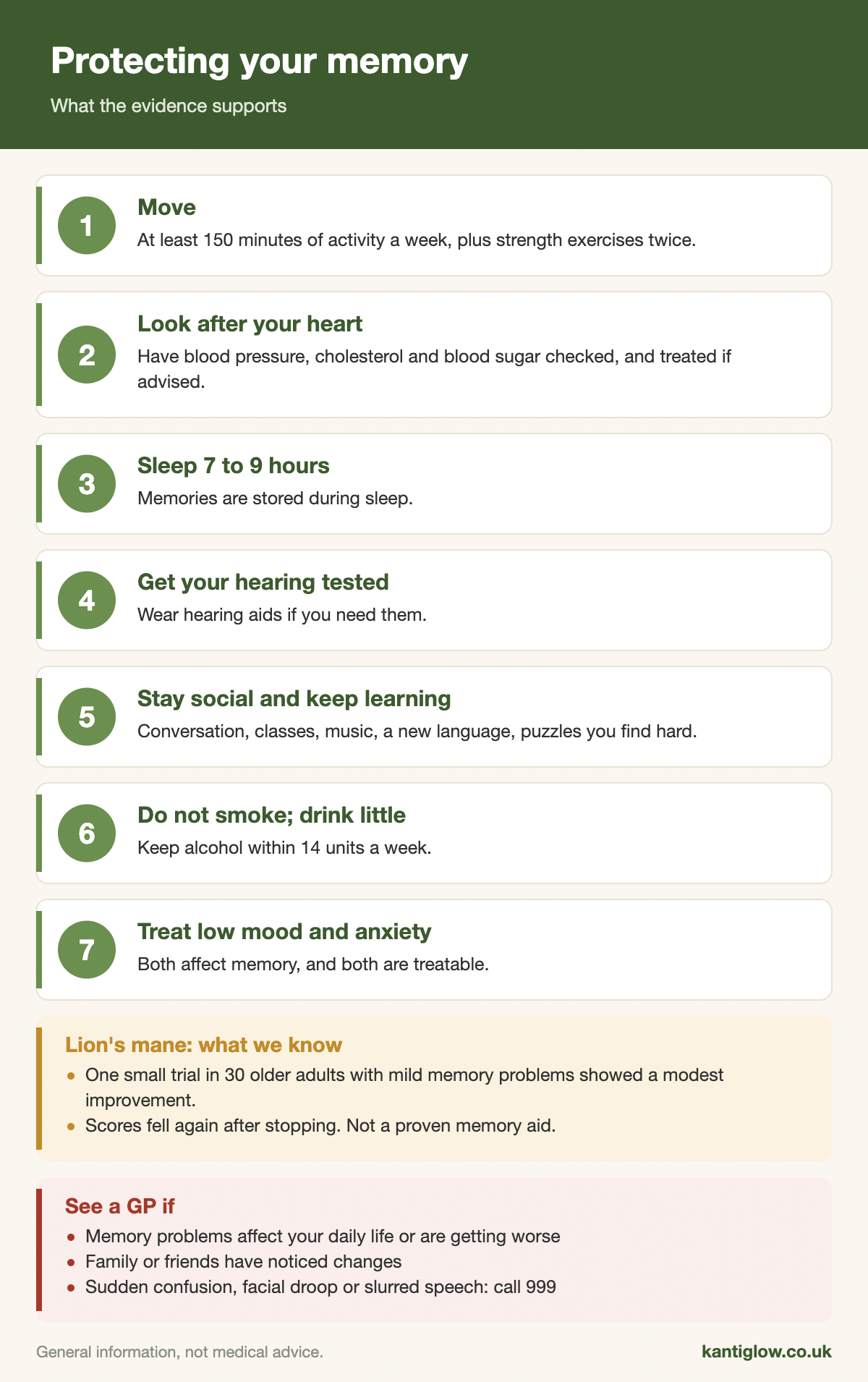
1. Move. At least 150 minutes of moderate activity a week, plus strength exercises twice a week, and less time sitting. Exercise has the strongest evidence of anything on this list.
2. Look after your heart. What is good for the heart is good for the brain. Have your blood pressure, cholesterol and blood sugar checked, and take treatment if it is advised.
3. Sleep seven to nine hours.
4. Get your hearing tested and wear hearing aids if you need them.
5. Stay connected and keep learning. Conversation, classes, volunteering, music, a new language, games and puzzles you find hard.
6. Do not smoke, and keep alcohol within 14 units a week.
7. Eat a balanced diet with plenty of vegetables, fruit, pulses, wholegrains, nuts and fish, and less saturated fat, salt and sugar.
8. Treat low mood and anxiety. Talk to a GP or refer yourself to NHS Talking Therapies.
9. Protect your head. Wear a helmet when cycling.
Everyday memory aids: a diary, lists, phone reminders, one fixed place for keys and glasses, saying a name aloud when you meet someone, and doing one thing at a time.
Does lion’s mane help?
What it is. Lion’s mane (Hericium erinaceus) is an edible mushroom with a shaggy white appearance, eaten in East Asia and now grown in the UK. Supplements are made from the fruiting body, the mycelium (the root-like part, often grown on grain), or both, as powder, capsules or extract.
What research shows.
- The trial most often quoted gave 30 Japanese adults aged 50 to 80 with mild cognitive impairment lion’s mane tablets or placebo for 16 weeks. The lion’s mane group scored better on a cognitive test, and their scores fell again in the four weeks after they stopped.
- A few other small studies, in healthy adults and in people with early memory problems, have given mixed results.
- Laboratory studies show compounds in the mushroom stimulate nerve growth factor. That has not been shown to matter in people.
- There are no trials showing it prevents dementia.
Powder, capsule or extract?
| Form | What it is | Note |
|---|---|---|
| Fruiting body powder | The dried, ground mushroom | Closest to eating the mushroom |
| Mycelium on grain | Mycelium grown on rice or oats and ground with it | Can be largely grain. Check the label |
| Extract | Hot-water or dual extract, often stating beta-glucan content | More concentrated. Products vary widely |
| Capsules | Any of the above in a capsule | Convenient. Check the amount per capsule |
No form has been shown to be better for memory. A label that states the part used, the extraction method and the beta-glucan content tells you more than marketing claims.
Cautions.
- Avoid it if you are allergic to mushrooms. Rashes and breathing symptoms have been reported.
- It may slow clotting and lower blood sugar. Check with a pharmacist if you take blood thinners or diabetes medicines, and stop two weeks before surgery.
- Avoid in pregnancy and breastfeeding, where safety is not established.
- Stomach upset is the commonest side effect.
If you try it, do the things in the section above as well, give it 12 to 16 weeks, and do not let it delay a GP appointment if your memory is getting worse.
Other supplements people ask about
| Supplement | What we know |
|---|---|
| Brahmi (Bacopa monnieri) | Small trials suggest modest improvement on memory tests after 8 to 12 weeks. Can cause nausea |
| Ginkgo biloba | Large trials found it does not prevent dementia. Interacts with blood thinners |
| Omega-3 | No clear benefit in people who already eat fish |
| B vitamins | Help only if you are deficient. B12 deficiency does cause memory problems |
| Vitamin D | No proven effect on memory. Take it in winter for other reasons |
| Ashwagandha | Small trials. Not suitable for everyone |
| Turmeric | No good evidence for memory |
| “Brain training” apps | Improve the games you practise, with little carry-over |
When to see a GP
See a GP if memory problems are affecting your day-to-day life, are getting steadily worse, or are noticed by family or friends. Go sooner if they come with low mood, a change in personality, difficulty with words or everyday tasks, or getting lost. Getting checked early matters, because several causes are treatable. Sudden confusion, weakness, facial droop or slurred speech is an emergency: call 999.
How to improve memory: frequently asked questions
Is forgetfulness normal with age?
Some is. It becomes a concern when it affects daily life.
At what age does memory decline?
Processing speed slows gradually from the 30s. Noticeable forgetfulness is common from middle age.
Why do I forget names?
Names carry little meaning to hook onto. Repeating a name when you hear it helps.
Why do I walk into a room and forget why?
Your attention shifted. It is very common.
Can stress cause memory loss?
Yes. It is one of the commonest causes.
Can lack of sleep affect memory?
Yes.
Can depression cause memory problems?
Yes, and treating it improves memory.
Can menopause affect memory?
Yes. Brain fog is common and usually improves.
Can medicines affect memory?
Yes. Ask a pharmacist to review what you take.
Does alcohol affect memory?
Yes, in the short and long term.
Can low B12 cause memory loss?
Yes. A blood test will show it.
Could it be my thyroid?
An underactive thyroid can cause trouble concentrating. It is found with a blood test.
What is mild cognitive impairment?
Memory or thinking problems greater than expected for age but not severe enough to be dementia.
What are the early signs of dementia?
Memory loss that affects daily life, difficulty with familiar tasks, confusion about time or place, and changes in mood.
Can dementia be prevented?
Not with certainty, but the risk can be reduced.
Does exercise help memory?
Yes. It has the strongest evidence.
Does blood pressure affect the brain?
Yes. High blood pressure in midlife raises dementia risk.
Does hearing loss affect memory?
It is a possible risk factor for dementia. Get your hearing tested.
Does socialising help?
Loneliness and isolation are possible risk factors. Staying connected is worthwhile.
Do crosswords and puzzles help?
Mentally stimulating activity is worthwhile, especially if it is new and challenging.
Which foods are good for memory?
A balanced diet rich in vegetables, fruit, pulses, wholegrains, nuts and fish.
Does coffee help memory?
It improves alertness for a few hours.
What is lion’s mane?
An edible mushroom, Hericium erinaceus.
Does lion’s mane improve memory?
One small trial showed a modest effect in older adults with mild memory problems.
How long does lion’s mane take to work?
The main trial measured changes over 8 to 16 weeks.
Do the effects last?
In the trial, scores fell again four weeks after stopping.
How much lion’s mane should I take?
There is no established dose. Follow the product label.
Is powder or extract better?
Neither has been shown to be better.
What is the difference between fruiting body and mycelium?
The fruiting body is the mushroom itself. Mycelium products may contain a lot of the grain it was grown on.
Is lion’s mane safe?
It appears well tolerated. Avoid it with mushroom allergy.
What are the side effects?
Stomach upset, and occasionally a rash.
Can I take lion’s mane with blood thinners?
Check with a pharmacist.
Is lion’s mane psychoactive?
No.
Can I eat lion’s mane as food?
Yes. It is a culinary mushroom.
Does lion’s mane regrow nerves?
Laboratory studies show effects on nerve growth factor. This has not been demonstrated in people.
Does lion’s mane help anxiety or mood?
A couple of very small studies. Not established.
Does brahmi improve memory?
Small trials suggest a modest effect after two to three months.
Does ginkgo work?
Large trials found no prevention of dementia.
Do omega-3 supplements help?
There is no clear benefit if you already eat fish.
Can I take lion’s mane and brahmi together?
There is no evidence the combination is better. Start one at a time.
How is memory tested?
A GP uses short questions and tasks, blood tests, and referral to a memory clinic if needed.
Should I worry if a parent had dementia?
Most dementia is not directly inherited. The same healthy habits apply.
What should I do if I am worried about a relative?
Encourage them to see a GP, and offer to go with them.
When should I see a GP?
When memory problems affect daily life or are getting worse.
Sources
- NHS: Memory loss
- NHS: Can dementia be prevented?
- NHS: Underactive thyroid symptoms
- NHS: NHS Talking Therapies
- Mori K and others. Lion’s mane in mild cognitive impairment: a double-blind placebo-controlled trial. Phytotherapy Research, 2009
- NHS: Herbal medicines
Shop the products in this guide
- Lion’s Mane Mushroom Extract 10:1 — £14.99
- Lion’s Mane Mushroom Capsules — £14.99
- Rooted Actives Lion’s Mane Fruiting Body Extract 60g — £29.99
- Stay Alive 6-in-1 Mushroom Complex 1000mg — £22.99
- Zespo Lion’s Mane, Cordyceps and Reishi Complex — £15.99
- Rooted Lion’s Mane Gummies and Cordyceps Capsules Combo — £23.99
Batch lab-tested, shipped from India. Food supplements should not replace a varied, balanced diet and a healthy lifestyle.
This guide is general information, not medical advice. Food supplements are not intended to diagnose, treat or cure any condition. Speak to a GP about memory problems that affect daily life or are getting worse.