
Quick answer: For ordinary wear-and-tear joint pain, the things that work best are free: strengthening exercise, staying active, and losing some weight if you are carrying extra. NICE puts those first, and recommends an anti-inflammatory gel for sore knees. Supplements come a long way behind. NICE tells doctors not to offer glucosamine because there is no strong evidence it works. Turmeric and boswellia have some encouraging but small trials. If you want to try one, treat it as a 12-week experiment alongside exercise, check the cautions, and stop if nothing changes. A hot, swollen joint, or morning stiffness lasting more than half an hour, needs a GP.
Key facts
- Osteoarthritis is the most common cause of joint pain in adults over 45.
- NICE’s core treatments are therapeutic exercise and weight management.
- Exercise can hurt a little at first. That is expected and does not mean damage.
- Any weight loss helps, and NICE says losing 10% is likely to be better than 5%.
- NICE recommends a topical anti-inflammatory gel for knee osteoarthritis.
- NICE says do not offer glucosamine: there is no strong evidence of benefit.
- Turmeric and boswellia are not medicines and cannot be sold as treating arthritis.
Why do my joints ache?
Most persistent joint pain in middle age and later is osteoarthritis: gradual changes in the cartilage and bone of a joint, most often in knees, hips, hands and the base of the thumb. Typical signs are pain that is worse with use and at the end of the day, stiffness for a few minutes on getting up, and a joint that creaks.
Other causes include an old injury, tendon problems, gout (sudden, very painful, often the big toe), and inflammatory arthritis such as rheumatoid arthritis, where joints are swollen and stiff for more than 30 minutes each morning. Those need medical treatment, not supplements.
Why are they worse in winter?
Many people say so, and research is mixed on why. The likely reasons are that we move less in cold, dark months, muscles tighten in the cold, and low mood makes pain harder to cope with. Vitamin D also falls in a UK winter. The answer is to keep moving, keep warm, and take the 10 micrograms of vitamin D a day the government advises for everyone in autumn and winter.
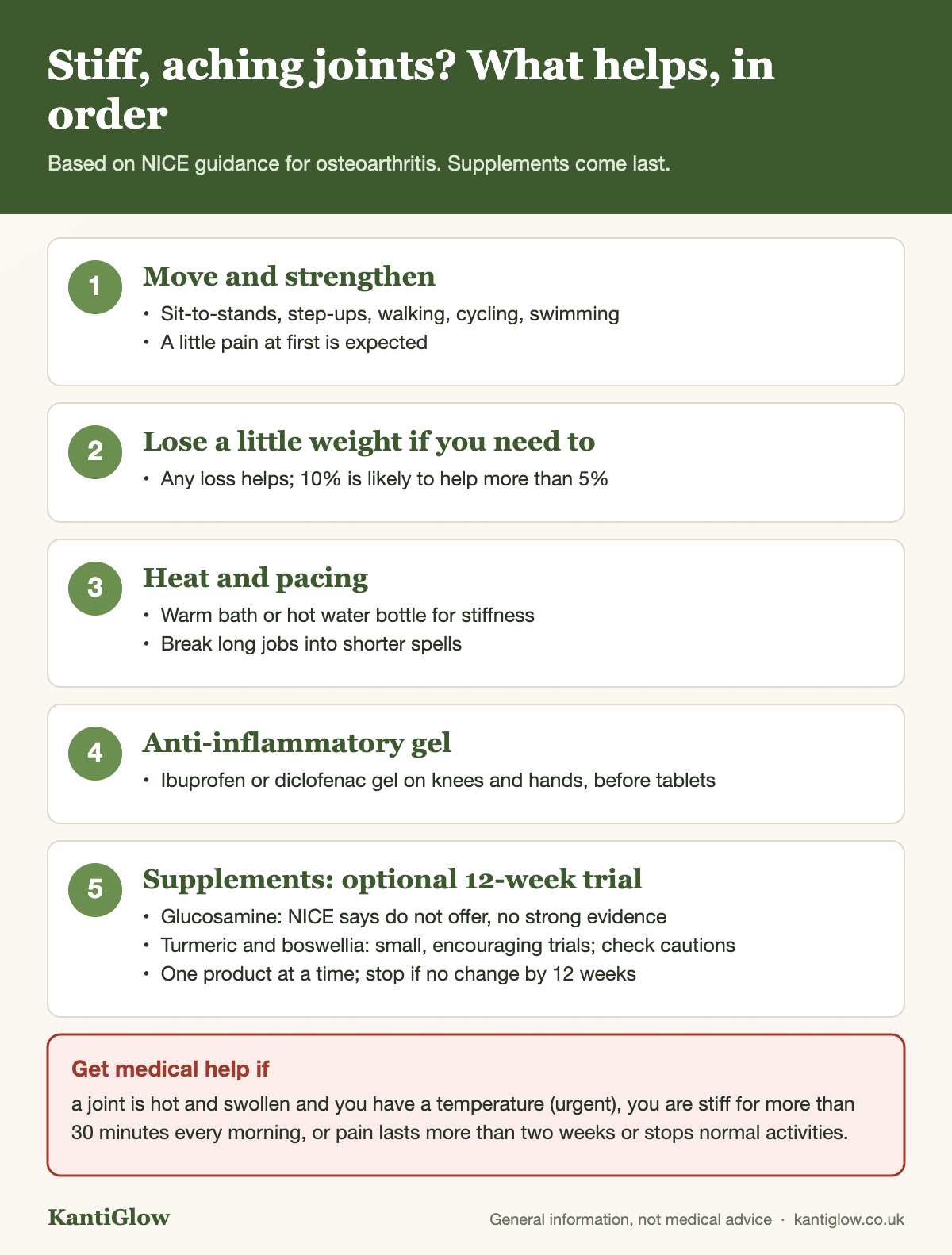
What helps, in order
1. Strengthen and move. Stronger thigh and hip muscles take load off the knee. Sit-to-stands from a chair, step-ups, straight leg raises and walking are a good start. Aim for a little every day. Cycling, swimming and yoga are kind to joints. Ask your GP about physiotherapy or a local ESCAPE-pain class.
2. Lose a little weight if you need to. Every kilo lost takes several kilos of force off each knee with every step.
3. Heat and pacing. A hot water bottle or warm bath eases stiffness. Break long jobs into shorter spells and change position often.
4. Anti-inflammatory gel. Ibuprofen or diclofenac gel from a pharmacy, rubbed into the knee or hand, is what NICE recommends before tablets. Check with a pharmacist if you have asthma, kidney problems or take blood thinners.
5. Tablets, if needed. NICE suggests the lowest dose for the shortest time and does not recommend routine paracetamol. Talk to a pharmacist or GP.
6. Supplements, if you choose. See below.
Ayurveda’s approach to stiff joints fits steps 1 to 3 well: warmth, warm cooked food, daily movement and regular oil massage (abhyanga) of the limbs. Warm oil massage has little trial evidence, but it is a pleasant way to apply heat and get a joint moving.
Glucosamine, turmeric or boswellia?
| Glucosamine | Turmeric (curcumin) | Boswellia (shallaki) | |
|---|---|---|---|
| What it is | An amino sugar, usually from shellfish shells or fermented corn | The yellow spice; curcumin is the studied compound | Resin from the Indian frankincense tree |
| Evidence | Large, well-run trials found little or no benefit. NICE says do not offer it. | Several small trials in knee osteoarthritis report modest pain reductions. Quality is low to moderate. | A handful of small trials report less pain and stiffness. Few are independent. |
| How long to judge | 12 weeks | 8 to 12 weeks | 8 to 12 weeks |
| Main cautions | Shellfish allergy (check source), warfarin, diabetes monitoring | Blood thinners, gallstones, pregnancy. Rare liver injury reported with high-absorption products | Stomach upset, blood thinners, pregnancy |
| Verdict | Hardest to justify on the evidence | Reasonable to try if the cautions do not apply | Reasonable to try if the cautions do not apply |
Three points apply to all of them. They are food supplements, so they cannot claim to treat arthritis. Products vary a great deal in what they contain. And none replaces exercise.
If you decide to try one
- Choose one product, not three at once.
- Rate your pain and stiffness out of 10 before you start, and again at 4, 8 and 12 weeks.
- Keep exercising throughout.
- Stop if there is no clear improvement by 12 weeks.
- Stop straight away and seek advice if you notice yellowing skin, dark urine, unusual bruising or stomach pain.
Turmeric in food
Cooking with turmeric is safe and part of a good diet, but the amount of curcumin in food is far lower than in trial capsules. Black pepper (piperine) increases absorption, which is why the two are often combined. It also increases the chance of interactions with medicines.
Who should check with a pharmacist first
Anyone taking warfarin or other blood thinners, diabetes medicine, chemotherapy or immunosuppressants. Anyone with liver disease, gallstones or a shellfish allergy. Anyone pregnant or breastfeeding. Stop turmeric and boswellia supplements two weeks before planned surgery unless your surgical team says otherwise.
When to see a GP
See a GP if joint pain is stopping you doing normal activities or affecting your sleep, has lasted more than two weeks, or keeps coming back. Ask for an urgent appointment or call 111 if a joint is swollen and hot and you have a high temperature or feel unwell, because that can be an infection in the joint. See a GP soon if your joints are stiff for more than 30 minutes every morning, several joints are swollen, or you also have a rash, weight loss or extreme tiredness.
Aching joints: frequently asked questions
Why are my knees stiff in the morning?
A few minutes of stiffness that eases as you move is typical of osteoarthritis. More than 30 minutes suggests inflammatory arthritis and needs a GP.
Why do my joints hurt more in cold weather?
Probably because we move less and muscles tighten in the cold. The research is mixed.
Is it arthritis or just getting older?
Osteoarthritis is common with age, but pain is not inevitable and can be improved.
Do I need an X-ray?
Usually not. NICE says osteoarthritis is diagnosed from symptoms and examination.
Should I rest a sore joint?
No. Long rest weakens muscles and makes it worse. Keep moving within comfort.
Will exercise wear out my joints faster?
No. Exercise strengthens the muscles that protect the joint and is the main treatment.
Is it normal for exercise to hurt at first?
Yes. Mild pain that settles within a day is expected. Sharp or lasting pain means ease off.
What is the best exercise for knee pain?
Thigh strengthening, such as sit-to-stands and straight leg raises, plus walking or cycling.
Is walking good for knee arthritis?
Yes. Start with short flat walks and build up.
Is climbing stairs bad for knees?
It loads the knee but also strengthens it. Use the handrail and lead with the stronger leg going up.
Does losing weight help joint pain?
Yes. Any loss helps, and more helps more.
Does heat or cold work better?
Heat for stiffness, cold for a hot swollen flare. Use whichever feels better.
Does ibuprofen gel work?
Yes, for knees and hands. NICE recommends it before tablets.
Should I take paracetamol?
NICE does not recommend it routinely for osteoarthritis because the benefit is small.
Does glucosamine work?
The best trials show little or no benefit, and NICE advises against offering it.
Why do some people swear by glucosamine?
Joint pain naturally comes and goes, and placebo effects in pain trials are large.
Is glucosamine sulphate better than hydrochloride?
Some older trials favoured the sulphate form, but independent trials have not confirmed a meaningful benefit.
Can I take glucosamine with a shellfish allergy?
Many products are made from shellfish. Look for a vegetarian, corn-derived version and check with a pharmacist.
Can I take glucosamine with warfarin?
It can increase warfarin’s effect. Speak to your anticoagulant clinic first.
Does glucosamine raise blood sugar?
It may slightly in some people. If you have diabetes, monitor more closely when starting.
Does chondroitin or MSM help?
Evidence for both is weak and inconsistent.
Does turmeric help joint pain?
Small trials suggest a modest benefit in knee osteoarthritis. Larger independent trials are needed.
How much turmeric should I take?
There is no agreed amount. Follow the label and do not exceed it.
Is turmeric in food enough?
Food amounts are much lower than trial doses. It is still a healthy spice.
Why is black pepper added to turmeric?
Piperine increases curcumin absorption. It can also change how some medicines are absorbed.
Is turmeric safe for the liver?
Usually, but rare cases of liver injury have been reported, mostly with high-absorption supplements.
Can I take turmeric with blood thinners?
Check with a pharmacist. It may increase bleeding risk.
Can I take turmeric with ibuprofen?
Occasional use together is unlikely to be a problem, but both can upset the stomach. Ask a pharmacist.
What is boswellia?
It is the resin of Boswellia serrata, known in Ayurveda as shallaki or Indian frankincense.
Does boswellia work?
A few small trials found less pain and stiffness. Evidence is limited.
How long does boswellia take to work?
Trials that showed an effect usually reported it within four to eight weeks.
What are boswellia’s side effects?
Mostly stomach upset, nausea and loose stools.
Can I take turmeric and boswellia together?
They are often combined. Start with one so you know what helps.
Which is best: glucosamine, turmeric or boswellia?
None is proven. On current evidence glucosamine is the weakest choice.
Is guggulu good for joints?
Yograj and other guggulu formulas are traditional joint remedies. Human evidence is limited and they can interact with medicines.
Does collagen help joints?
Some small trials are positive. Evidence is not strong.
Do omega-3 or fish oils help?
They may help in rheumatoid arthritis. Evidence in osteoarthritis is weak.
Should I take vitamin D?
Yes in autumn and winter, 10 micrograms a day, as UK advice for everyone. It is for bone and muscle health, not a pain treatment.
Does oil massage help stiff joints?
It warms the area and eases stiffness for a while. There is little research.
Do copper bracelets or magnets work?
No. Trials show no benefit.
Do knee supports help?
NICE does not recommend them routinely. They may help some people with an unstable joint.
Does acupuncture help?
NICE advises against it for osteoarthritis.
Are steroid injections worth it?
They can give short-term relief of a few weeks. Discuss with a GP.
When is a knee replacement considered?
When pain and loss of function seriously affect your life despite other treatment. Age and weight alone should not rule it out.
Could it be gout?
Sudden severe pain, redness and swelling in one joint, often the big toe, suggests gout. See a GP.
Sources
- NICE NG226: Osteoarthritis in over 16s, diagnosis and management
- NHS: Osteoarthritis
- NHS: Joint pain
- Arthritis UK: Complementary and alternative treatments
- NHS: Vitamin D
- ESCAPE-pain programme
Considering curcumin? See our full range of turmeric & curcumin supplements, including combinations with black pepper and BCM-95, all lab-tested and delivered across the UK.
Shop the products in this guide
- Carbamide Forte Glucosamine Chondroitin MSM — £17.99
- Carbamide Forte Joint Support Glucosamine Chondroitin — £11.99
- Tata 1mg Joint Support Advanced Glucosamine — £26.99
- Himalayan Organics Glucosamine Chondroitin MSM — £4.99
- HXN Glucosamine Boswellia Chondroitin MSM Collagen — £28.99
- CureGarden Curcumin BCM-95 — £20.99
- Vedistry Shallaki Boswellia Joint — £15.99
- The Joint Mobility Kit — £38.00
Batch lab-tested, shipped from India. Food supplements should not replace a varied, balanced diet and a healthy lifestyle.
This guide is general information, not medical advice. Food supplements and herbal products are not intended to diagnose, treat or cure any condition. Speak to a GP or pharmacist about persistent joint pain and before taking a supplement if you have a medical condition or take medication.