Quick answer: Knee pain that builds gradually, is worse on stairs and after sitting, and comes with a little stiffness is most often osteoarthritis or irritation behind the kneecap. Both respond best to strengthening the thigh and hip muscles, keeping active, and losing some weight if you need to. Ibuprofen gel helps with flare-ups. Supplements are a distant extra: glucosamine and chondroitin are no longer prescribed on the NHS because there is no strong evidence they work. Boswellia has a handful of small trials suggesting it may ease knee osteoarthritis pain within a few weeks, but they are not strong enough to be sure. See a GP if pain has not improved after a few weeks, and get urgent advice for a knee that is very swollen, locks, gives way, or is hot and red with a fever.
Key facts
- Stiffness and mild swelling in both knees, mainly in older adults, usually means osteoarthritis.
- Exercise that strengthens muscles and improves general fitness is the main treatment, with weight loss if you are overweight.
- For a new strain, ease the load and use a cold pack wrapped in a cloth for up to 20 minutes every 2 to 3 hours.
- Anti-inflammatory gel is usually tried before tablets.
- Painless clicking is normal. Painful clicking, locking or giving way needs assessment.
- Boswellia is a food supplement in the UK. It cannot be sold as relieving pain or treating arthritis.
What is causing my knee pain?
| What it feels like | Likely cause |
|---|---|
| Stiff, achy, mildly swollen knees, often both, worse after rest and at the end of the day | Osteoarthritis |
| Ache around or behind the kneecap, worse on stairs, squatting or after sitting with knees bent | Kneecap (patellofemoral) pain |
| Pain after twisting or overstretching, often during sport | Sprain or strain |
| Pain just below the kneecap after a lot of running or jumping | Tendonitis |
| Knee gives way, will not straighten, or you felt a pop | Torn ligament or cartilage |
| Warm, red swelling over the front of the knee, worse kneeling | Bursitis |
| Hot, red, suddenly very painful joint | Gout or a joint infection: urgent |
What to do first
- For a recent strain or flare: take weight off it for a day or two, avoid long periods standing, and use a cold pack. Paracetamol, or ibuprofen as gel or tablets, can help in the short term if they are suitable for you.
- For a long-standing ache: keep moving. Rest weakens the muscles that protect the knee.
- Heat often eases stiffness before exercise.
- Footwear: cushioned, supportive shoes with a low heel.
- Weight: every kilo lost removes several kilos of load from the knee with each step.
Five exercises that help
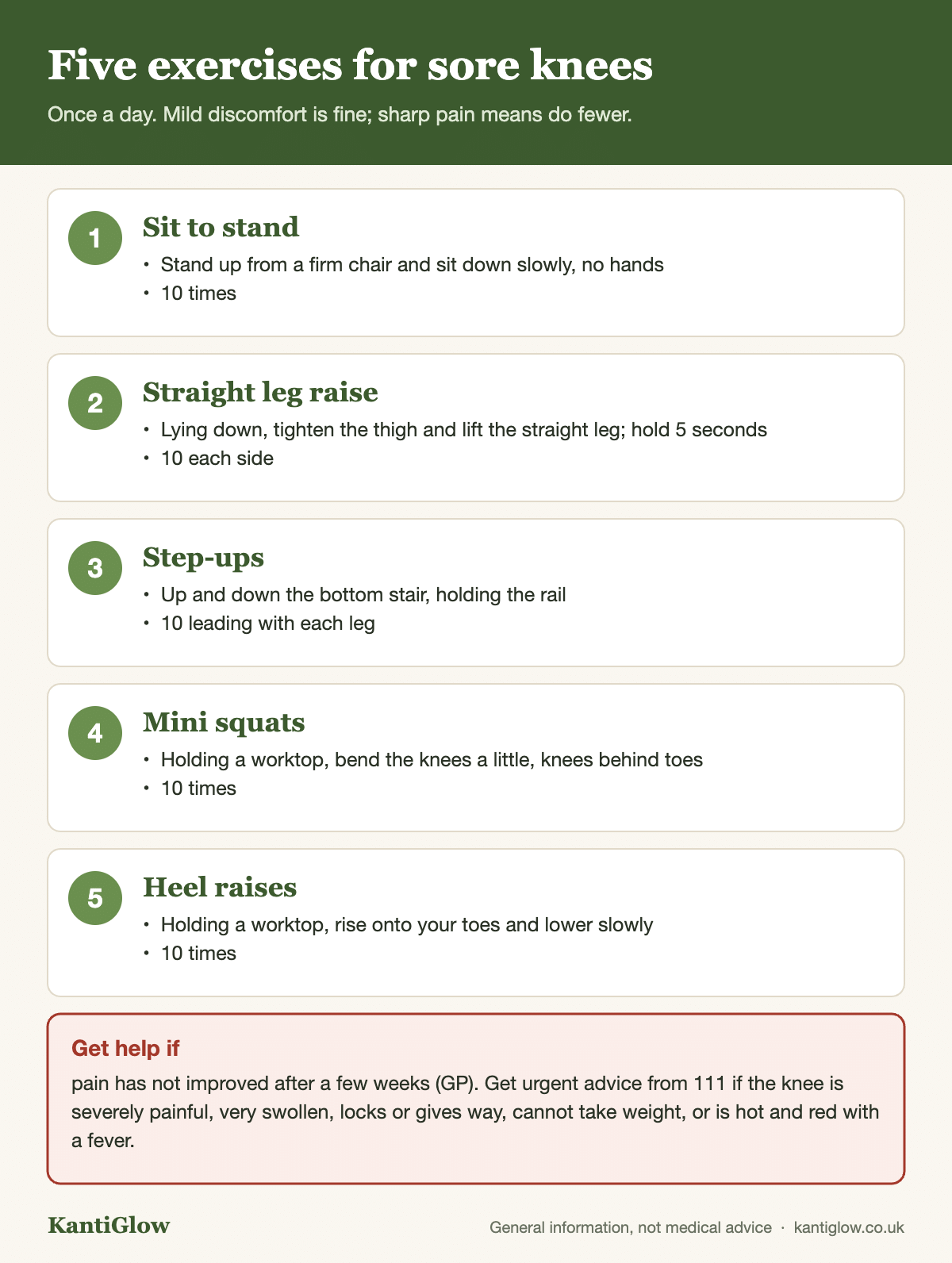
Do these once a day. Mild discomfort during or after is expected and safe. Sharp pain, or pain that is still worse the next morning, means do fewer.
- Sit to stand. From a firm chair, stand up and sit down slowly without using your hands. 10 times. Too easy? Cross your arms or use a lower chair.
- Straight leg raise. Lying on your back, one knee bent, tighten the thigh of the straight leg and lift it to the height of the other knee. Hold 5 seconds. 10 each side.
- Step-ups. Step up onto the bottom stair and down again, holding the rail. 10 leading with each leg.
- Mini squats. Holding a worktop, bend your knees a little as if starting to sit, keeping knees behind toes. 10 times.
- Heel raises. Holding a worktop, rise onto your toes and lower slowly. 10 times.
Add walking, cycling or swimming for general fitness, building up gradually. A physiotherapist can tailor a programme, and many areas run ESCAPE-pain classes for knee and hip osteoarthritis. In much of the UK you can refer yourself to NHS physiotherapy.
Medicines, in the usual order
- Anti-inflammatory gel (ibuprofen or diclofenac) rubbed into the knee.
- Anti-inflammatory tablets for short periods if the gel is not enough, with advice from a pharmacist or GP.
- Paracetamol, usually for short-term relief when other medicines cannot be used.
- Capsaicin cream, on prescription, if gels have not helped.
- A steroid injection for a bad flare, which can give relief for weeks or months.
Is boswellia worth trying?
Boswellia serrata is the Indian frankincense tree. Its resin is called shallaki in Ayurveda, where it has long been used for joints. Modern supplements contain extracts standardised for boswellic acids.
What the research shows. Several small trials in knee osteoarthritis, typically 4 to 12 weeks long, reported less pain and stiffness than placebo, sometimes within the first few weeks. The trials are small, use different extracts, and many were funded by the makers. Reviews conclude the results are promising but low in certainty. Boswellia does not appear in NICE’s recommendations, and NICE advises against routinely offering supplements for osteoarthritis.
Side effects. Mostly stomach upset, nausea, acid reflux and loose stools.
Who should check first. Anyone on blood thinners, immunosuppressants or several regular medicines; anyone with liver disease; and anyone pregnant or breastfeeding, who should avoid it. Stop two weeks before planned surgery unless your surgical team says otherwise.
If you try it.
- Choose a product that states the extract and its boswellic acid content, and follow the label.
- Score your pain on stairs out of 10 before you start, then at 4, 8 and 12 weeks.
- Keep doing the exercises.
- Stop if there is no clear change at 12 weeks.
Our guide Stiff, Aching Knees and Joints? compares boswellia with glucosamine and turmeric.
When to get help
See a GP if knee pain has not improved after a few weeks.
Call 111 or get urgent advice if the pain is severe, you cannot move the knee or put weight on it, it is badly swollen or has changed shape, it locks, gives way or clicks painfully, or it is hot and red and you have a high temperature or feel shivery.
Knee pain: frequently asked questions
Why do my knees hurt on stairs?
Stairs load the joint behind the kneecap. Kneecap pain and osteoarthritis are the usual causes.
Why do my knees hurt after sitting?
Stiffness after rest is typical of osteoarthritis and kneecap pain. It eases as you move.
Is walking good for knee pain?
Yes. Start with short, flat walks and build up.
Should I rest my knee?
For a day or two after a strain. Long rest makes most knee pain worse.
Ice or heat?
A cold pack for a new injury or a swollen flare. Heat for stiffness.
Is clicking in my knee normal?
Painless clicking is. Painful clicking, locking or giving way should be assessed.
Do I have arthritis?
Possibly, if you are over 45 with activity-related pain and brief morning stiffness. A GP can usually tell without an X-ray.
Will exercise damage my knees?
No. It is the main treatment.
Is some pain during exercise acceptable?
Yes, if it is mild and settles within a day.
What is the best exercise for knee pain?
Thigh and hip strengthening, such as sit-to-stands and step-ups.
Are squats bad for knees?
Shallow, controlled squats are helpful. Avoid deep squats while the knee is sore.
Is cycling good for knees?
Yes. It is low impact. Set the saddle high enough that your knee is only slightly bent at the bottom.
Is running bad for knees?
Recreational running does not cause arthritis in healthy knees. With pain, cut back and strengthen first.
Does losing weight help?
Yes, considerably.
Do knee supports help?
They may give confidence in the short term. They are not routinely recommended.
What shoes are best?
Cushioned, supportive shoes with a low heel.
Does ibuprofen gel work?
Yes, and it is usually tried before tablets.
Should I take glucosamine?
It is no longer prescribed on the NHS because there is no strong evidence it works.
What is boswellia?
The resin of the Indian frankincense tree, called shallaki in Ayurveda.
Does boswellia help knee pain?
Small trials suggest it may. The evidence is not strong.
How long does boswellia take to work?
Some trials reported changes within four weeks. Allow up to twelve.
How much boswellia should I take?
Extracts differ, so there is no single dose. Follow the product label.
What is AKBA?
One of the boswellic acids that extracts are often standardised to.
What are the side effects of boswellia?
Stomach upset, reflux, nausea and loose stools.
Can I take boswellia with ibuprofen?
Check with a pharmacist. Both can upset the stomach.
Can I take boswellia with blood thinners?
Ask your pharmacist or anticoagulant clinic first.
Can I take boswellia long term?
Trials lasted up to about six months. Longer-term safety is not well studied.
Is boswellia safe in pregnancy?
No. Avoid it.
Is frankincense oil the same thing?
No. Essential oil for aromatherapy is not the oral extract used in trials and should not be swallowed.
Boswellia or turmeric?
Neither is proven. Both have small encouraging trials.
Can I take boswellia and turmeric together?
They are often combined. Starting one at a time shows you which helps.
Does collagen help knees?
Evidence is limited.
Do steroid injections work?
They can ease a flare for weeks to months.
Do hyaluronic acid injections work?
They are not recommended by NICE for osteoarthritis.
Does acupuncture help?
NICE does not recommend it for osteoarthritis.
Does oil massage help?
Warmth and massage ease stiffness for a while. There is little research.
Does cold weather make knees worse?
Many people find so. Staying warm and active helps.
Does vitamin D help knee pain?
It supports bone and muscle health. It is not a pain treatment.
When is surgery considered?
When pain seriously affects daily life despite other treatment.
Can young people get knee pain?
Yes, usually from kneecap pain, tendon irritation or growth-related conditions.
What is a Baker’s cyst?
A fluid swelling behind the knee, often linked with arthritis. See a GP if the calf becomes painful or swollen.
Could it be gout?
A suddenly hot, red, very painful knee could be. Get urgent advice.
Can I refer myself to physiotherapy?
In many areas, yes. Check your local NHS musculoskeletal service or GP surgery website.
When should I see a GP?
If the pain has not improved after a few weeks, or straight away for the urgent signs above.
Sources
- NHS: Knee pain
- NHS: Osteoarthritis treatment
- NICE NG226: Osteoarthritis in over 16s, diagnosis and management
- Arthritis UK: Complementary and alternative treatments
- ESCAPE-pain programme
Shop the products in this guide
- Vedistry Shallaki Boswellia Joint — £15.99
- Pure Nutrition Shallaki Boswellia — £9.99
- Herb Essential Boswellia Shallaki 500mg — £9.99
- Biotic Boswellia Serrata Capsules — £8.99
- Vitaminnica Boswellia Serrata 2500mg — £19.99
- HealthyHey Boswellia Curcumin — £21.99
- INLIFE Joint Support Boswellia Guggul — £15.99
Batch lab-tested, shipped from India. Food supplements should not replace a varied, balanced diet and a healthy lifestyle.
This guide is general information, not medical advice. Food supplements and herbal products are not intended to diagnose, treat or cure any condition. Speak to a GP or physiotherapist about knee pain that persists, and to a pharmacist before taking a supplement if you take medication.
Pingback: Glucosamine vs Turmeric vs Boswellia | KantiGlow