
Quick answer: A churna is a finely ground herbal powder, and the usual way to take one is to stir a small measured amount into a carrier: warm water for most purposes, or honey, warm milk or ghee where tradition calls for it. Follow the amount on your product’s label, which for most single-herb powders works out at a level quarter to half teaspoon once or twice a day. Never swallow powder dry, because it can be inhaled and cause choking. Take it at the time the label suggests and at least two hours away from any medicines. If the taste is the problem, mix it into a spoon of honey, hide it in yoghurt, or fill empty capsules. Check the ingredients and warnings first, and ask a pharmacist if you are pregnant or take medication.
Key facts
- “Churna” simply means powder. It may be one herb, such as ashwagandha or amla, or a classical blend, such as triphala or hingvashtak.
- A level teaspoon of a typical herb powder weighs about 3 to 5 g, but this varies with how fine and dense the powder is.
- The traditional carrier is called anupana. Common ones are warm water, honey, milk and ghee.
- Honey must never be given to babies under 12 months.
- Some churnas contain a lot of salt or sugar.
- Herbal medicines are not advised for children, in pregnancy or breastfeeding, or for people with kidney or liver problems, without advice.
First, read the label
Before working out how to take it, check four things:
- Ingredients. Is it one herb or a blend? Are there added salts or sugar? Is there any mineral or metal-based ingredient? If you do not recognise something, ask the seller or a pharmacist.
- Amount. The label should give a daily amount in grams or spoonfuls. Use that, not a figure from a video or a relative.
- Warnings. Who should not take it, and any medicines it should not be combined with.
- Batch number and best-before date.
If the label gives no amount and no ingredients list in English, do not take the product.
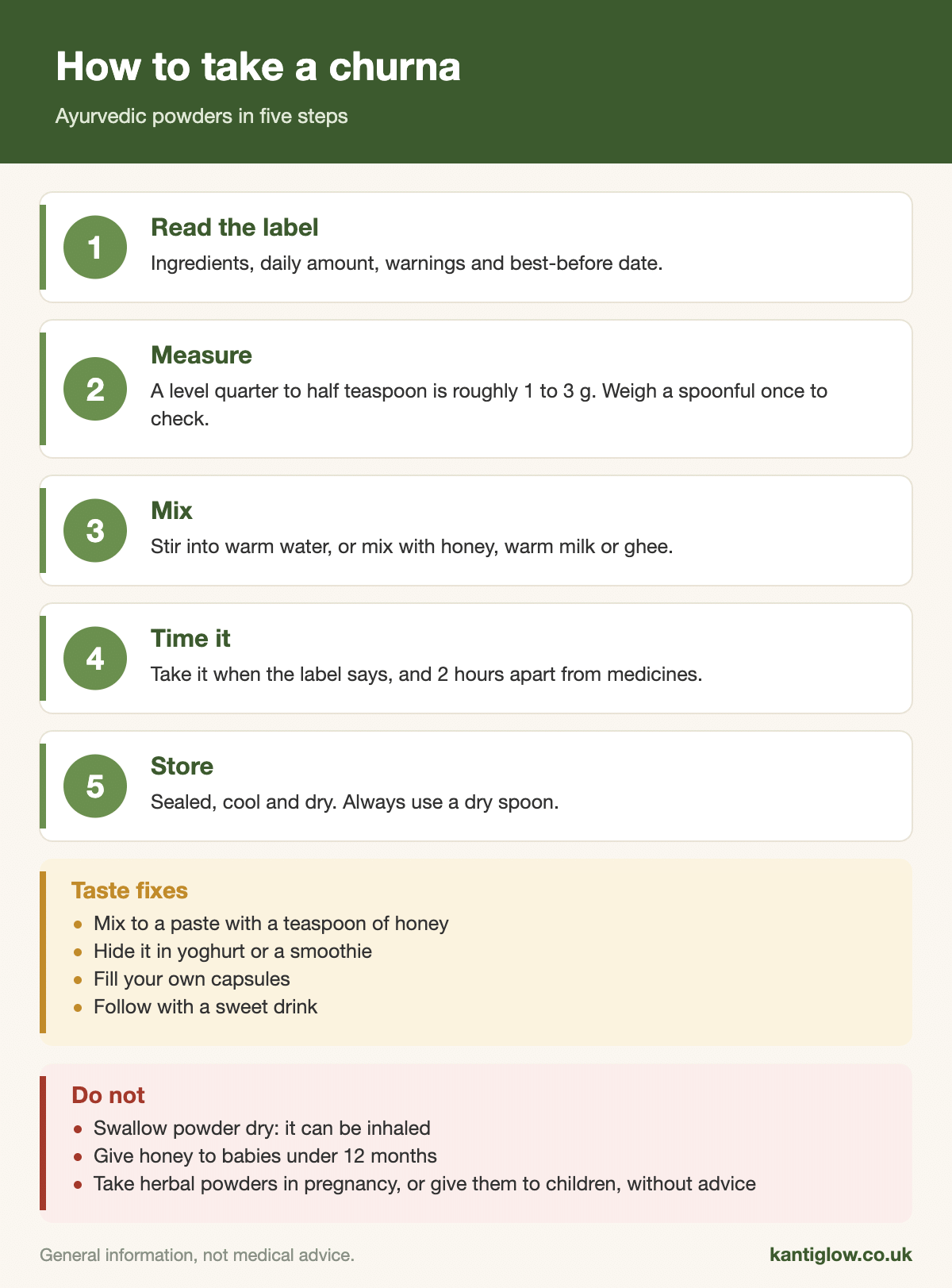
How to take a churna, step by step
1. Measure. Use a proper measuring spoon, levelled off, not cutlery. For most single-herb powders the label amount works out at 1 to 3 g at a time, roughly a level quarter to half teaspoon. If you have kitchen scales that read in grams, weigh your spoonful once so you know what it holds.
2. Start low. Take half the label amount for the first few days to see how your stomach reacts.
3. Mix it into a carrier. Stir the powder into about half a cup of warm water until there are no dry lumps, and drink it straight away. Or mix it to a paste with a teaspoon of honey or ghee and follow with warm water.
4. Never take it dry. Tipping powder straight into your mouth risks inhaling it, which can cause coughing, choking and chest infection.
5. Rinse your mouth or drink some water afterwards. Some powders stain teeth or leave grit.
6. Keep it away from medicines. Leave at least two hours between a churna and any tablets, because powders, especially fibre-rich ones, can reduce how well medicines are absorbed.
7. Review. Give it eight to twelve weeks, then decide whether it has earned its place.
Which carrier?
| Carrier | Traditionally used with | Practical notes |
|---|---|---|
| Warm water | Almost anything; triphala, digestive churnas | The simplest and safest default |
| Honey | Sitopaladi and talisadi, pungent or bitter powders | Makes a paste that is easy to swallow. Counts as sugar. Not for under-ones |
| Warm milk | Ashwagandha, shatavari, turmeric | Use any milk you tolerate. Skip if dairy upsets you |
| Ghee | Hingvashtak with the first mouthfuls of rice; ashwagandha | A small amount, half a teaspoon. It is saturated fat |
| Buttermilk or yoghurt | Digestive powders after meals | Masks taste well |
| Fruit juice or a smoothie | Amla, moringa and other greens | Not traditional, but effective for taste |
Ayurveda holds that the carrier directs and tempers the herb. There is little research on this. In practical terms, choose the carrier that gets the powder down comfortably and suits your diet.
When to take it
Follow the label first. Traditional timings, for reference:
| Churna | Usual traditional timing |
|---|---|
| Triphala | In the evening or at bedtime, with warm water |
| Ashwagandha | In the evening, with warm milk |
| Hingvashtak, lavan bhaskar | With or just before meals |
| Avipattikar | Before meals |
| Sitopaladi, talisadi | Between meals, with honey |
| Amla | In the morning, with water |
| Isabgol (psyllium husk) | Any time, with a full glass of water, not just before lying down |
Powders that upset an empty stomach are better taken after food.
Taste fixes
- Honey paste. Mix the powder with a teaspoon of honey, swallow, and chase with warm water.
- Yoghurt, lassi or a smoothie. Banana and peanut butter hide most things.
- Warm milk with cardamom or cinnamon for ashwagandha and shatavari.
- Make your own capsules. Empty vegetarian capsules and a small filling tray are inexpensive. A size 00 capsule holds roughly half a gram, so several are needed per dose.
- Shot and chaser. Mix with a small amount of water, drink in one go, and follow with juice.
- Switch form. If you cannot get on with the powder, tablets of the same herb are a reasonable alternative.
Things to watch
- Salt. Hingvashtak, lavan bhaskar and some other digestive churnas contain rock salt. Count it if you have high blood pressure, heart or kidney disease.
- Sugar. Sitopaladi is mostly rock sugar and is taken with honey. Count it if you have diabetes.
- Liquorice (mulethi, yashtimadhu) in a blend can raise blood pressure with regular use.
- Laxative effect. Triphala and some others loosen the bowels. Reduce the amount if stools become loose.
- Mineral or metal-based ingredients. Check the list and ask before taking anything you are unsure of.
- Pregnancy, breastfeeding and children. Do not take or give herbal powders without advice.
- Medicines. Herbal products can interact with prescribed medicines. Show the label to a pharmacist.
Storing your churna
Keep it in its original container with the lid tightly closed, in a cool, dry cupboard away from the cooker and kettle. Always use a dry spoon. Moisture makes powder clump and can let mould grow. Do not decant it into an unlabelled jar: you will lose the batch number, the best-before date and the instructions. Throw it away if it smells musty, has clumped hard, or shows any sign of insects or mould.
When to stop and get advice
Stop and speak to a pharmacist or GP if you develop a rash, itching, swelling of the lips or face, stomach pain, persistent diarrhoea or vomiting, yellowing of the skin or eyes, dark urine or palpitations. Call 999 for difficulty breathing or swelling of the tongue or throat. If you inhale powder and keep coughing or become breathless, seek medical advice.
How to take churna: frequently asked questions
What is churna?
A finely ground herbal powder used in Ayurveda.
How do you take churna?
Stir a measured amount into warm water, or mix with honey, milk or ghee.
How much churna should I take?
The amount on the label. For many single-herb powders that is 1 to 3 g at a time.
How much is 3 g in teaspoons?
Roughly a level half teaspoon to one teaspoon, depending on the powder. Weigh it once to check.
Can I take churna dry?
No. It can be inhaled.
Should I take churna with hot or cold water?
Warm water mixes best and is traditional.
Can I mix churna in tea or coffee?
You can, though the taste rarely improves. Water or milk is better.
Can I take churna with milk?
Yes, for herbs traditionally taken that way, such as ashwagandha.
Can I take churna with honey?
Yes. Remember it adds sugar, and is not for under-ones.
Why is ghee used?
It is the traditional carrier for some formulas. Use a small amount.
What is anupana?
The carrier a herb is taken with.
Does the carrier change how the herb works?
Tradition says so. There is little research.
Should I take churna before or after food?
Follow the label. After food if it upsets your stomach.
Morning or night?
It depends on the churna. Triphala and ashwagandha are traditionally taken in the evening.
Can I take two churnas together?
Start one at a time so you can tell what each does.
Can I take churna with my medicines?
Leave two hours between them, and check with a pharmacist.
How long does churna take to work?
Digestive powders may act within a day. Tonics are usually judged after several weeks.
How long can I take churna for?
Review after eight to twelve weeks and take breaks.
Can I take churna every day?
Follow the label. Long-term daily use of any herb should be reviewed.
How do I make churna taste better?
Mix it with honey, yoghurt or a smoothie, or fill capsules.
Can I put churna in capsules?
Yes. Several capsules are needed to match a spoonful.
Are tablets as good as powder?
They contain the same herb. Powder is usually cheaper per gram.
Can I add churna to food?
Culinary ones such as hingvashtak are meant to be eaten with food. Others can be stirred into yoghurt or porridge.
Can I cook with churna?
Heat may reduce some compounds. Stir it in after cooking.
How do I take triphala churna?
Traditionally in the evening with warm water.
How do I take ashwagandha powder?
Traditionally in the evening with warm milk.
How do I take amla powder?
In water or juice, usually in the morning.
How do I take hingvashtak churna?
A small amount with ghee and the first mouthfuls of a meal, or in warm water after eating.
How do I take sitopaladi churna?
Mixed with honey and licked slowly from a spoon.
How do I take isabgol?
In a full glass of water, drunk straight away.
Does churna contain sugar or salt?
Some do. Check the ingredients.
Is churna safe in pregnancy?
Do not take herbal powders in pregnancy without advice.
Can children take churna?
Not without medical advice.
Can people with diabetes take churna?
Check the ingredients for sugar and ask your pharmacist.
How should I store churna?
Sealed, cool and dry, in its original container.
How long does churna last?
Until the best-before date if kept dry.
Can churna go off?
Yes. Discard it if it smells musty or shows mould.
Why has my churna clumped?
Moisture has got in. Use a dry spoon.
Is home-made churna safe?
It is hard to be sure of plant identity, cleanliness and dose. Bought products with batch testing are safer.
How do I know a churna is good quality?
A full label, a batch number, a named manufacturer and heavy-metal test results.
What if I take too much?
Expect stomach upset. Call 111 if you feel unwell.
What if I inhale some?
Cough it up and drink water. Seek advice if coughing or breathlessness continues.
What side effects should I watch for?
Rash, stomach pain, diarrhoea, yellowing skin or palpitations.
When should I see a GP?
If you have side effects, or symptoms you are treating have not improved.
Sources
- NHS: Herbal medicines
- NHS: Pregnancy, foods to avoid
- NHS: High blood pressure
- MHRA: Yellow Card scheme
Shop the products in this guide
- Baidyanath Avipattikar Churna — £10.99
- Baidyanath Sitopaladi Churna 60g — £3.99
- Baidyanath Talisadi Churna 60g — £3.99
- Patanjali Divya Hingvashtak Churna 100g — £3.99
- Krishna’s Ajmodadi Churna — £3.99
- Dadimashtak Churna — £5.99
- Baidyanath Ashwagandhadi Churna 100g — £4.99
- Bharat Panchkol Churna — £6.99
Batch lab-tested, shipped from India. Food supplements should not replace a varied, balanced diet and a healthy lifestyle.
This guide is general information, not medical advice. Herbal products are not intended to diagnose, treat or cure any condition. Follow the label on your product, and speak to a pharmacist before taking a herbal powder if you are pregnant, breastfeeding, have a medical condition or take medication.
Pingback: Hingvashtak Churna, Ajwain & Hing UK Guide | KantiGlow