
Quick answer: Gout causes sudden, severe pain in a joint, most often the big toe, which becomes hot, swollen and red. See a GP: anti-inflammatory medicine started early usually brings an attack under control within a couple of days. Meanwhile, rest and raise the limb, apply an ice pack for up to 20 minutes at a time, drink plenty of water and keep bedclothes off the joint. To prevent further attacks, lose weight gradually if you need to, have alcohol-free days, cut back on sugary drinks, stay hydrated, and take uric acid-lowering medicine every day if it is prescribed. Guggulu formulas such as Kaishore guggulu are the traditional Ayurvedic choice, but there is very little research on them in gout and they do not replace prescribed treatment.
Key facts
- Gout is caused by a build-up of uric acid, which forms crystals in and around joints.
- An attack usually lasts five to seven days and then settles, but it can damage the joint if attacks keep happening.
- Being overweight, drinking alcohol, taking diuretics, and having high blood pressure, kidney problems or diabetes all make gout more likely.
- Attacks can be triggered by heavy drinking, a very large meal, dehydration, injury to a joint, or an illness with a high temperature.
- People with frequent attacks or high uric acid may need daily uric acid-lowering medicine, which must be taken regularly even when there are no symptoms.
- A hot, swollen joint with a high temperature, shivering or feeling sick needs urgent assessment, because it may be an infection.
Is it gout?
| Typical of gout | Could be something else |
|---|---|
| Comes on suddenly, often overnight | Pain that builds over weeks |
| One joint, most often the big toe | Several joints on both sides |
| Hot, swollen, red, too painful to touch | Stiffness that is worst in the morning and eases with movement |
| Peaks within a day; settles in about a week | Fever, shivering or feeling unwell (get urgent help) |
| Repeats months or years later | Pain after an injury |
Gout can also affect the ankle, knee, hand, wrist and elbow. On brown or black skin the redness can be harder to see; go by the heat, swelling and pain. A GP may arrange a blood test for uric acid a few weeks after the attack, when the result is more reliable.
What to do during an attack
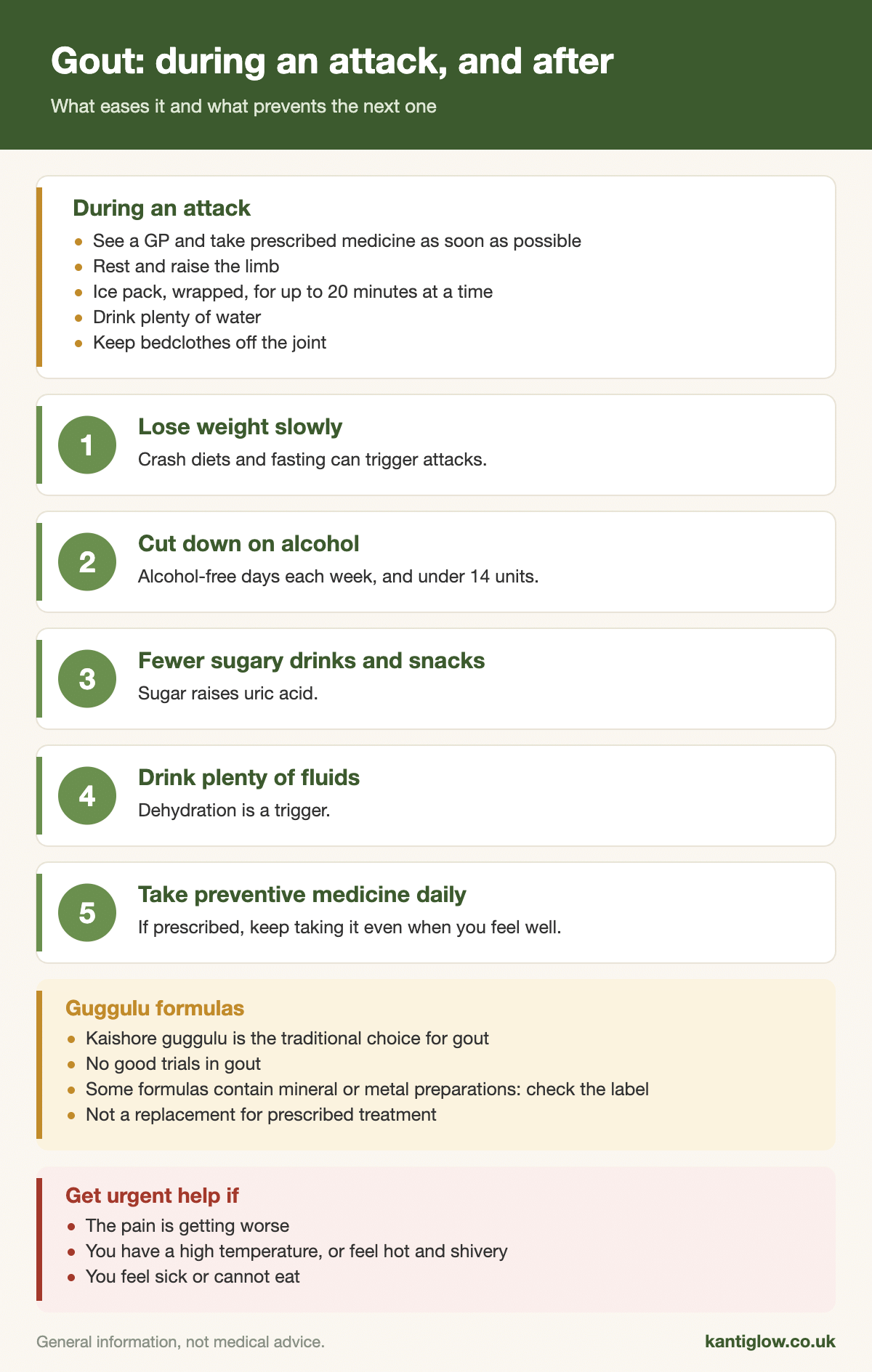
- Contact a GP and take any medicine prescribed as soon as possible. Usually this is an anti-inflammatory such as ibuprofen or naproxen; some people are given colchicine or a short course of steroids instead.
- Rest and raise the limb.
- Cool the joint with an ice pack or a bag of frozen peas wrapped in a towel, for up to 20 minutes at a time.
- Drink plenty of water, unless a doctor has told you to limit fluids.
- Keep bedclothes off the joint at night. A box or cage over the foot helps.
- Do not knock or put pressure on the joint.
Avoid aspirin for the pain, which can raise uric acid. If you already take allopurinol or febuxostat, keep taking it through the attack.
How to prevent the next attack
1. Lose weight gradually if you are overweight. Crash diets and fasting can trigger attacks.
2. Cut down on alcohol. Have several alcohol-free days a week and keep within 14 units. Beer and spirits are the worst offenders.
3. Go easy on sugar. Avoid large amounts of sugary drinks and snacks. Fructose raises uric acid.
4. Drink plenty of fluids.
5. Eat a balanced diet, and follow any food list your doctor gives you. The foods highest in purines are offal (liver, kidney), game, oily fish such as sardines, anchovies and mackerel, shellfish, and yeast or meat extracts. Have these less often and in smaller portions. Pulses, dal and vegetables contain purines too but are not linked to gout in the same way, so they do not need to be avoided.
6. Choose low-fat dairy, which is associated with a lower risk.
7. Exercise regularly, avoiding hard impact on affected joints.
8. Stop smoking.
9. Ask a GP about vitamin C supplements, and about whether any of your medicines, such as water tablets, could be contributing.
10. Take preventive medicine every day if it is prescribed. Allopurinol or febuxostat lowers uric acid over months, and stopping it lets crystals build up again. Attacks can become more frequent in the first weeks of treatment; that is expected and not a reason to stop.
Guggulu and its formulas
What guggulu is. Guggulu, or guggul, is the gum resin of Commiphora wightii (Indian bdellium), a relative of myrrh. In Ayurveda the purified resin (shuddha guggulu) is the base of a family of pills, each combining it with different herbs.
| Formula | Main additions | Traditional use | What to know |
|---|---|---|---|
| Kaishore guggulu | Triphala, guduchi (giloy), ginger, pepper | Vatarakta, the classical description closest to gout; skin complaints | The usual Ayurvedic suggestion for gout. Contains giloy, which has been linked to liver injury in some people |
| Yograj guggulu | A long list of warming digestive herbs | Joint and muscle aches | Generally herbal. Check the label |
| Mahayograj guggulu | Yograj plus several mineral and metal bhasmas | Chronic joint conditions | Contains mineral and metal preparations. Take only with qualified supervision |
| Triphala guggulu | Triphala, long pepper | Piles, fistula, boils, weight | Has a laxative effect |
| Medohar (Navaka) guggulu | Triphala, trikatu, other herbs | Weight | No good evidence |
| Kanchanar guggulu | Kanchanar bark, triphala, trikatu | Swellings, thyroid complaints | Do not use for a thyroid condition without medical advice |
| Gokshuradi guggulu | Gokshura, triphala, trikatu | Urinary complaints | Limited research |
| Simhanada guggulu | Triphala, castor oil, sulphur | Rheumatic complaints | Contains purified sulphur and is strongly laxative |
What research shows. Guggul extracts were studied mainly for cholesterol, with early Indian trials positive and a later, better-designed American trial finding no benefit and a slight rise in LDL cholesterol. For gout specifically, there are no good trials of Kaishore guggulu or any other formula. Its use is traditional.
Cautions with guggulu.
- Stomach upset, loose stools, headache and skin rashes are the commonest side effects. The rash can be widespread.
- It may affect thyroid function. Avoid it if you have a thyroid condition unless your doctor agrees.
- It can interact with blood thinners, some blood pressure and heart medicines, thyroid medicine and hormonal contraception. Ask a pharmacist.
- Do not take it in pregnancy or while breastfeeding.
- Avoid it if you have liver or kidney disease.
- Formulas containing bhasmas or sulphur are mineral preparations. Check the ingredients list and take them only under qualified supervision.
If you want to try a guggulu formula for gout, tell your GP, keep taking any prescribed medicine, choose a purely herbal formula with a full ingredients list, and stop if you develop a rash, yellowing of the skin or eyes, dark urine or tummy pain.
Other remedies people ask about
| Remedy | What we know |
|---|---|
| Cherries or cherry juice | Some studies link them with fewer attacks. Reasonable to try alongside treatment |
| Vitamin C | May lower uric acid slightly. Ask your GP |
| Coffee | Associated with lower risk in population studies |
| Lemon water, apple cider vinegar, celery seed | No good evidence |
| Turmeric | No good evidence for gout |
| Giloy | Traditional for vatarakta. Linked to liver injury in some people |
| Triphala | No evidence for gout |
When to get help
See a GP if you have sudden severe pain in a joint, or if it is hot, swollen and red. Ask for an urgent appointment or call 111 if the pain is getting worse, or you also have a very high temperature, feel hot and shivery, or feel sick or cannot eat. These can be signs of an infection inside the joint, which needs treatment the same day.
Gout attack: frequently asked questions
What is gout?
A type of arthritis caused by uric acid crystals in a joint.
What does a gout attack feel like?
Sudden, severe pain with a hot, swollen, red joint.
Which joint does gout affect?
Most often the big toe. Also the ankle, knee, hand, wrist and elbow.
How long does an attack last?
About five to seven days with treatment.
What causes gout?
A build-up of uric acid.
What triggers an attack?
Heavy drinking, a large meal, dehydration, injury or illness.
What should I do in an attack?
See a GP, take prescribed medicine, rest, raise and cool the joint, and drink water.
Which painkiller is best?
Usually an anti-inflammatory, as advised by a GP or pharmacist.
Can I take aspirin?
No, not for gout pain.
Should I use ice or heat?
Ice, wrapped, for up to 20 minutes.
Should I rest or move?
Rest during the attack.
Does drinking water help?
Yes.
Is gout hereditary?
It often runs in families.
Do women get gout?
Yes, mainly after the menopause.
Can gout be cured?
Daily uric acid-lowering medicine can stop attacks for good.
What is allopurinol?
A daily medicine that lowers uric acid.
Why did I get an attack after starting allopurinol?
Attacks can increase at first as crystals dissolve. Keep taking it.
Which foods cause gout?
Offal, game, oily fish, shellfish and yeast extracts are highest in purines.
Do I need to stop eating dal and lentils?
No. Plant purines are not linked to gout in the same way.
Is alcohol bad for gout?
Yes, especially beer and spirits.
Are sugary drinks bad for gout?
Yes.
Do cherries help?
Some studies suggest fewer attacks.
Does vitamin C help?
It may lower uric acid slightly. Ask your GP.
Does losing weight help?
Yes, if done gradually.
Can fasting trigger gout?
Yes.
What is guggulu?
The gum resin of Commiphora wightii, used as a base for Ayurvedic pills.
Which guggulu is used for gout?
Kaishore guggulu, by tradition.
Does Kaishore guggulu work for gout?
There are no good trials.
What is Yograj guggulu?
A herbal formula traditionally used for aching joints.
What is the difference between Yograj and Mahayograj guggulu?
Mahayograj adds mineral and metal preparations.
Is Mahayograj guggulu safe?
Take it only with qualified supervision.
What is Triphala guggulu used for?
Traditionally piles and boils. It is laxative.
Does Medohar guggulu help weight loss?
There is no good evidence.
Does guggulu lower cholesterol?
The best-designed trial found it did not.
What are the side effects of guggulu?
Stomach upset, loose stools, headache and skin rash.
Who should not take guggulu?
Pregnant or breastfeeding women, and people with thyroid, liver or kidney conditions.
Does guggulu interact with medicines?
Yes. Ask a pharmacist.
Can I take guggulu with allopurinol?
Ask your GP or pharmacist first.
What happens if gout is not treated?
Repeated attacks can damage joints and cause tophi and kidney stones.
When should I get urgent help?
If a hot, swollen joint comes with fever, shivering or feeling sick.
Sources
- NHS: Gout
- NHS: Alcohol units
- NHS: Herbal medicines
- Szapary PO and others. Guggulipid for the treatment of hypercholesterolemia: a randomized controlled trial. JAMA, 2003
Shop the products in this guide
- Baidyanath Yograj Guggulu Tablets — £4.99
- Baidyanath Kaishore Guggulu, 160 — £6.99
- Baidyanath Triphala Guggulu Tablets — £3.99
- Baidyanath Medohar Guggulu — £6.99
- Baidyanath Kanchnar Guggulu, 160 — £6.99
- Dhootapapeshwar Gokshuradi Guggulu — £6.99
- Baidyanath Trayodashang Guggulu, 80 — £5.99
- Himalaya Shuddha Guggulu, 60 — £10.99
Batch lab-tested, shipped from India. Food supplements should not replace a varied, balanced diet and a healthy lifestyle.
This guide is general information, not medical advice. Herbal products are not intended to diagnose, treat or cure any condition, including gout. See a GP about a hot, swollen, painful joint.