Quick answer: Most lower back pain gets better within a few weeks, and the most effective thing you can do is keep moving. Stay as active as you can, avoid long spells in bed, use heat for stiffness, do gentle back exercises and stretches, and take an anti-inflammatory painkiller such as ibuprofen if it is suitable for you. Paracetamol on its own is not recommended for back pain. Curcumin, the main pigment in turmeric, has some trial evidence for knee osteoarthritis, but there are no good trials in back pain, and the choice between BCM-95 and curcumin with piperine is about absorption, not proven benefit. Call 999 or go to A&E if back pain comes with numbness around your genitals or bottom, loss of bladder or bowel control, or weakness in both legs.
Key facts
- Back pain usually improves within a few weeks, though it can last longer or come back.
- The cause is often not clear. Common causes are a pulled muscle or strain; sciatica and a slipped disc are others.
- Staying active is recommended. Staying in bed for long periods is not.
- Anti-inflammatory painkillers such as ibuprofen can help but are not suitable for everyone. Paracetamol alone is not recommended.
- Heat packs help stiffness and muscle spasm; ice packs help pain and swelling.
- In many areas you can refer yourself to NHS physiotherapy services without seeing a GP.
First: check for red flags
Call 999 or go to A&E if you have back pain and:
- Pain, tingling, weakness or numbness in both legs.
- Numbness or tingling around your genitals or bottom.
- Difficulty peeing, or loss of bladder or bowel control.
- Chest pain.
- It started after a serious accident.
Get an urgent GP appointment or call 111 if:
- You have a high temperature or feel hot, shivery and unwell.
- The pain is sudden and severe, or getting worse quickly.
See a GP if:
- It has not improved after a few weeks, or is stopping you doing daily activities.
- You have lost weight without trying.
- There is a lump, swelling or change in the shape of your back.
- The pain does not ease with rest, or is worse at night.
- It is worse when you cough, sneeze or open your bowels.
- The pain is between your shoulder blades.
Why backs hurt
In most people no single structure can be blamed. Muscles, ligaments, discs and joints all contribute, and the pain is usually not a sign of damage. Stress, poor sleep, low mood, fear of moving and long periods sitting all make pain worse and last longer. Scans are not helpful for ordinary back pain, because the changes they show are just as common in people without pain.
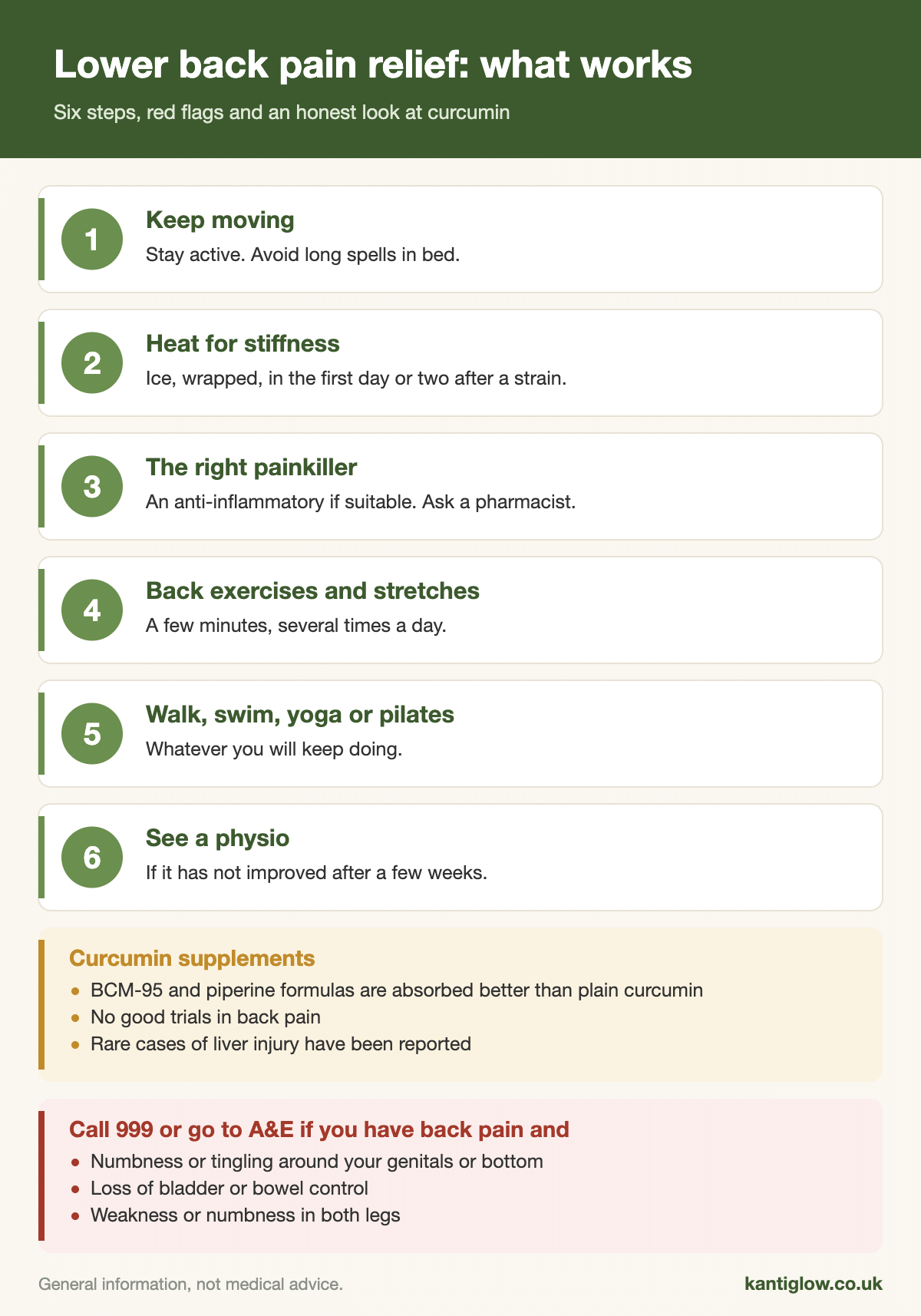
What works for lower back pain relief
1. Keep moving. Carry on with normal activities as far as you can, at a gentler pace. Movement is safe even when it hurts a little. Bed rest slows recovery.
2. Heat for stiffness and spasm. A hot water bottle or heat pack wrapped in a cloth, for 15 to 20 minutes. Use an ice pack, wrapped, in the first day or two after a strain.
3. The right painkiller. An anti-inflammatory such as ibuprofen, taken with food for a short time, helps many people. It is not suitable if you have had stomach ulcers, have kidney problems, are on blood thinners, are in later pregnancy, or for some people with asthma or heart disease. Ask a pharmacist. Anti-inflammatory gels are an alternative.
4. Back exercises and stretches. Knee rolls, knee-to-chest stretches, pelvic tilts and gentle back extensions, a few minutes several times a day.
5. Walk, swim, or try yoga or pilates. Whatever you will keep doing.
6. Change position often. Stand up every 30 minutes if you sit for work. There is no single correct posture; the best one is the next one.
7. Sleep in a comfortable position. On your side with a pillow between your knees, or on your back with one under them.
8. Look after your mood and sleep.
9. Lift sensibly: load close to your body, bend your knees, and do not twist while lifting.
If it is not improving after a few weeks, treatment may include physiotherapy or group exercise classes, manual therapy alongside exercise, and CBT to help you cope with pain.
Where curcumin fits
What it is. Turmeric root contains about 2 to 5 per cent curcuminoids, the yellow pigments, of which curcumin is the main one. Supplements concentrate these, typically to 95 per cent.
The absorption problem. Curcumin on its own is poorly absorbed and quickly broken down. Manufacturers get round this in different ways:
| Type | How it works | What to know |
|---|---|---|
| Curcumin with piperine (black pepper extract) | Piperine slows the breakdown of curcumin in the gut and liver. A well-known small study reported much higher blood levels when the two were taken together | Piperine also slows the breakdown of many medicines, so interactions are more likely. Can irritate the stomach |
| BCM-95 (also sold as Curcugreen) | Curcuminoids recombined with turmeric’s own essential oils | Maker-funded studies report several times the absorption of standard curcumin. Contains no pepper |
| Phospholipid, micellar and nanoparticle forms | Curcumin bound to fats or dispersed in tiny droplets | Higher absorption again in maker-funded studies |
| Turmeric powder | The whole spice | Low curcumin content. Fine as food |
BCM-95 or piperine? There are no independent head-to-head trials showing that either leads to better results in people. BCM-95 avoids piperine’s effect on other medicines, which matters if you take regular prescriptions. A piperine formula is usually cheaper. Higher absorption is not automatically a good thing: it also means more exposure for the liver.
What trials show. The best evidence for curcumin is in knee osteoarthritis, where several small trials report modest reductions in pain over 8 to 12 weeks. For lower back pain there are no good trials. Anyone telling you it works for backs is extrapolating.
Safety.
- Stomach upset, nausea and loose stools are the commonest side effects.
- Rare cases of liver injury have been reported with turmeric and curcumin supplements, particularly high-absorption formulas. Stop and see a GP if you develop yellow skin or eyes, dark urine, itching or pain in the upper right of your tummy.
- Avoid if you have gallstones or a blocked bile duct.
- It may increase the effect of blood thinners. Stop two weeks before surgery.
- Check with a pharmacist if you take diabetes medicines, chemotherapy, tacrolimus or regular prescriptions, especially with piperine formulas.
- Do not take supplements in pregnancy or while breastfeeding. Turmeric in food is fine.
- The acceptable daily intake set by food safety bodies is up to 3 mg of curcumin per kilogram of body weight, about 210 mg for a 70 kg adult. Many supplements exceed this.
If you try it, use it alongside movement and exercise, not instead of them, keep to the label amount, review after eight weeks, and stop if you notice no benefit.
Other things people try
| Option | What we know |
|---|---|
| Physiotherapy and exercise programmes | Good evidence |
| Yoga, pilates, tai chi | Helpful for many people |
| Massage and manual therapy | May help short term, alongside exercise |
| Acupuncture | Not recommended for back pain in current UK guidance |
| Back belts, corsets and special mattresses | No good evidence |
| Glucosamine | Not effective for back pain |
| Boswellia, ashwagandha, devil’s claw | Limited or no evidence for back pain |
| Mahanarayan and other warming oils | Massage and warmth feel good. No specific evidence |
| Magnesium, vitamin D | No good evidence unless you are deficient |
Preventing the next episode
Regular exercise is the only thing reliably shown to reduce recurrences. Add strength work for the back, hips and tummy muscles twice a week, keep to a healthy weight, break up long periods of sitting, and do not smoke.
Lower back pain relief: frequently asked questions
What gives the fastest lower back pain relief?
Gentle movement, heat and a suitable anti-inflammatory painkiller.
Should I rest or keep moving?
Keep moving.
How long does lower back pain last?
Usually a few weeks.
Is heat or ice better?
Heat for stiffness and spasm. Ice in the first day or two after a strain.
Which painkiller is best?
An anti-inflammatory such as ibuprofen, if it is suitable for you.
Does paracetamol work?
It is not recommended on its own for back pain.
Do anti-inflammatory gels help?
They can, with fewer side effects than tablets.
Which exercises help?
Knee rolls, knee-to-chest stretches, pelvic tilts and walking.
Is walking good for back pain?
Yes.
Should I see a physio?
If it has not improved after a few weeks. You can often self-refer.
Do I need a scan?
Usually not.
What is sciatica?
Pain down the leg from an irritated nerve in the lower back.
What is a slipped disc?
A disc that bulges and can press on a nerve. Most settle without surgery.
Can stress cause back pain?
It makes pain worse and longer-lasting.
Is my mattress to blame?
Rarely. Choose one you find comfortable.
What is the best sleeping position?
On your side with a pillow between your knees, or on your back with one under them.
Does sitting cause back pain?
Long periods without moving can. Change position often.
Should I wear a back support?
There is no good evidence that it helps.
Does massage help?
It may help in the short term, alongside exercise.
Does yoga help?
Yes, for many people.
What is curcumin?
The main yellow pigment in turmeric.
Does curcumin help back pain?
There are no good trials.
Does curcumin help arthritis?
Small trials in knee osteoarthritis report modest pain relief.
What is BCM-95?
A branded curcumin extract combined with turmeric essential oils.
What is piperine?
An extract of black pepper that slows the breakdown of curcumin.
Is BCM-95 better than curcumin with piperine?
Neither has been shown to give better results.
Which should I choose if I take medication?
Ask a pharmacist. Piperine is more likely to interact.
Is turmeric powder as good as a supplement?
It contains far less curcumin. It is fine as food.
How much curcumin is safe?
The acceptable daily intake is up to 3 mg per kilogram of body weight.
Can curcumin harm the liver?
Rare cases have been reported. Stop if you develop yellowing or dark urine.
Who should not take curcumin?
People with gallstones, on blood thinners, or who are pregnant or breastfeeding, without advice.
Can I take curcumin with ibuprofen?
Ask a pharmacist. Both can affect the stomach and bleeding.
How long does curcumin take to work?
Arthritis trials ran for 8 to 12 weeks.
Does glucosamine help back pain?
No.
Does magnesium help back pain?
There is no good evidence.
Does an Ayurvedic oil massage help?
Warmth and massage are soothing. No specific evidence.
How do I stop back pain coming back?
Regular exercise, including strength work.
Is back pain ever serious?
Rarely. Know the red flags.
When should I call 999?
For numbness around the genitals or bottom, loss of bladder or bowel control, or weakness in both legs.
When should I see a GP?
If it has not improved after a few weeks or is affecting daily life.
Sources
- NHS: Back pain
- NHS: Herbal medicines
- Shoba G and others. Influence of piperine on the pharmacokinetics of curcumin in animals and human volunteers. Planta Medica, 1998
- MHRA: Yellow Card scheme
Shop the products in this guide
- Curegarden Curcumin BCM-95 — £20.99
- Carbamide Forte Curcumin with Piperine 95% (60) — £19.99
- Himalaya Haridra Turmeric (60) — £8.99
- Ayurleaf Haridra Turmeric (60) — £7.99
- Organic India Turmeric Formula (60) — £5.99
- HealthyHey Boswellia and Curcumin — £21.99
- Neemveda Neem, Turmeric and Black Pepper (180) — £7.99
Batch lab-tested, shipped from India. Food supplements should not replace a varied, balanced diet and a healthy lifestyle.
This guide is general information, not medical advice. Food supplements are not intended to diagnose, treat or cure any condition, including back pain. See a GP about back pain that has not improved after a few weeks.