Quick answer: A bhasma is a mineral, metal or gem that has been repeatedly purified, ground with herbal juices and burnt at high temperature until it becomes a fine ash. Bhasmas belong to rasa shastra, the branch of Ayurveda that uses minerals, and include preparations of iron, mica, calcium-rich shells, zinc, tin, gold, and in some formulas lead or mercury compounds. Tradition holds that correct processing makes them safe. Independent laboratory testing does not consistently support that, and products of this kind are the ones most often linked to lead and mercury poisoning. A bhasma is not something to choose for yourself: take one only on the advice and under the supervision of a qualified practitioner, at the stated amount, for a limited time, and never in pregnancy, while breastfeeding, or for a child.
Key facts
- Bhasma means “ash”. Pishti is a related preparation made by grinding a mineral or gem with rose water, without burning.
- Some bhasmas are calcium compounds from shell, coral or pearl; others are iron, zinc, tin, copper, mica, gold or silver; a few traditional formulas use lead, mercury or arsenic compounds.
- A US study of Ayurvedic products bought online found about one in five contained detectable lead, mercury or arsenic, and metal-based (rasa shastra) products were the most likely to.
- Lead and mercury build up in the body. Unborn babies and children are most at risk.
- In the UK, such products are not registered medicines and cannot claim to treat any condition.
- Herbal and traditional medicines are not recommended in pregnancy or breastfeeding, for children, or for people with kidney or liver problems, without advice.
What a bhasma is
Rasa shastra developed in India over roughly a thousand years as a way of using metals and minerals in very small amounts. The classical process has three broad stages:
- Shodhana (purification). The raw material is heated and quenched, or soaked and boiled, in liquids such as herbal decoctions, buttermilk or cow’s urine.
- Bhavana (trituration). It is ground for hours with specified herbal juices and pressed into small discs.
- Marana (incineration). The discs are sealed in clay vessels and burnt in a pit of cow-dung cakes or a furnace. The cycle of grinding and burning is repeated, sometimes dozens of times.
The result is a very fine powder, usually an oxide, sulphide or carbonate of the starting material. Classical texts describe tests for a finished bhasma, such as being fine enough to enter the lines of a fingerprint and floating on water. These show fineness. They do not measure what the body absorbs or whether toxic metals are present.
Common bhasmas and pishtis
| Name | Made from | Chemically | Notes |
|---|---|---|---|
| Shankha bhasma | Conch shell | Calcium carbonate / oxide | Essentially a calcium antacid |
| Godanti bhasma | Gypsum | Calcium sulphate | |
| Praval pishti / bhasma | Coral | Calcium carbonate | Coral harvesting raises conservation concerns |
| Mukta pishti | Pearl | Calcium carbonate | |
| Mukta shukti pishti / bhasma | Pearl oyster shell | Calcium carbonate | |
| Akik pishti | Agate | Silica | |
| Abhrak bhasma | Mica | Silicates of iron, magnesium, aluminium | Quality depends heavily on processing |
| Lauh / mandur bhasma | Iron / iron rust | Iron oxides | Risk of iron excess |
| Yashad bhasma | Zinc | Zinc oxide | |
| Vanga bhasma | Tin | Tin oxide | |
| Trivang bhasma | Tin, zinc and lead | Mixed oxides | Contains lead |
| Naga bhasma | Lead | Lead oxide / sulphide | Contains lead |
| Tamra bhasma | Copper | Copper oxide / sulphide | Copper toxicity possible |
| Swarna bhasma | Gold | Fine gold particles | Found in “gold” tonics |
| Rajat bhasma | Silver | Silver compounds | |
| Rasa sindoor, makaradhwaj, kajjali | Mercury and sulphur | Mercury sulphide | Contain mercury |
The calcium-based preparations at the top of the table are chemically similar to ordinary calcium supplements and antacids. Those lower down contain heavy metals by design.
Where bhasmas hide
Many are not sold as single bhasmas but inside classical tablets whose names give no clue. Examples include mahayograj guggulu, arogyavardhini vati, chandraprabha vati, sutshekhar ras, kamdudha ras, some “gold” versions of chyawanprash, shilajit and ashwagandha, and most products with “ras”, “rasa” or “rasayan” in a classical formula name. Read the ingredients list for the words bhasma, pishti, shuddha parad (mercury), shuddha gandhak (sulphur), naga, vanga, tamra, lauh, mandur, abhrak and swarna.
Is bhasma safe?
The traditional view. Properly made bhasmas are held to be transformed into safe, absorbable forms, effective in tiny doses and free of the toxicity of the raw metal.
What testing shows.
- Surveys in the United States, the UK and elsewhere have repeatedly found lead, mercury and arsenic in Ayurvedic products, most often in rasa shastra preparations, at levels that would exceed safe daily intakes if taken as directed.
- Public health agencies have documented clusters of lead poisoning traced to such products, including in pregnant women.
- Quality varies enormously between manufacturers and batches. The classical process is long and costly, and shortcuts are not visible in the finished powder.
- There are no good clinical trials showing that the benefits of metal-containing bhasmas outweigh the risks.
A fair summary. Calcium-based bhasmas and pishtis from a reputable maker carry little more risk than a calcium supplement, provided they are tested for contaminants. Preparations containing lead, mercury or arsenic carry a real risk of poisoning. Iron, copper and zinc preparations sit in between and can cause harm in excess. None should be self-prescribed.
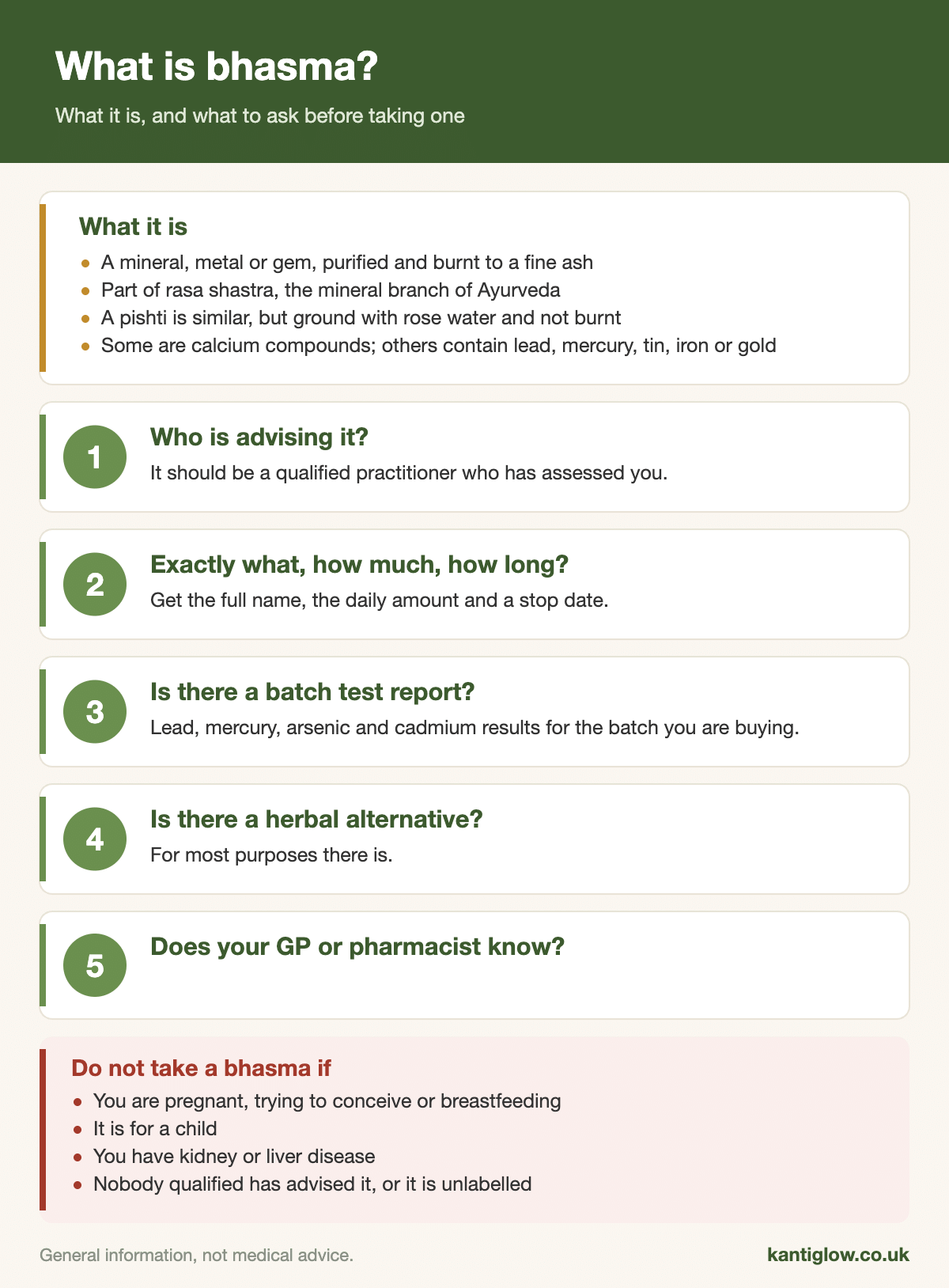
Questions to ask before taking a bhasma
1. Who is advising it? A bhasma should come from a qualified Ayurvedic practitioner who has assessed you, not from a relative, a video or a product page. Ask about their training and whether they belong to a professional register.
2. Exactly what is it, how much, and for how long? Get the full name, the daily amount in milligrams and a stop date. Classical doses are tiny, often 60 to 250 mg a day, and courses are short.
3. Is there a heavy-metal test report for this batch? Ask the seller for a certificate of analysis showing lead, mercury, arsenic and cadmium. If they cannot supply one, do not take it.
4. Is there a herbal alternative? For most purposes there is.
5. Does my GP or pharmacist know? Tell them, particularly if you take prescribed medicines or have a blood test coming up.
6. Who made it? A named, licensed manufacturer, a batch number and an expiry date are the minimum.
Do not take a bhasma if
- You are pregnant, trying to conceive or breastfeeding.
- It is for a child.
- You have kidney or liver disease.
- You have haemochromatosis (iron bhasmas) or Wilson’s disease (copper bhasmas).
- It is unlabelled, home-made or was brought from abroad without a full ingredients list.
- Nobody qualified has advised it.
Signs of a problem
Stop taking the product and see a GP if you develop tummy pain, constipation, nausea, loss of appetite, tiredness, headaches, irritability, poor concentration, aching muscles or joints, pins and needles, a metallic taste, or pale skin. These can be symptoms of lead or mercury poisoning and are easily mistaken for other things. Take the packaging, say what you took and for how long, and ask whether a blood lead test is appropriate. Call 111 for severe tummy pain with vomiting, confusion or seizures.
Report suspected side effects, and any product you believe is unsafe, to the MHRA through the Yellow Card scheme.
What the law says
- In India, bhasmas are licensed Ayurvedic medicines made under the Drugs and Cosmetics Act, with official limits for heavy metals that apply to herbal products. Classical metal-based preparations are treated differently because the metal is the intended ingredient.
- In the UK, there are no registered or licensed bhasma medicines. A product can be sold as a food supplement only if it is safe and meets food law, including legal limits for lead, cadmium and mercury, and it may make no medicinal claims. The NHS advises against buying unlicensed herbal medicines online.
- AYUSH, GMP and FSSAI marks are Indian approvals, not UK ones.
Does KantiGlow sell bhasma products?
Yes. We stock a small number of classical bhasma and pishti preparations for customers who have been advised to take them by a qualified practitioner, and their product pages say so. We do not recommend choosing them for yourself, and we would rather you bought a plain herb than a mineral preparation you are unsure about.
What is bhasma: frequently asked questions
What is bhasma?
A mineral, metal or gem that has been purified and burnt to a fine ash for use in Ayurveda.
What does bhasma mean?
Ash.
What is rasa shastra?
The branch of Ayurveda that uses minerals and metals.
How is bhasma made?
By repeated purification, grinding with herbal juices and incineration.
What is the difference between bhasma and pishti?
A bhasma is burnt. A pishti is ground with rose water without burning.
Is bhasma safe?
It depends on the type and the maker. Metal-containing bhasmas carry a real risk.
Does bhasma contain heavy metals?
Some are made from them. Others can be contaminated.
Which bhasmas contain lead?
Naga bhasma and trivang bhasma, among others.
Which contain mercury?
Rasa sindoor, makaradhwaj, kajjali and formulas containing parad.
Which are calcium-based?
Shankha, godanti, praval, mukta and mukta shukti preparations.
Is shankha bhasma safe?
It is essentially calcium carbonate. Use a tested product and take it with advice.
Is abhrak bhasma safe?
Quality depends on processing. Take it only under supervision.
Is swarna bhasma safe?
There is little safety data. Take it only under supervision.
Is lauh bhasma a good iron supplement?
No. Prescribed iron is tested and dosed reliably.
Does processing remove the toxicity?
Tradition says so. Testing does not consistently confirm it.
Do the traditional tests prove safety?
No. They show fineness, not metal content or absorption.
Has anyone been poisoned by bhasma products?
Yes. Cases of lead and mercury poisoning are documented.
Can I take bhasma in pregnancy?
No.
Can children take bhasma?
No.
Can I take bhasma with my medicines?
Not without telling your GP or pharmacist.
How much bhasma is taken?
Classical amounts are very small. Follow the practitioner’s instruction and the label.
How long can it be taken?
Short courses only, with a stop date.
How is bhasma taken?
Usually mixed with honey, ghee or milk as directed.
Who can prescribe a bhasma?
A qualified Ayurvedic practitioner who has assessed you.
How do I find a qualified practitioner?
Ask about training and professional registration.
Should I ask for a test report?
Yes, for the batch you are buying.
What is a certificate of analysis?
A lab report for a batch showing results against limits.
Which tablets contain hidden bhasmas?
Mahayograj guggulu, arogyavardhini vati, chandraprabha vati and many “ras” formulas.
Does chyawanprash contain bhasma?
Plain versions do not. Some “special” or “gold” versions do.
Does shilajit gold contain bhasma?
“Gold” formulas usually contain swarna bhasma. Check the ingredients.
Is bhasma legal in the UK?
It is not a registered medicine. Products must meet food safety law and make no medicinal claims.
What does AYUSH approval mean?
An Indian manufacturing licence. It is not UK approval.
What are the symptoms of lead poisoning?
Tummy pain, constipation, tiredness, headaches, poor concentration and anaemia.
What are the symptoms of mercury poisoning?
Tremor, numbness, mood changes and kidney problems.
How is lead poisoning diagnosed?
With a blood test arranged by a GP.
What should I do if I have been taking a bhasma?
Tell your GP, and stop if you have any symptoms.
Can I report a problem?
Yes, to the MHRA Yellow Card scheme.
Is there a herbal alternative?
Usually. Ask the practitioner.
Does KantiGlow sell bhasma?
Yes, for customers advised by a qualified practitioner.
What is the safest approach?
Do not self-prescribe, insist on batch testing, and keep your GP informed.
Sources
- NHS: Herbal medicines
- Saper RB et al., JAMA 2008: Lead, mercury and arsenic in Ayurvedic medicines sold via the internet
- Food Standards Agency: Food supplements, guidance for businesses
- MHRA: Yellow Card scheme
Shop the products in this guide
- Dabur Praval Panchamrut (20) — £12.99
- Basic Ayurveda Abhrak Bhasma — £4.99
- Patanjali Divya Medha Vati (120) — £8.99
Batch lab-tested, shipped from India. Food supplements should not replace a varied, balanced diet and a healthy lifestyle.
This guide is general information, not medical advice. Mineral and metal-based Ayurvedic preparations should be taken only on the advice and under the supervision of a qualified practitioner. They are not intended to diagnose, treat or cure any condition. Speak to your GP if you are worried about a product you have taken.