Quick answer: High cholesterol has no symptoms, and what you do about it depends on your overall risk of heart attack and stroke, not on the number alone. The changes that reliably lower it are eating less saturated fat and more unsaturated fat and fibre, being active for 150 minutes a week, stopping smoking and cutting down on alcohol. If your risk is high or your cholesterol stays up, a statin is the proven treatment. Berberine, a compound from plants including the Ayurvedic herb daruharidra, has trials showing modest reductions in cholesterol, smaller than a statin achieves. It has real cautions, is not suitable in pregnancy or breastfeeding, interacts with several medicines, and must never replace a prescribed statin.
Key facts
- High cholesterol usually causes no symptoms. A blood test is the only way to know.
- Risk is higher if you are over 50, male, past the menopause, of South Asian or sub-Saharan African origin, or have a family history.
- As a general guide, total cholesterol should be 5 mmol/L or below and non-HDL (“bad”) cholesterol 4 mmol/L or below. Your GP will interpret your result with your overall risk.
- Aim for at least 150 minutes of moderate activity a week.
- Keep alcohol to 14 units a week or less, spread over three or more days.
- Statins are the most common treatment. Alternatives exist for people who cannot take them.
What do my results mean?
| Measure | What it is | General guide for healthy adults |
|---|---|---|
| Total cholesterol | All the cholesterol in your blood | 5 mmol/L or below |
| HDL | “Good” cholesterol, which carries cholesterol away | Above 1.0 (men) or 1.2 (women) |
| Non-HDL | Total minus HDL: all the “bad” types | 4 mmol/L or below |
| LDL | The main “bad” cholesterol | 3 mmol/L or below |
| Triglycerides | Another blood fat | 1.7 or below fasting, 2.3 non-fasting |
These are guides, and targets are lower if you have had a heart attack or stroke or have diabetes. Your GP will usually calculate a ten-year risk score that combines cholesterol with age, blood pressure, smoking, ethnicity and family history. That score, more than the cholesterol figure, decides whether medicine is recommended.
Very high cholesterol at a young age, or a close relative who had a heart attack before 60, can point to an inherited condition called familial hypercholesterolaemia. This needs medication, and diet alone will not correct it.
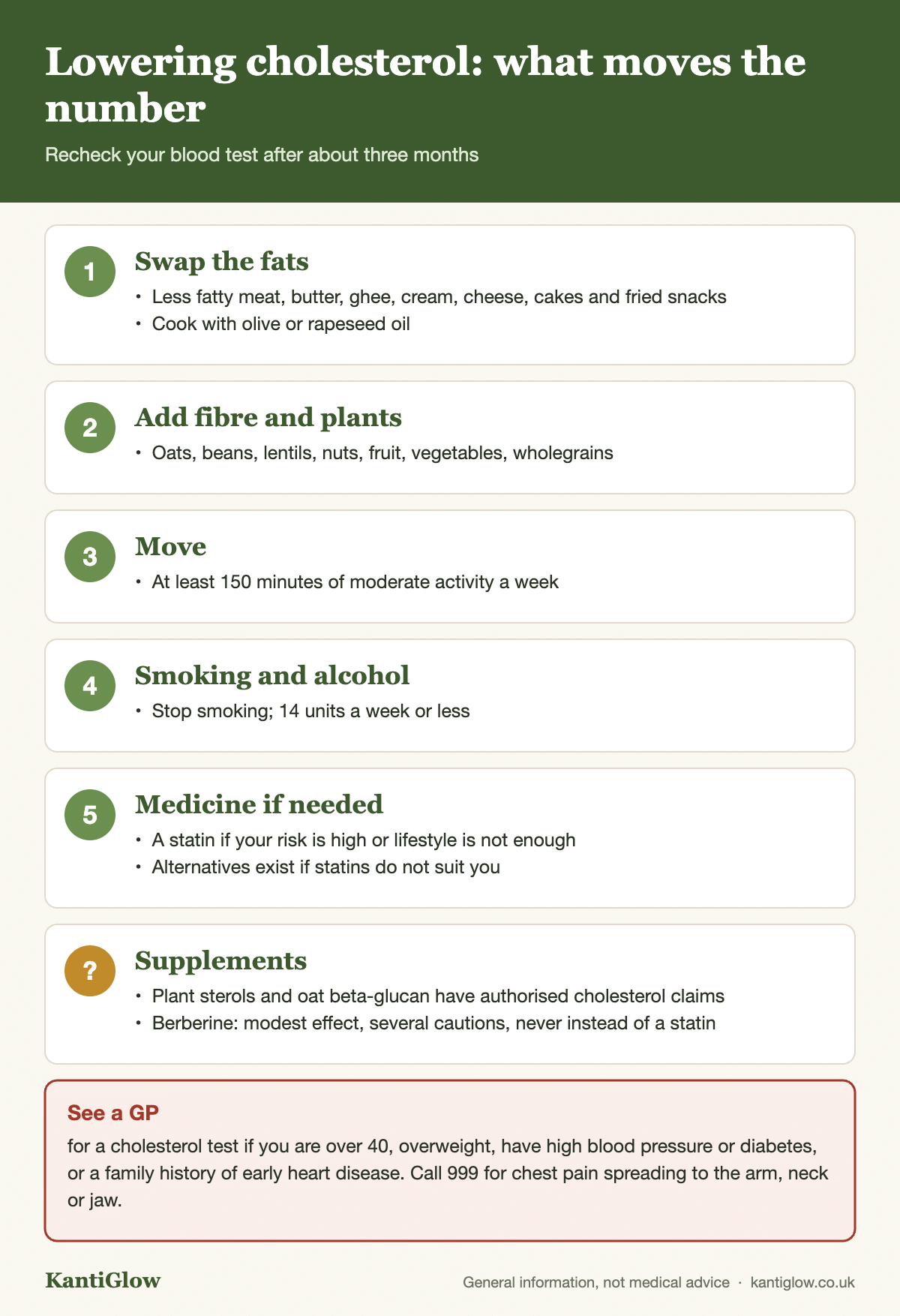
What lowers cholesterol, step by step
1. Change the fats. Cut down on fatty meat, sausages and pies, butter, lard and ghee, cream and cheese, cakes and biscuits, and foods made with coconut or palm oil. Cook with olive or rapeseed oil instead. In Indian cooking, the biggest savings usually come from using less ghee and butter, less paneer and cream, and fewer fried snacks and sweets.
2. Add fibre and plants. Oats, barley, beans, lentils, chickpeas, nuts, seeds, fruit and vegetables, and wholegrain roti, rice or bread. Have oily fish such as mackerel or salmon if you eat fish.
3. Move. At least 150 minutes of moderate activity a week, such as brisk walking, swimming or cycling.
4. Stop smoking and keep alcohol within 14 units a week.
5. Lose weight if you are carrying extra, particularly round the middle.
6. Recheck. Give the changes about three months, then have your blood test repeated.
7. Medicine. If your cholesterol has not come down, or your risk is high, your doctor may recommend a statin. If statins do not suit you, there are alternatives, including ezetimibe and injections.
Supplements and foods with evidence
| Option | Evidence | Note |
|---|---|---|
| Plant sterols and stanols (fortified spreads, yoghurt drinks) | Authorised claim: shown to lower blood cholesterol at 1.5 to 3 g a day | Not recommended in pregnancy or for children unless advised |
| Oat or barley beta-glucan | Authorised claim at 3 g a day | A bowl of porridge plus oatcakes gets you most of the way |
| Soluble fibre such as isabgol (psyllium) | Modest LDL reduction in trials | Take with plenty of water |
| Berberine | Modest reductions in LDL and triglycerides in trials; see below | Several cautions |
| Red yeast rice | Contains a natural statin, with statin side effects and variable dose | Do not combine with a statin; best avoided |
| Garlic, guggulu, amla | Small or inconsistent effects | Guggulu interacts with medicines |
Berberine in detail
What it is. Berberine is a yellow compound found in several plants, including daruharidra (Berberis aristata, tree turmeric), barberry and goldenseal. Daruharidra has a long history in Ayurveda. Most supplements contain purified berberine.
What trials show. Pooled results from trials, many of them small and carried out in China, report modest falls in total and LDL cholesterol and triglycerides after two to three months, typically at 500 mg two or three times a day. The effect is smaller than a standard statin dose, and there are no trials showing that berberine prevents heart attacks or strokes, which is the reason for lowering cholesterol in the first place.
Side effects. Constipation, diarrhoea, wind, stomach cramps and nausea are common, especially at the start.
Who should not take it.
- Anyone pregnant or breastfeeding, and babies and children. Berberine can raise bilirubin in newborns.
- People taking ciclosporin or other transplant medicines.
Who must check with a pharmacist or GP first.
- People on diabetes medicines, including metformin, because blood sugar may fall further.
- People on blood pressure medicines, blood thinners, sedatives or several regular medicines. Berberine affects the liver enzymes that process many drugs.
- People with liver or kidney problems.
The legal position. Berberine is sold as a food supplement. It has no authorised health claim in the UK and cannot be sold as lowering cholesterol or blood sugar, or as an alternative to medicine.
If you try it. Tell your GP. Do not stop or skip a statin. Use one product at the label dose, have your cholesterol rechecked after three months, and stop if it has not changed.
When to see a GP
Ask your GP surgery for a cholesterol test if you are over 40 and have not had one, are overweight, have high blood pressure or diabetes, or have a family history of high cholesterol or early heart disease. Adults aged 40 to 74 in England are invited for an NHS Health Check every five years. Call 999 for chest pain that spreads to the arm, neck or jaw, or signs of a stroke.
How to lower cholesterol: frequently asked questions
What is high cholesterol?
Too much of a fatty substance called cholesterol in the blood, which can narrow blood vessels.
What are the symptoms of high cholesterol?
Usually none.
What causes high cholesterol?
Fatty food, inactivity, excess weight, smoking, alcohol, age and genes.
What is a normal cholesterol level?
As a general guide, total cholesterol of 5 mmol/L or below and non-HDL of 4 or below.
What is the difference between LDL and HDL?
LDL deposits cholesterol in arteries. HDL carries it away.
What is non-HDL cholesterol?
Total cholesterol minus HDL: all the harmful types together.
Why are South Asians at higher risk?
South Asian origin is linked with higher rates of heart disease and diabetes at lower body weights.
Can thin people have high cholesterol?
Yes. Genes and diet matter as well as weight.
How quickly can I lower my cholesterol?
Diet changes can show in a blood test within about three months.
How much can diet lower cholesterol?
It varies, often by 5 to 10%, more with larger changes.
Which foods lower cholesterol?
Oats, beans, lentils, nuts, fruit, vegetables and foods with unsaturated fats.
Which foods raise cholesterol?
Fatty meat, butter, ghee, cream, cheese, cakes, biscuits and foods with coconut or palm oil.
Is ghee bad for cholesterol?
It is high in saturated fat. Use it sparingly.
Is coconut oil healthy?
It is high in saturated fat and raises LDL.
Do eggs raise cholesterol?
For most people, eggs in moderation have little effect. Saturated fat matters more.
Does exercise lower cholesterol?
It raises HDL and helps lower LDL and triglycerides.
Does alcohol affect cholesterol?
Yes, particularly triglycerides.
Do I need a statin?
That depends on your overall risk. Your GP will advise.
Are statins safe?
They are among the most studied medicines. Most people have no side effects.
Can I come off statins if I change my diet?
Only with your doctor’s agreement.
What is berberine?
A plant compound found in daruharidra, barberry and other plants.
What is daruharidra?
Tree turmeric, Berberis aristata, an Ayurvedic herb that contains berberine.
Does berberine lower cholesterol?
Trials show modest reductions, smaller than a statin.
How much berberine was used in trials?
Usually 500 mg two or three times a day. Follow your product’s label.
How long does berberine take to work?
Trials measured changes after two to three months.
What are berberine’s side effects?
Constipation, diarrhoea, wind, cramps and nausea.
Is berberine safe long term?
Most trials lasted under six months. Long-term safety is not well studied.
Can I take berberine with a statin?
Only with your GP’s or pharmacist’s agreement.
Can I take berberine instead of a statin?
No. It has not been shown to prevent heart attacks or strokes.
Can I take berberine with metformin?
Not without advice. Blood sugar may drop further.
Is berberine safe in pregnancy?
No. Avoid it in pregnancy and while breastfeeding.
Is berberine “nature’s Ozempic”?
No. That is a social media slogan. Any effect on weight in trials is small.
Does berberine help with weight loss?
Trials show little change.
Is berberine legal in the UK?
Yes, as a food supplement without health claims.
Do plant sterols work?
Yes, at 1.5 to 3 g a day they lower cholesterol.
Do oats lower cholesterol?
Yes. The beta-glucan in oats has an authorised claim at 3 g a day.
Does isabgol lower cholesterol?
Soluble fibre gives a modest reduction.
Is red yeast rice safe?
It contains a natural statin with the same side effects. It is best avoided.
Does garlic lower cholesterol?
Any effect is small.
Does guggulu lower cholesterol?
Results are inconsistent, and it interacts with medicines.
Do omega-3 supplements help?
They can lower triglycerides. They do not lower LDL.
How often should I be tested?
Your GP will advise. The NHS Health Check is every five years from 40 to 74.
What is familial hypercholesterolaemia?
An inherited condition causing very high cholesterol from birth. It needs medication.
When should I see a GP?
If you have not been tested and have risk factors, or your result was high.
Sources
- NHS: High cholesterol
- NHS: How to lower your cholesterol
- NHS: Medicines for high cholesterol
- NHS: NHS Health Check
- NHS: Herbal medicines
- Great Britain nutrition and health claims register
Shop the products in this guide
- Nutrija Berberine HCl 500mg 98% — £15.99
- Carbamide Forte Berberine with Milk Thistle Capsules — £17.99
- Organic Wellness Daru Haldi Capsules — £11.99
- Kamdhenu Daruhaldi Powder — £11.99
- Bixa Botanical Daruharidra Powder 200g (Berberis aristata) — £12.99
Batch lab-tested, shipped from India. Food supplements should not replace a varied, balanced diet and a healthy lifestyle.
This guide is general information, not medical advice. Food supplements are not intended to diagnose, treat or cure any condition. Do not stop or change prescribed medication without speaking to your GP, and check with a pharmacist before taking a supplement alongside medication.