Quick answer: The liver can often recover from alcohol if you stop or cut down early enough, and nothing else does that job. Fat build-up, the first stage of alcohol-related liver disease, usually reverses when you stop drinking. Later stages recover only partly or not at all, and often give no warning before they are advanced. Milk thistle and kutki are traditional liver herbs. Milk thistle has been tested in many trials without showing clear benefit for liver disease, and kutki has very little human research. Neither protects your liver from alcohol or makes drinking safer. If you drink heavily every day, do not stop suddenly without medical advice, because withdrawal can be dangerous. Your GP can arrange liver tests and support.
Key facts
- Low-risk drinking means no more than 14 units a week, spread over at least 3 days. A half pint of beer or a single shot of spirits is about 1 unit.
- Alcohol-related liver disease has three stages: fatty liver, alcohol-related hepatitis and cirrhosis.
- Early liver damage often has no symptoms.
- Stopping drinking is the treatment at every stage.
- If you drink heavily and regularly, get medical advice before stopping.
- “Liver detox” and “cleanse” products have no scientific basis.
Am I drinking too much?
Count your units for a typical week. Rough guides: a pint of 4% beer is about 2.3 units, a large (250 ml) glass of 12% wine is 3 units, a bottle of wine is around 9 to 10 units, and a single 25 ml measure of spirits is 1 unit.
You are above the low-risk guideline if you regularly exceed 14 units a week. The risk to the liver rises steeply with daily heavy drinking and with binges. Other signs that alcohol has become a problem are needing a drink to relax or sleep, drinking more than you planned, others commenting on it, and morning shakes or sweats that ease with a drink.
Some people are more vulnerable at lower amounts: women, people who are overweight, those with hepatitis B or C, and people with a family history of liver disease.
Warning signs
Early, if there are any: tiredness, poor appetite, feeling sick, weight loss without trying, and discomfort in the upper right side of the tummy.
Later: yellowing of the skin or whites of the eyes, a swollen tummy or legs, a high temperature, shaky hands, vomiting blood or passing black stools, and confusion or memory problems.
Most people with early damage feel completely well. That is why a blood test matters more than how you feel.
Can the liver recover?
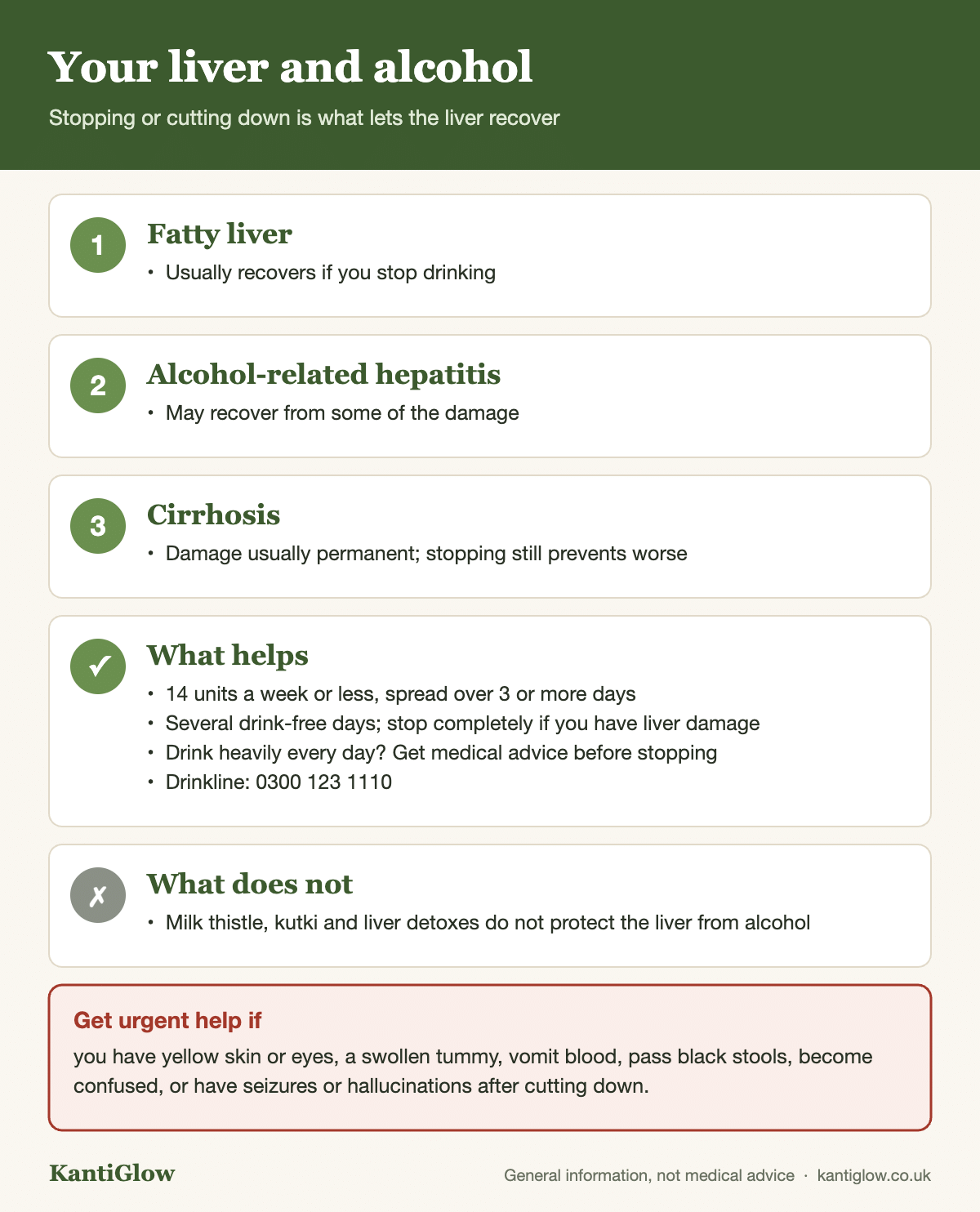
| Stage | What is happening | If you stop drinking |
|---|---|---|
| Fatty liver | Fat builds up in liver cells | It usually recovers |
| Alcohol-related hepatitis | The liver is inflamed and damaged | It may recover from some of the damage |
| Cirrhosis | Heavy scarring | The damage usually cannot be reversed, but stopping prevents further harm and improves survival |
What helps
- Cut down, or stop. If you have been told you have liver damage, the aim is to stop completely.
- Do not stop abruptly if you are dependent. If you drink heavily most days, or get shakes, sweats or anxiety when you do not drink, speak to your GP or local alcohol service first. Withdrawal can cause seizures. They can arrange a safe reduction or medicines.
- Have several drink-free days each week and avoid binges if you are staying within the guideline.
- Practical tactics: smaller glasses, lower-strength drinks, a soft drink between alcoholic ones, not keeping alcohol at home, and telling someone your plan.
- Eat well. Heavy drinking depletes vitamins, especially thiamine (B1). A balanced diet with enough protein helps recovery, and a GP may prescribe thiamine.
- Lose weight if you need to. Excess weight and alcohol together damage the liver faster than either alone.
- Take care with paracetamol. Keep strictly to the dose on the pack, and ask a pharmacist if you drink heavily.
- Get support. Your GP, local NHS alcohol services, Drinkline on 0300 123 1110, and groups such as Alcoholics Anonymous.
- Get tested. Ask your GP for liver blood tests. They may also arrange a scan.
Milk thistle: what it can and cannot do
What it is. Milk thistle (Silybum marianum) is a European plant whose seeds contain silymarin. It has been used for the liver for centuries.
In the UK. Some milk thistle products hold a traditional herbal registration. Their registered use is to relieve symptoms associated with occasional over-indulgence in food and drink, such as indigestion and upset stomach, based on traditional use only. That is a statement about digestive discomfort, not about protecting or repairing the liver.
What trials show. Milk thistle has been tested in many trials in people with alcohol-related and other liver diseases. The better-quality trials have not shown a clear benefit on liver damage, complications or survival.
Safety. Generally well tolerated. It can cause loose stools, nausea and bloating. Avoid it if you are allergic to daisies, ragweed or artichokes, and in pregnancy and breastfeeding. Check with a pharmacist if you take diabetes medicines or several regular medicines.
The bottom line. Milk thistle does not undo the effects of alcohol and does not prevent a hangover in any way that has been shown.
Kutki: what it can and cannot do
What it is. Kutki (Picrorhiza kurroa) is a bitter root from the Himalayas, one of the main liver herbs of Ayurveda. It is an ingredient in classical formulas such as arogyavardhini.
What research shows. Laboratory and animal studies are encouraging. Human trials are few, small and mostly old. There is not enough evidence to say it helps any liver condition.
Cautions. It is very bitter and can cause loose stools, cramps and vomiting. It may stimulate the immune system, so avoid it with autoimmune conditions and immunosuppressant medicines. Avoid it in pregnancy and breastfeeding. Wild kutki is an endangered plant, so choose cultivated sources. Some classical formulas that contain kutki also contain metal-based ingredients; check the full ingredients list.
If you have liver disease, do not take either herb, or any other herbal product, without your liver team’s or GP’s agreement.
Do liver detoxes and cleanses work?
No. The liver clears alcohol at a fixed rate of roughly one unit an hour, and nothing speeds that up. Detox teas, cleanses and “liver flush” kits do not remove toxins or fat from the liver. Some contain laxatives, and a few herbal products have themselves caused liver injury.
When to get help
See a GP if you regularly drink more than 14 units a week, are worried about your drinking, or have tiredness, poor appetite, nausea or pain in the upper right tummy.
Get urgent help (999 or A&E) for yellow skin or eyes, a swollen tummy, vomiting blood, black stools, confusion, or seizures or hallucinations after cutting down.
Liver and alcohol: frequently asked questions
How much alcohol damages the liver?
Risk rises above 14 units a week and climbs steeply with heavy daily drinking.
How do I know if my liver is damaged?
Often you cannot tell. A blood test from your GP is the way to find out.
What are the first signs of liver damage from alcohol?
Tiredness, poor appetite, nausea and discomfort in the upper right tummy, if any.
Can the liver repair itself?
Often, in the early stages, if you stop drinking.
How long does the liver take to recover?
It varies with the damage. Fat in the liver can clear within weeks of stopping.
Is fatty liver from alcohol reversible?
Usually, yes.
Can cirrhosis be reversed?
Usually not, but stopping drinking prevents further damage.
What is a unit of alcohol?
10 ml of pure alcohol: about half a pint of ordinary beer or a single measure of spirits.
How many units are in a bottle of wine?
Around 9 to 10.
Is binge drinking worse than daily drinking?
Both harm the liver. Daily heavy drinking carries the highest risk of cirrhosis.
Do I need drink-free days?
Yes, several each week.
Is it safe to stop drinking suddenly?
Not if you drink heavily every day. Get medical advice first.
What are alcohol withdrawal symptoms?
Shaking, sweating, anxiety and sickness, and in severe cases seizures and hallucinations.
What tests check the liver?
Blood tests, and sometimes an ultrasound or a scan of liver stiffness.
Can I have normal blood tests and still have liver damage?
Yes.
Does milk thistle protect the liver from alcohol?
That has not been shown.
Does milk thistle repair liver damage?
The better trials have not shown that it does.
What is milk thistle used for in the UK?
Registered products are for symptoms of over-indulgence such as indigestion, based on traditional use.
What is silymarin?
The group of compounds in milk thistle seeds.
How do you take milk thistle?
As tablets or capsules, following the product leaflet.
Is milk thistle safe?
For most adults, yes. It can cause mild stomach upset.
Who should avoid milk thistle?
People allergic to the daisy family, and pregnant or breastfeeding women.
Does milk thistle prevent hangovers?
There is no good evidence that it does.
Can I take milk thistle every day?
Follow the product leaflet. See a GP if symptoms continue.
What is kutki?
A bitter Himalayan root, Picrorhiza kurroa, used in Ayurveda for the liver.
Does kutki help the liver?
Human evidence is too limited to say.
What are the side effects of kutki?
Loose stools, cramps and vomiting.
Who should avoid kutki?
People with autoimmune conditions or on immunosuppressants, and pregnant or breastfeeding women.
Can I take milk thistle and kutki together?
There is no evidence the combination is better. Start one at a time if at all.
Is Liv.52 good for alcohol-related liver damage?
A controlled trial in alcohol-related cirrhosis found no benefit.
Do liver detox products work?
No.
Does drinking water flush out alcohol?
It helps dehydration. It does not speed up alcohol clearance.
Does coffee help the liver?
Coffee drinkers have lower rates of liver scarring in studies. It does not cancel out alcohol.
What should I eat to help my liver?
A balanced diet with enough protein, fruit and vegetables.
Do I need vitamins if I drink heavily?
Possibly thiamine. Ask your GP.
Is paracetamol safe if I drink?
At the normal dose for most people. Heavy drinkers should ask a pharmacist.
Can herbal products harm the liver?
Yes, some can.
Is alcohol worse for women’s livers?
Women develop liver damage at lower amounts than men.
Does being overweight add to the risk?
Yes, considerably.
Is red wine better for the liver?
No. The alcohol is what matters.
Where can I get help to cut down?
Your GP, local alcohol services, Drinkline on 0300 123 1110, or Alcoholics Anonymous.
Will my GP judge me?
No. GPs see this every day and can help.
What is the treatment for alcohol-related liver disease?
Stopping drinking, with support, and specialist care for advanced disease.
When should I get urgent help?
For jaundice, a swollen tummy, vomiting blood, black stools, confusion or withdrawal seizures.
Sources
- NHS: Alcohol-related liver disease
- NHS: Herbal medicines
- MHRA: Herbal medicines granted a traditional herbal registration
- NHS: Non-alcoholic fatty liver disease (MASLD)
- NHS: Alcohol support
Shop this plan at KantiGlow
- Tata 1mg Milk Thistle (Silymarin)
- INLIFE Milk Thistle 800mg
- Jiva Ayurveda Kutki Tablets
- Attar Ayurveda Kutki Powder
- Gaurveda Kutki Powder
All products are authentic Indian and UK-labelled brands, sourced directly from India and dispatched within 24–72 hours (UK delivery typically 5–7 working days).
Related guides
Shop the products in this guide
- Tata 1mg Milk Thistle 70% Silymarin Capsules 60 — £13.99
- Gaurveda Kutki Powder 100g — £9.99
- Himalaya Organic Turmeric Curcumin Capsules 60 — £8.99
Lab-tested, vegetarian, shipped from India. Food supplements should not replace a varied diet.
This guide is general information, not medical advice. Herbal products are not intended to diagnose, treat or cure any condition. If you are worried about your drinking or your liver, speak to your GP. Do not stop drinking suddenly if you drink heavily every day.