Quick answer: It is true that curcumin, the yellow compound in turmeric, is poorly absorbed on its own. Three things help, and Indian cooking has always done all of them: black pepper, fat and heat. Piperine in black pepper slows the breakdown of curcumin, fat carries it across the gut wall, and gentle cooking makes it more soluble. A half to one teaspoon of turmeric a day in food, cooked in oil with a pinch of pepper, is a sensible amount. Turmeric stirred into cold water gives you very little. Supplements that combine concentrated curcumin with piperine are a different matter from the spice: they deliver far more, can interact with medicines, and have been linked to rare cases of liver injury, so keep to the label and check with a pharmacist if you take regular medication.
Key facts
- Turmeric root contains roughly 2 to 5 per cent curcuminoids. A teaspoon of ground turmeric (about 3 g) provides around 60 to 150 mg.
- Curcumin dissolves in fat, not water, and is rapidly broken down in the gut wall and liver.
- In a small study, taking 20 mg of piperine with 2 g of curcumin greatly increased the amount of curcumin reaching the blood.
- Piperine slows the same enzymes that break down many medicines.
- The acceptable daily intake for curcumin is up to 3 mg per kilogram of body weight.
- Turmeric has no authorised health claims in the UK.
Why turmeric is hard to absorb
Three things stand in the way. Curcumin does not dissolve in water, so in the watery contents of the gut it clumps and passes through. What does cross the gut wall is quickly converted by enzymes there and in the liver into forms the body excretes. And what reaches the blood is cleared within a few hours. The result is that blood levels after a plain turmeric drink are barely measurable.
That is not the whole story. Curcumin and its breakdown products may act within the gut itself, and turmeric contains other compounds besides curcumin. But if your aim is to absorb it, how you take it makes a large difference.
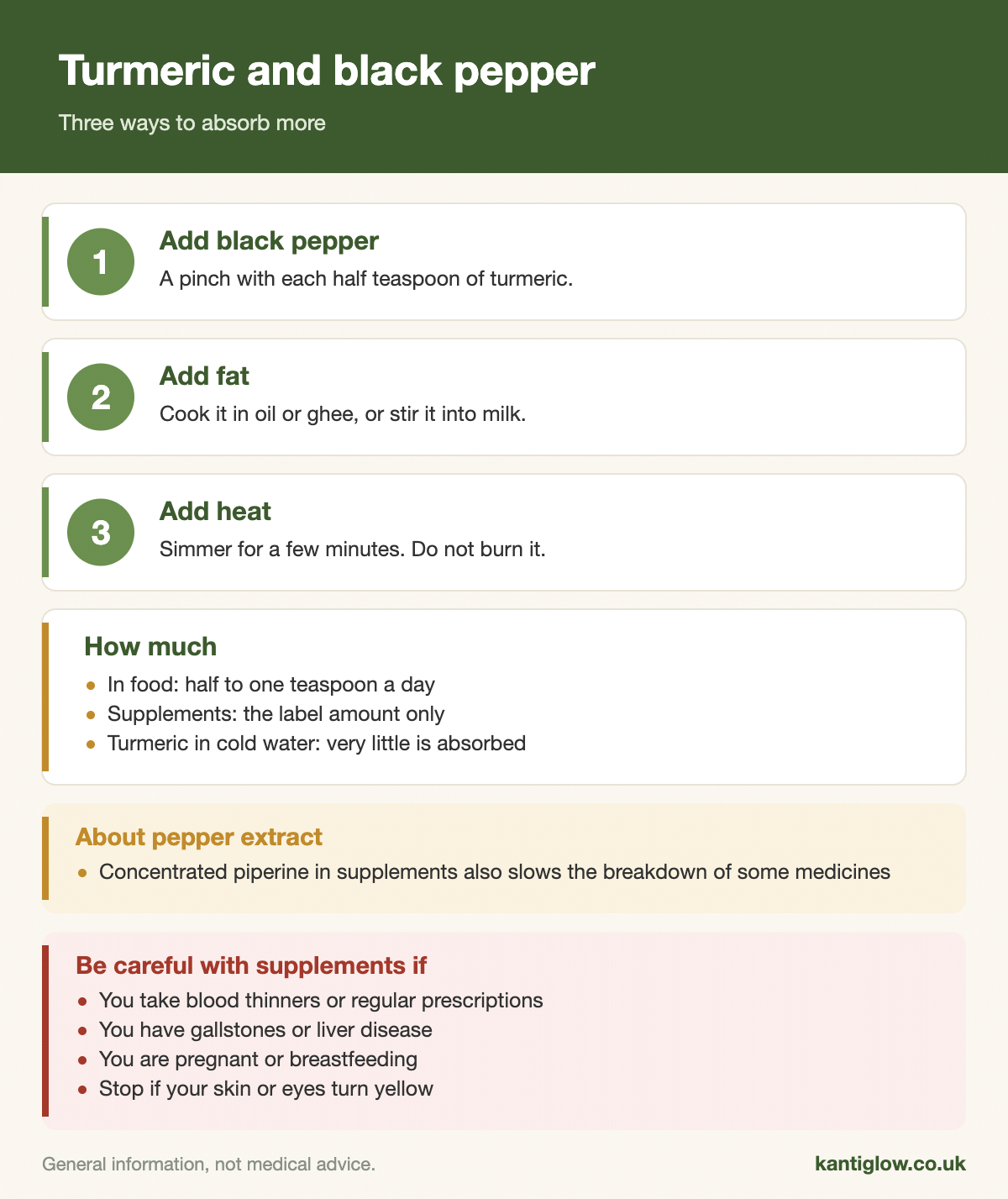
Three ways to absorb more
1. Black pepper. Piperine, the compound that makes pepper hot, temporarily slows the enzymes that break curcumin down. You do not need much: a pinch of freshly ground pepper, about a twentieth of a teaspoon, with each half teaspoon of turmeric.
2. Fat. Curcumin dissolves in oil and ghee and is absorbed along with them. Frying turmeric briefly in oil at the start of cooking (the tadka) or stirring it into full-fat milk does this.
3. Heat. Simmering for a few minutes makes curcumin more soluble. Very long boiling or high-temperature frying breaks some of it down, so add turmeric early in cooking and do not burn it.
The combination. A dal or curry that begins with turmeric and pepper in hot oil uses all three. So does golden milk made by warming milk with turmeric, pepper and a little ghee.
Ways of taking turmeric, compared
| Method | Absorption | Comment |
|---|---|---|
| Turmeric in cold water or juice | Very low | The powder does not dissolve |
| Turmeric tea with hot water | Low | Better with pepper and a little oil or milk |
| Cooked in oil with pepper, in food | Moderate | The traditional and most sensible way |
| Golden milk with pepper and fat | Moderate | A good daily habit if you enjoy it |
| Fresh turmeric root, grated | Similar to powder | About a centimetre of root equals half a teaspoon of powder |
| Turmeric capsules (plain powder) | Low | Just the spice in a capsule |
| Curcumin extract with piperine | High | A concentrated supplement. More interactions |
| Enhanced formulas such as BCM-95 or phospholipid curcumin | High | Concentrated supplements. See our guide to curcumin types |
How much?
As food. Half to one teaspoon of ground turmeric a day across your cooking is typical of an Indian diet and is safe for almost everyone.
As a supplement. Follow the label, and do not take more in the belief that more is better. The acceptable daily intake of curcumin works out at about 210 mg for a 70 kg adult, and many supplements provide several times that. If you take a supplement, there is no need to add large amounts of the spice on top.
Is black pepper always a good idea?
In cooking amounts, yes. In supplements, piperine is added in concentrated form, typically 5 to 20 mg, and its effect is not limited to curcumin. It can raise blood levels of some medicines, including certain blood pressure, epilepsy, transplant and asthma drugs, and blood thinners. If you take regular prescription medicines, ask a pharmacist before using a curcumin-with-piperine supplement. Concentrated piperine can also aggravate heartburn.
Be careful if
- You take blood thinners or antiplatelet medicines. Turmeric supplements may add to their effect.
- You have gallstones or a blocked bile duct. Turmeric stimulates the gallbladder.
- You are due for surgery. Stop supplements two weeks before.
- You take diabetes medicines. Turmeric may lower blood sugar a little.
- You are prone to kidney stones. Turmeric is high in oxalate.
- You have low iron. Large amounts may reduce iron absorption.
- You are pregnant or breastfeeding. Turmeric in food is fine. Avoid supplements.
- You have liver disease. Avoid supplements.
Liver injury. Health authorities in several countries have recorded rare cases of liver injury in people taking turmeric or curcumin supplements, often high-absorption products. Stop and see a GP if you develop yellowing of the skin or eyes, dark urine, itching, nausea or pain in the upper right of your tummy. This has not been a concern with turmeric used in cooking.
What does turmeric actually do?
Laboratory studies show curcumin affects pathways involved in inflammation, which is why it has been studied so widely. In people, the most consistent findings are modest reductions in knee osteoarthritis pain in small trials. For most of the other things turmeric is promoted for, the evidence is weak or absent. It is a good spice and a reasonable thing to include in your diet. It is not a medicine.
Buying and storing turmeric
- Buy ground turmeric from a reputable brand. Turmeric has been adulterated with lead-based colouring in some countries, so avoid loose, unbranded powder of unknown origin.
- Whole dried root ground at home, or fresh root, avoids that risk.
- Store in an airtight container away from light. It keeps its colour and aroma for about a year.
- It stains. Wipe surfaces at once; sunlight fades stains on fabric.
Turmeric and black pepper: frequently asked questions
Why take turmeric and black pepper together?
Pepper slows the breakdown of curcumin, so more is absorbed.
How much black pepper do I need with turmeric?
A pinch per half teaspoon of turmeric.
Is turmeric useless without pepper?
No, but far less curcumin is absorbed.
Does fat help turmeric absorb?
Yes. Curcumin dissolves in fat.
Does cooking destroy turmeric?
Gentle cooking helps. Prolonged high heat breaks some of it down.
Is turmeric in water any good?
Very little is absorbed.
Is turmeric tea effective?
Add pepper and a little milk or oil.
What is the best way to take turmeric?
Cooked in oil with pepper, in food.
How much turmeric should I have a day?
Half to one teaspoon in cooking.
Can I take turmeric every day?
In food amounts, yes.
When is the best time to take turmeric?
With a meal.
What is curcumin?
The main yellow compound in turmeric.
How much curcumin is in turmeric?
About 2 to 5 per cent.
What is piperine?
The pungent compound in black pepper.
Does white pepper work?
It contains piperine too.
Does long pepper work?
Yes. It also contains piperine.
Does ginger help absorption?
There is no good evidence that it does.
Is fresh turmeric better than powder?
They are similar. Fresh has more aroma.
Is golden milk a good way to take it?
Yes, with pepper and a little fat.
Are turmeric capsules better than the spice?
Plain turmeric capsules are the spice in a capsule. Curcumin extracts are much more concentrated.
Are turmeric supplements safe?
For many adults at the label amount. They are not for everyone.
Can turmeric harm the liver?
Rare cases have been reported with supplements.
Can I take turmeric with blood thinners?
In food, yes. Ask before taking supplements.
Can I take turmeric with blood pressure tablets?
Food amounts are fine. Ask about supplements with piperine.
Does black pepper interact with medicines?
Concentrated piperine can.
Can I take turmeric with gallstones?
Avoid supplements.
Does turmeric cause kidney stones?
It is high in oxalate. Avoid large amounts if you are prone to stones.
Does turmeric affect iron?
Large amounts may reduce absorption.
Is turmeric safe in pregnancy?
In food, yes. Avoid supplements.
Can children have turmeric?
In food, yes.
Does turmeric help arthritis?
Small trials in knee osteoarthritis report modest pain relief with curcumin supplements.
Does turmeric reduce inflammation?
It affects inflammatory pathways in the laboratory. Effects in people are modest.
Does turmeric help digestion?
It is traditionally used for that. Evidence is limited.
Does turmeric boost immunity?
That has not been shown.
Does turmeric whiten teeth or stain them?
It stains. Rinse after drinking it.
Can turmeric upset the stomach?
In large amounts, yes.
Is cheap turmeric safe?
Buy branded products. Loose powder has sometimes been adulterated.
How should I store turmeric?
Airtight, away from light.
How do I remove turmeric stains?
Wash promptly and dry in sunlight.
Should I tell my GP I take turmeric supplements?
Yes.
Sources
- Shoba G and others. Influence of piperine on the pharmacokinetics of curcumin in animals and human volunteers. Planta Medica, 1998
- NHS: Herbal medicines
- MHRA: Yellow Card scheme
Related guides
- Triphala: What It Is and How to Take It
- Shilajit vs Ashwagandha: How to Choose
- Ashwagandha in the UK: KSM-66, Forms & How to Take
This guide is general information, not medical advice. Food supplements are not intended to diagnose, treat or cure any condition. Speak to a pharmacist before taking a turmeric or curcumin supplement if you have a medical condition or take medication.