Quick answer: Before you take ashwagandha, check it suits you: it is not for pregnancy or breastfeeding, and people with thyroid, liver or autoimmune conditions, or who take thyroid, diabetes, blood pressure, sedative or immune-suppressing medicines, should ask a pharmacist or doctor first. If it does suit you, follow the amount on the label, take it with food, and start at the lower end. Evening suits most people because it can cause drowsiness. Trials that reported less stress or better sleep ran for six to twelve weeks, so give it about eight weeks before judging, and stop at around three months to review, because safety beyond that has not been studied. Stop at once and see a GP if your skin or eyes turn yellow, your urine goes dark, or you develop palpitations.
Key facts
- Trials of ashwagandha for stress typically used 225 to 1,250 mg a day of extract for 6 to 12 weeks, with several finding more benefit at 500 to 600 mg a day than at lower amounts.
- It appears to be well tolerated for up to about three months. Long-term safety over many months or years is unknown.
- Common side effects are mild stomach upset, loose stools, nausea and drowsiness.
- Case reports describe acute liver injury, with recovery after stopping.
- It may affect thyroid hormone levels and can interact with thyroid, diabetes, blood pressure, sedative and immunosuppressant medicines.
- Products vary widely in the part of the plant used, the extraction method and the withanolide content, which makes it hard to compare them.
First: is it suitable for you?
Do not take it if you are:
- Pregnant, trying to conceive, or breastfeeding.
- Under 18.
Ask a doctor or pharmacist first if you have:
- A thyroid condition, overactive or underactive.
- Liver disease, or a past reaction to a supplement.
- An autoimmune condition, such as rheumatoid arthritis, lupus or multiple sclerosis.
- Hormone-sensitive prostate cancer.
- Diabetes or blood pressure treated with medicine.
- A planned operation in the next two weeks.
Or if you take:
- Thyroid hormone (levothyroxine).
- Diabetes or blood pressure medicines.
- Sedatives, sleeping tablets or anti-anxiety medicines.
- Immunosuppressants.
- Antidepressants or other regular prescriptions, to be safe.
What you have bought
Look at the label for four things:
| Check | What it tells you |
|---|---|
| Part of the plant | “Root” is the traditional part. “Root and leaf” extracts are chemically different |
| Powder or extract | Root powder (churna) is the whole dried root, taken in gram amounts. Extracts are concentrated and taken in hundreds of milligrams |
| Amount per tablet or capsule | Needed to work out your daily intake |
| Withanolide content | Extracts are often standardised, for example to 1.5%, 2.5% or 5% |
Branded extracts such as KSM-66, Sensoril and Shoden are covered in our separate guide to choosing a type.
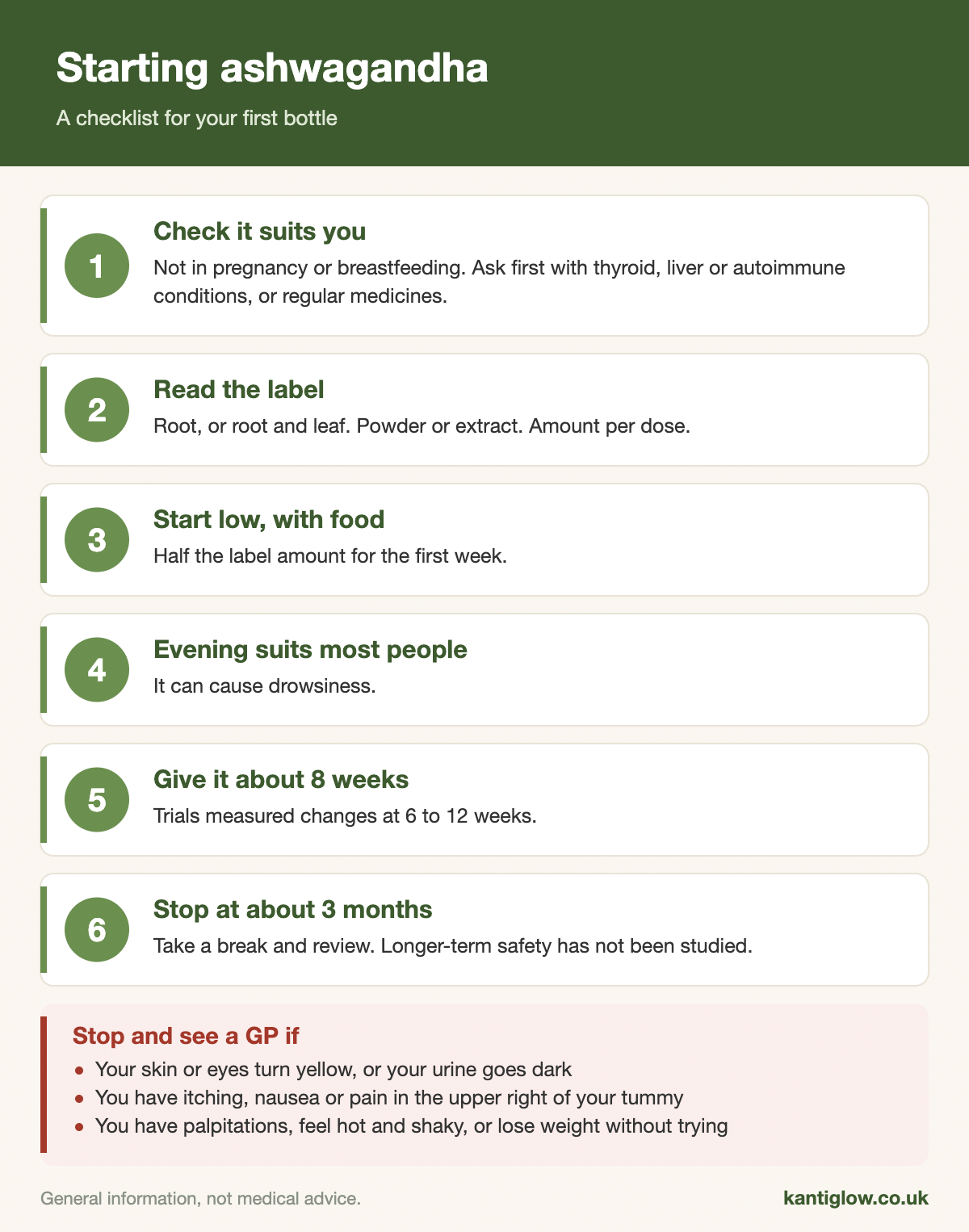
How to take it, step by step
1. Follow the label. Use the daily amount printed on your product. Do not add a second ashwagandha product on top, and check any “stress” or “sleep” blend you take for ashwagandha as an ingredient.
2. Start low. Take half the label amount, or one capsule if the label says one to two, for the first week.
3. Take it with food or milk. This reduces stomach upset.
4. Choose your time.
- Evening, an hour or so before bed, if it makes you drowsy or you are taking it with sleep in mind.
- Morning, if you find it does not make you sleepy and you prefer it then.
- Split between morning and evening if the label gives a twice-daily amount.
5. Powder. Stir the measured amount into warm milk, traditionally with a little honey or ghee, or into yoghurt or a smoothie. The taste is earthy and bitter.
6. Be consistent. Take it at the same time each day. Missing a day does not matter; do not double up.
7. Avoid alcohol and other sedating products close to the time you take it.
8. Keep a note. Rate your sleep, stress and energy each week, and write down any new symptoms.
What to expect
| When | What people report |
|---|---|
| First days | Often nothing. Some feel sleepy or have a mild stomach upset |
| Weeks 2 to 4 | Some notice they fall asleep more easily or feel less wound up |
| Weeks 6 to 8 | The point at which most trials measured a difference |
| Week 8 | Review. If you notice no change, stop |
| Around 12 weeks | Stop and take a break, whether or not it has helped |
Individual responses vary, and a good share of the improvement seen in trials also occurred in people taking a placebo.
How long, and taking breaks
There are no studies showing ashwagandha is safe when taken continuously for many months or years. A sensible pattern is up to three months, followed by a break of at least a few weeks, and a conversation with a pharmacist or GP before starting again. If you stop and feel no different, you did not need it.
Stop and get advice if
- Your skin or the whites of your eyes turn yellow, your urine is dark, you itch all over, feel sick, or have pain in the upper right of your tummy. These can be signs of liver injury. Stop and see a GP the same day.
- You have palpitations, feel hot, shaky or unusually anxious, or lose weight without trying. These can be signs of an overactive thyroid.
- You develop a rash, swelling or breathing difficulty. Call 999 for swelling of the face or throat.
- You become very drowsy.
- You find you are pregnant.
Tell the doctor what you have been taking and bring the bottle. You can report a suspected side effect through the Yellow Card scheme.
Does it work?
A review of seven small trials, mostly in India, found lower stress and anxiety scores, less sleeplessness and lower cortisol with ashwagandha than with placebo, and a pooled analysis of five sleep studies found a small improvement. The trials are short and small and used different products, so the honest summary is “may modestly help in the short term”. In the UK it has no authorised health claims and is sold as a food supplement, and the Food Standards Agency has been reviewing its safety.
What matters more than the supplement
If you bought ashwagandha for stress or sleep, these have stronger evidence: a fixed wake-up time, daylight and exercise, less caffeine and alcohol, a wind-down hour, and talking therapy if worry or low mood is persistent. Use the supplement, if at all, alongside them.
How to take ashwagandha: frequently asked questions
How do I take ashwagandha?
Follow the label, with food, starting low.
Should I take it in the morning or at night?
Evening suits most people, because it can cause drowsiness.
Should I take it with food?
Yes.
Can I take it on an empty stomach?
It is more likely to upset your stomach.
How much should I take?
The amount on your product’s label.
What amounts did trials use?
Mostly 225 to 1,250 mg a day of extract.
How long does it take to work?
Trials measured changes at six to twelve weeks.
How long can I take it for?
Up to about three months, then take a break.
Is it safe long term?
That has not been studied.
Do I need to cycle it?
Taking breaks is sensible.
What happens when I stop?
Nothing in particular. There is no known withdrawal.
Can I take it every day?
During a course, yes.
What if I miss a dose?
Carry on the next day. Do not double up.
What are the side effects?
Stomach upset, loose stools, nausea and drowsiness.
Can ashwagandha damage the liver?
Rare cases have been reported. Stop if you develop yellowing or dark urine.
Can it affect the thyroid?
Yes. Avoid it with a thyroid condition unless your doctor agrees.
Can I take it with levothyroxine?
Not without medical advice.
Can I take it with antidepressants?
Ask a pharmacist first.
Can I take it with blood pressure tablets?
Ask a pharmacist first. It may add to their effect.
Can I take it with diabetes medicine?
Ask first. It may lower blood sugar.
Can I take it with sleeping tablets?
Not without advice. It can add to drowsiness.
Can I take it in pregnancy?
No.
Can I take it while breastfeeding?
No.
Can teenagers take it?
No.
Can I drink alcohol with it?
Avoid combining them.
Can I drive after taking it?
Not if it makes you drowsy.
Can I take it with magnesium?
There is no known interaction.
Can I take it with coffee?
Yes, though caffeine works against sleep and calm.
Powder or capsules?
Capsules are easier to measure. Powder is traditional and cheaper.
How do I take the powder?
In warm milk, yoghurt or a smoothie.
What does it taste like?
Earthy and bitter.
What is the difference between root and leaf?
They contain different compounds. Root is the traditional part.
What are withanolides?
Compounds in the plant used to standardise extracts.
Does ashwagandha make you sleepy?
It can.
Will it help me sleep?
Small trials suggest a modest improvement, mainly in people with insomnia.
Will it reduce stress?
Small, short trials suggest a modest effect.
Does it raise testosterone?
It may slightly. Men with hormone-sensitive prostate cancer should avoid it.
Is it legal in the UK?
Yes, in food supplements.
Should I tell my GP I take it?
Yes.
When should I stop and see a GP?
For yellow skin or eyes, dark urine, palpitations or a rash.
Sources
- US National Institutes of Health, Office of Dietary Supplements: Ashwagandha fact sheet for health professionals
- Food Standards Agency: Call for evidence on ashwagandha
- NHS: Herbal medicines
- MHRA: Yellow Card scheme
Related guides
- Shilajit vs Ashwagandha: How to Choose
- Giloy (Guduchi): A UK Guide
- Methi (Fenugreek): A UK Guide
- Kalonji (Black Seed): A UK Guide
Shop the products in this guide
- Baidyanath Ashwagandhadi Churna Powder 100g — £4.99
- Jiva Ashwagandha & Brahmi Tablets 120 — £6.99
- Ashwagandha Gummies 30 — £8.99
- Man Matters Shilajit with Ashwagandha, Gokshura & Safed Musli Capsules — £12.99
Lab-tested, vegetarian, shipped from India. Food supplements should not replace a varied diet.
This guide is general information, not medical advice. Food supplements are not intended to diagnose, treat or cure any condition. Speak to a pharmacist or GP before taking ashwagandha if you have a medical condition or take medication, and do not take it in pregnancy or while breastfeeding.
Pingback: Triphala UK Guide: Tablets vs Churna, How to Take It | KantiGlow
Pingback: KSM-66 vs Sensoril vs Ashwagandha Root – UK Guide | KantiGlow
Pingback: Ayurvedic Morning Routine (Dinacharya) UK Guide | KantiGlow
Pingback: Brahmi vs Ashwagandha vs Lion’s Mane – UK Comparison | KantiGlow
Pingback: Ashwagandha vs Magnesium – Which Should You Take? UK | KantiGlow
Pingback: Shatavari Women’s Monthly Routine (UK Guide) | KantiGlow