Quick answer: Most people who take giloy for a short time have no problems, but there are well-documented reports from India of liver injury in people taking it, some of them serious. The risk appears highest in people who have an autoimmune condition or existing liver disease, or who take it daily for months. Giloy stimulates the immune system, which is the reason people take it and also the likely reason it can harm some of them. It has no proven benefit for preventing infections. Do not take it if you have an autoimmune or liver condition, are pregnant or breastfeeding, or take immunosuppressants. If you do take it, keep it short, and stop and seek medical advice at the first sign of jaundice, dark urine, itching or unusual tiredness.
Key facts
- Giloy is Tinospora cordifolia, also called guduchi or amrita. It is one of the most widely used herbs in Ayurveda.
- Use rose sharply during the Covid pandemic, when it was promoted as an immunity booster.
- From 2021, hospitals in India published case series of liver injury in people taking giloy, some resembling autoimmune hepatitis.
- No herb can be sold in the UK as boosting immunity or preventing infection.
- The NHS advises that people with liver or kidney problems, and pregnant or breastfeeding women, should not take herbal medicines without advice.
- Suspected side effects of herbal products can be reported through the MHRA Yellow Card scheme.
What is giloy?
Giloy is a climbing shrub native to India. The stem is the part used, as a powder, tablets, juice, a starchy extract called giloy satva, or a concentrated tablet called ghanvati. Classical texts describe it as a rejuvenating herb and use it in formulas for fevers, joints and digestion.
A related plant, Tinospora crispa, looks similar and has a clearer record of liver toxicity. Mix-ups between the two may explain some cases, which is one reason to buy only from manufacturers that verify the plant species.
What do people take it for, and does it work?
| Use | What the evidence shows |
|---|---|
| “Immunity” and preventing infections | Laboratory studies show it activates immune cells. There are no good trials showing fewer infections in people |
| Hay fever | One small trial reported fewer nasal symptoms. Not confirmed |
| Blood sugar | Small studies suggest a modest lowering. Not a treatment |
| Fever, dengue, Covid | No reliable evidence. Never use it in place of medical care |
| Joints | Traditional use. Very little research |
In short, giloy has a long tradition and a small evidence base, and the claim it is best known for, immunity, is the least supported.
The liver injury reports
- What was reported. From 2021 onwards, liver specialists in several Indian cities described patients who developed jaundice and hepatitis after taking giloy, usually daily for weeks to months. Some cases looked like autoimmune hepatitis. In the largest series, of 43 patients from several hospitals, symptoms began a median of 46 days after starting giloy. Most people recovered after stopping it and some needed steroid treatment. Others presented with acute liver failure or a sudden worsening of existing liver disease, which can be fatal.
- Who was affected. Many had an autoimmune condition, such as autoimmune thyroid disease, a family tendency to one, or underlying liver disease they did not know about. Some had no known risk factor.
- The suggested mechanism. Giloy stimulates the immune system. In susceptible people this may trigger the immune system to attack the liver.
- The disagreement. India’s ministry for traditional medicine questioned the reports, arguing that the plant was not always identified and that giloy is safe when correctly sourced and dosed. Liver specialists responded with further work in which the herb their patients had taken was confirmed to be Tinospora cordifolia.
- Where that leaves you. The absolute risk is unknown, because millions of people have taken giloy and only the cases that reached hospital were counted. It is clearly not zero, and it is concentrated in identifiable groups.
Who should not take giloy
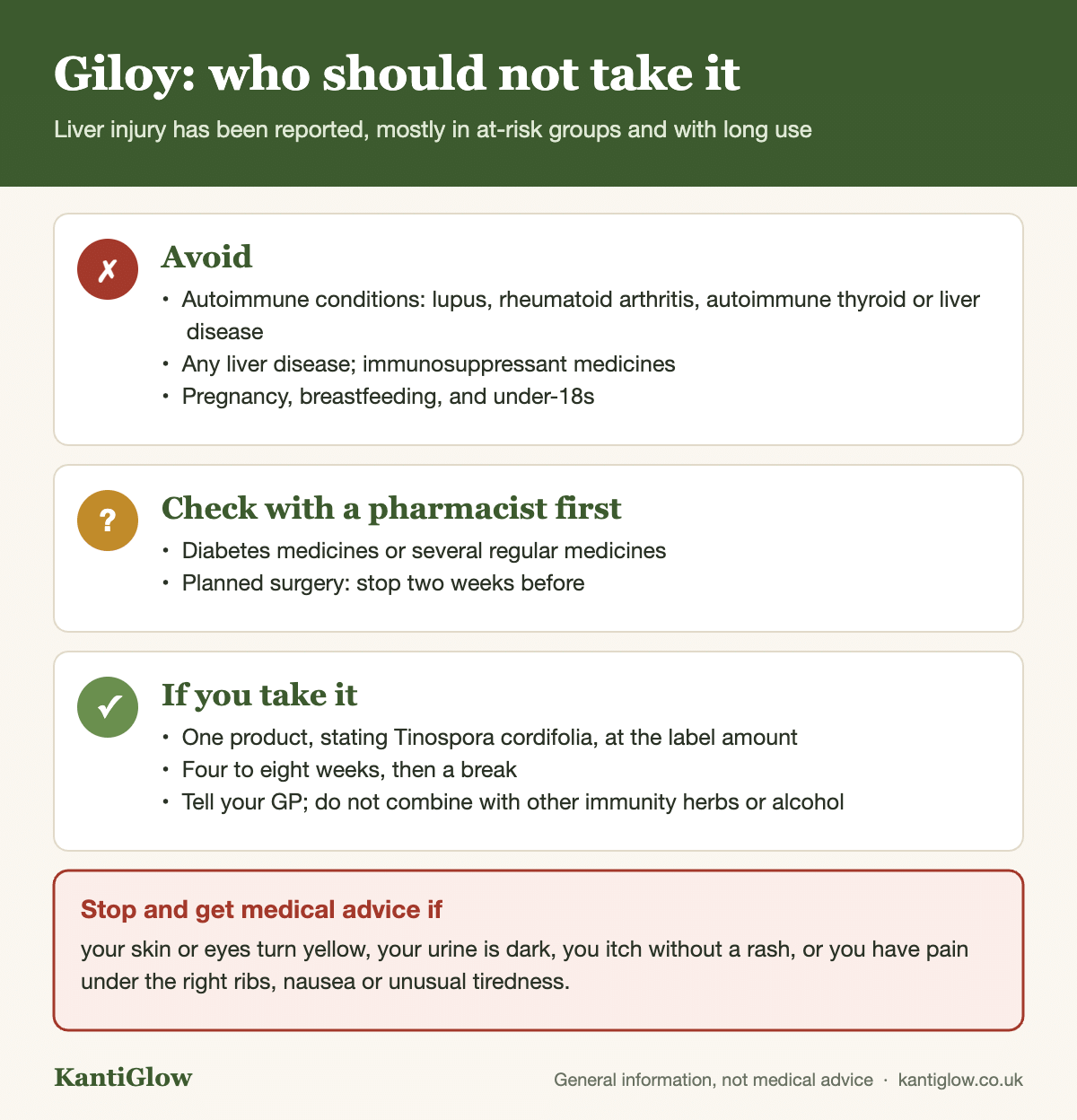
Avoid it if you:
- have an autoimmune condition, including lupus, rheumatoid arthritis, autoimmune hepatitis, inflammatory bowel disease, multiple sclerosis, psoriasis, type 1 diabetes or autoimmune thyroid disease
- have any liver disease, including fatty liver with abnormal blood tests, hepatitis B or C, or a history of heavy drinking
- take immunosuppressant medicines, for example after a transplant or for an autoimmune condition
- are pregnant, breastfeeding or trying to conceive
- are under 18
Check with a pharmacist or GP first if you:
- take diabetes medicines, because blood sugar may fall further
- take several regular medicines
- are due to have surgery, in which case stop two weeks before
If you choose to take it
- Buy a product that states the plant species and part, a batch number and a named manufacturer.
- Keep to the label amount. More is not better.
- Do not take it continuously. Four to eight weeks, then a break, is a cautious pattern.
- Do not combine it with other “immunity” herbs or with alcohol.
- Tell your GP and pharmacist that you take it.
- If you have been taking it for months, consider asking your GP for a liver blood test.
Stop and get medical advice if you notice
- yellowing of the skin or the whites of the eyes
- dark urine or pale stools
- itching without a rash
- pain or discomfort under the right ribs
- loss of appetite, nausea or unusual tiredness
Stop the product, keep the packaging, and see a GP promptly or call 111. Mention the herb by name. Get urgent help for confusion, a swollen tummy or vomiting blood.
What supports your immune system
Nothing “boosts” a healthy immune system beyond normal. What keeps it working properly:
- seven to nine hours of sleep
- a varied diet with plenty of fruit and vegetables and enough protein
- regular exercise
- not smoking, and little alcohol
- vitamin D, 10 micrograms a day in autumn and winter
- handwashing
- the vaccines you are offered
Vitamins C and D and zinc contribute to the normal function of the immune system. Taking extra when you already have enough has not been shown to prevent infections.
Is giloy safe: frequently asked questions
What is giloy?
The stem of Tinospora cordifolia, an Ayurvedic herb also called guduchi.
Is giloy safe?
For many people short term, yes. It has been linked to liver injury in some.
Can giloy damage the liver?
Yes, in some people. Cases have been reported from India since 2021.
How common is liver injury from giloy?
Unknown. It appears uncommon but is concentrated in at-risk groups.
Who is most at risk?
People with autoimmune conditions or existing liver disease, and those taking it for months.
What are the signs of liver injury?
Yellow skin or eyes, dark urine, itching, tummy pain and tiredness.
How quickly does it happen?
In reported cases, usually after weeks to months of daily use.
Does the liver recover?
Most people recovered after stopping. A few did not.
Should I stop taking giloy?
Stop if you are in an at-risk group or have any warning signs. Otherwise weigh the limited benefit against the risk.
I took giloy during Covid. Should I be worried?
If you feel well and stopped some time ago, harm is unlikely. Ask your GP if you have any concerns.
Should I have a liver blood test?
Consider it if you have taken giloy daily for months or have symptoms.
Does giloy boost immunity?
It stimulates immune cells in the laboratory. It has not been shown to prevent infections.
Did giloy help with Covid?
There is no reliable evidence that it did.
Does giloy help with fever?
That is a traditional use without good evidence. See a doctor for a persistent fever.
Does giloy help dengue or raise platelets?
There is no reliable evidence. Dengue needs medical care.
Does giloy lower blood sugar?
Slightly, in small studies. Do not use it in place of diabetes treatment.
Can I take giloy with metformin?
Not without advice.
Does giloy help hay fever?
One small trial suggested it might.
Does giloy help arthritis?
There is very little research. Avoid it with rheumatoid arthritis and other autoimmune types.
Why is giloy risky in autoimmune disease?
It stimulates the immune system, which may worsen or trigger autoimmune activity.
Can I take giloy with thyroid problems?
Avoid it with autoimmune thyroid disease such as Hashimoto’s or Graves’ disease.
Can I take giloy with immunosuppressants?
No.
Is giloy safe in pregnancy?
No. Avoid it.
Can children take giloy?
No, not without medical advice.
Is giloy safe for older adults?
Check with a pharmacist first, particularly alongside regular medicines.
How much giloy is safe?
There is no established safe dose. Keep to the label and to short periods.
How long can I take giloy?
A cautious approach is four to eight weeks, then a break.
Is giloy juice safer than tablets?
There is no evidence that one form is safer.
What is giloy ghanvati?
A concentrated tablet made from giloy extract.
What is giloy satva?
A starchy extract from the stem.
Is home-grown giloy safer?
Not necessarily. Misidentifying the plant is a known problem.
What is Tinospora crispa?
A similar-looking species with a clearer record of liver toxicity.
How do I know which species is in my product?
The label should state Tinospora cordifolia. Ask the seller if it does not.
Can I take giloy with ashwagandha?
Both have been linked to rare liver injury. Combining them is not advisable.
Can I take giloy with turmeric supplements?
High-absorption turmeric extracts have also been linked to liver injury. Avoid stacking them.
Can I drink alcohol while taking giloy?
It is best not to.
Does giloy interact with paracetamol?
No specific interaction is known. Keep to the normal paracetamol dose.
Is giloy legal in the UK?
It is sold as a food supplement, without health claims.
Is giloy a registered herbal medicine?
No.
How do I report a side effect?
Through the MHRA Yellow Card scheme, and tell your GP.
What can I take instead for immunity?
Vitamin D in winter, and the habits that keep immunity normal: sleep, diet, exercise and vaccines.
Is chyawanprash safer?
It is a food-like tonic. It is high in sugar and research is limited.
Are other Ayurvedic herbs linked to liver injury?
Rare cases have been reported with ashwagandha and with some turmeric extracts.
When should I see a GP?
At any warning sign, or if you are in an at-risk group and have been taking giloy.
Sources
- Kulkarni AV et al., Hepatology Communications 2022: Tinospora cordifolia (giloy)-induced liver injury, multicentre study from India
- NHS: Herbal medicines
- MHRA: Yellow Card scheme
- NHS: Vitamin D
- NHS: Common cold
- Great Britain nutrition and health claims register
Related guides
- Kalonji (Black Seed): A UK Guide
- Methi (Fenugreek): A UK Guide
- Bhumi Amla: A UK Guide
- Ashwagandha in the UK: KSM-66, Forms & How to Take
Shop the products in this guide
- Zandu Giloy (Guduchi) Tablets 60 — £4.99
- Jiva Giloy Capsules 60 — £7.99
- Himalaya Guduchi Tablets 60 — £7.99
- KantiGlow Selection Tulsi Amla Giloy Ayurvedic Immunity Wellness Capsules 60 — £18.99
Lab-tested, vegetarian, shipped from India. Food supplements should not replace a varied diet.
This guide is general information, not medical advice. Herbal products are not intended to diagnose, treat, cure or prevent any disease. Stop taking giloy and speak to a GP if you develop any of the warning signs above.
Pingback: Chyawanprash UK Guide: What It Is & How to Eat It | KantiGlow