Quick answer: Most mothers who worry about supply are making enough milk. The reliable signs are your baby’s nappies, weight and behaviour at the breast, not how your breasts feel or how often your baby wants to feed. If supply is low, what works is more frequent and more effective milk removal: getting a feed observed so attachment can be corrected, feeding on demand from both breasts, skin-to-skin contact, and expressing after feeds once breastfeeding is established. Methi (fenugreek) is the traditional herb for milk supply. The research is small and mixed, it has side effects, and it must not be taken in pregnancy. It should never take the place of feeding support. Speak to your midwife or health visitor, or call the National Breastfeeding Helpline on 0300 100 0212, open 24 hours a day.
Key facts
- From day 5, a baby getting enough milk has at least 6 heavy, wet nappies every 24 hours, and from day 4 at least 2 soft, yellow poos a day.
- After the first few days, steady weight gain and an alert, healthy baby are the best signs.
- Poor attachment and positioning, and not feeding often enough, are the commonest reasons for low supply.
- Alcohol, smoking, stress, illness, some medicines, nipple shields and early use of formula or dummies can all affect supply.
- Breast milk is made on a supply-and-demand basis: the more milk is removed, the more is made.
- Fenugreek is a food supplement in the UK and cannot make breastfeeding claims.
Is my baby getting enough?
Reassuring signs
- Feeds begin with a few quick sucks, then long, rhythmic sucks and swallows with pauses.
- You can hear and see your baby swallowing.
- Their cheeks stay rounded while sucking.
- They seem calm during feeds and come off the breast by themselves.
- They are content after most feeds.
- Your breasts feel softer afterwards.
- Wet and dirty nappies are as described above.
- Weight gain is steady after the first few days.
Things that do not mean low supply
- Feeding very often, including in clusters in the evening.
- Soft breasts after the early weeks.
- A baby who takes a bottle after a feed. Babies suck for comfort.
- Getting little out with a pump. Pumping is a skill, and babies are far more efficient.
- Short feeds, in an older baby who has become quicker.
Signs to act on
- Fewer wet or dirty nappies than expected.
- Poor weight gain, or weight loss beyond the first days.
- A baby who is very sleepy, hard to wake for feeds or floppy.
- Dark urine, a dry mouth or a sunken soft spot.
- Pain throughout feeds, or damaged nipples.
Why supply can be low
- Attachment and positioning that stop the baby draining the breast.
- Infrequent or timed feeds.
- Tongue-tie.
- Formula top-ups or dummies before breastfeeding is established.
- Time apart after birth, for example with a premature baby.
- Illness in mother or baby.
- Alcohol and smoking.
- Anxiety, stress or depression.
- Previous breast surgery.
- Some medicines, including decongestants and some contraceptives. Ask a pharmacist.
- Less commonly, thyroid problems, polycystic ovary syndrome or retained placenta.
What increases milk supply
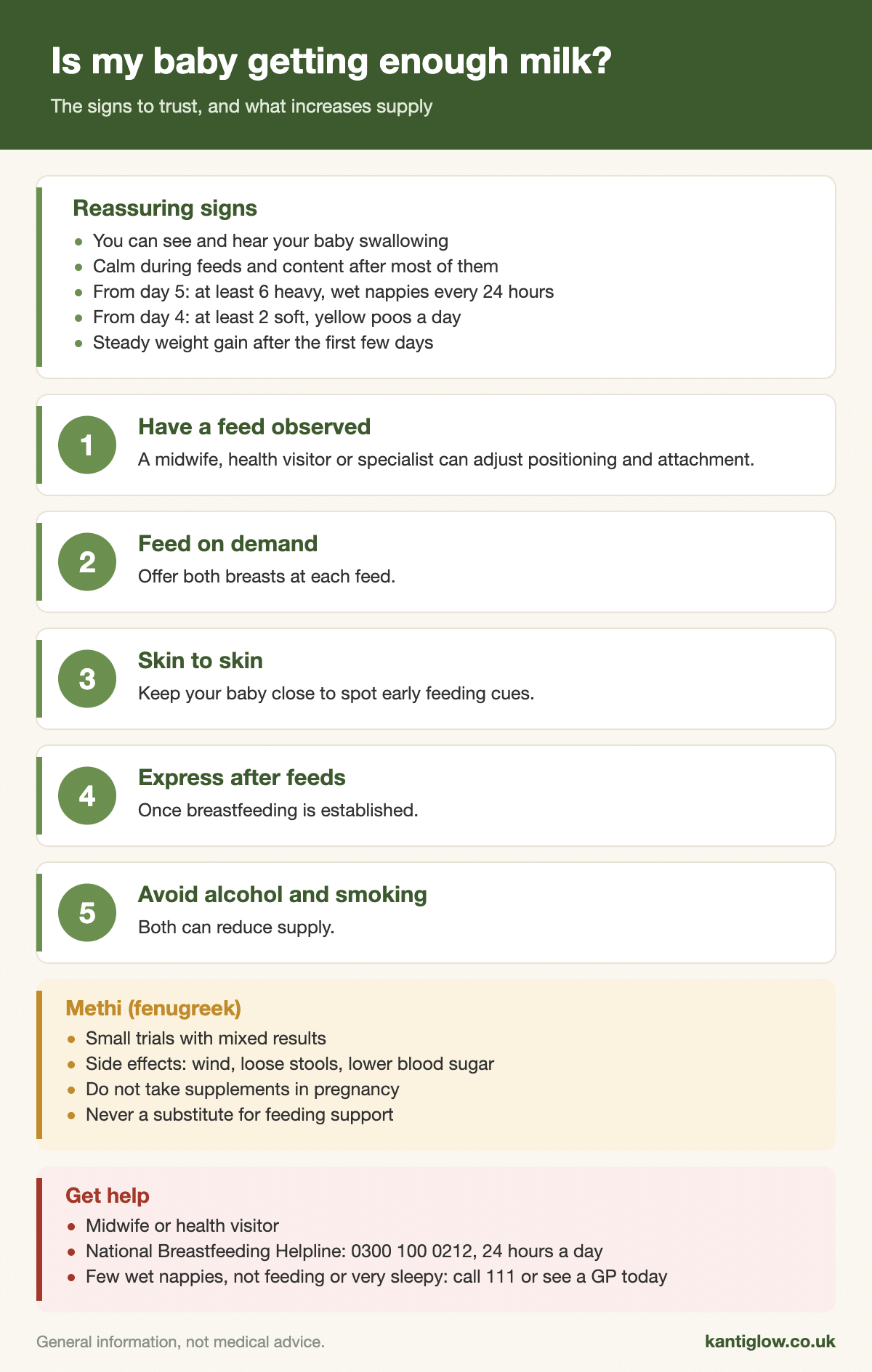
1. Have a feed observed. A midwife, health visitor or breastfeeding specialist can watch a full feed and adjust positioning and attachment. This is the step that makes the biggest difference.
2. Feed on demand, day and night, at least 8 times in 24 hours in the early weeks. Offer both breasts at each feed and alternate the side you start on.
3. Hold your baby skin to skin. It triggers the hormones that release milk and helps you notice early feeding cues.
4. Express after feeds once breastfeeding is established, by hand or pump. Draining the breast signals it to make more.
5. Avoid formula bottles and dummies until breastfeeding is going well, unless a health professional advises top-ups. If top-ups are needed, express at the same time to protect supply.
6. Look after yourself. Eat regular meals, drink when you are thirsty, rest when you can and accept help. You do not need a special diet or extra fluids beyond thirst.
7. Avoid alcohol and smoking.
8. Have tongue-tie checked if feeding is painful or your baby cannot stay attached.
Expect it to take several days of frequent, effective feeding before supply responds.
Does methi (fenugreek) help?
What it is. Methi (Trigonella foenum-graecum) is the seed and leaf used in Indian cooking. The seeds have a long tradition as a food for new mothers, in laddoos, in dal and as a tea.
What research shows. A handful of small trials have tested fenugreek for milk supply. Some found mothers produced a little more milk in the first days or weeks; others found no difference from placebo. The studies are small and of mixed quality, and none shows it works when the underlying problem is attachment or infrequent feeding.
Side effects and cautions.
- A maple-syrup smell in sweat, urine and sometimes the baby’s urine. It is harmless but can be mistaken for a rare metabolic condition, so tell your health visitor.
- Wind, loose stools and nausea in the mother; some mothers report a windy, unsettled baby.
- It can lower blood sugar. Take care if you have diabetes or take diabetes medicines.
- It may increase the effect of blood-thinning medicines.
- It belongs to the same plant family as peanuts and chickpeas. Avoid it if you have a peanut or chickpea allergy.
- It may worsen asthma in some people.
- Do not take fenugreek supplements in pregnancy. Large amounts may stimulate the womb. Methi used as a spice in cooking is fine.
If you decide to try it. Talk to your midwife, health visitor or pharmacist first. Use it alongside feeding support, not instead of it. Follow the label, start low, give it one to two weeks, and stop if you or your baby develop symptoms. Methi as food, in dal, in vegetable dishes or as soaked seeds, is a gentler option than concentrated capsules.
Other things people suggest
| Remedy | What we know |
|---|---|
| Shatavari | The traditional Ayurvedic herb for nursing mothers. A few small trials. Safety data in breastfeeding are limited |
| Fennel, cumin, ajwain and jeera water | Traditional and pleasant as food or tea. No good evidence |
| Oats, almonds, gond laddoo, panjiri | Nourishing foods for a tired mother. No direct effect on supply shown |
| Brewer’s yeast, “lactation cookies” | No good evidence |
| Drinking extra water or milk | Drink to thirst. Forcing fluids does not raise supply |
| Blessed thistle, moringa | Small studies only |
| Domperidone | A prescription medicine sometimes used by specialists. A doctor decides |
No herb or food replaces frequent, effective feeding.
Where to get help
- Your midwife or health visitor.
- A local breastfeeding or infant-feeding team or drop-in. Ask your health visitor.
- National Breastfeeding Helpline: 0300 100 0212, open 24 hours a day, every day.
- Your GP, for pain, mastitis, low mood or a baby who is not gaining weight.
Mixed feeding and formula feeding are valid choices too. Getting help is about making the feeding you want work, not about pressure to carry on.
When to get urgent help
Call 111 or see a GP the same day if your baby has far fewer wet nappies than usual, is not feeding, is unusually sleepy or hard to wake, or has a dry mouth. Call 999 if your baby is floppy, unresponsive or has trouble breathing. See a GP promptly for a hot, red, painful area of breast with fever, which may be mastitis.
Low milk supply: frequently asked questions
How do I know if my baby is getting enough milk?
By wet and dirty nappies, steady weight gain and contented behaviour after most feeds.
How many wet nappies should a baby have?
At least 6 heavy, wet nappies every 24 hours from day 5.
Is it normal for my baby to feed all the time?
Frequent and cluster feeding is normal, especially in the early weeks and evenings.
My breasts feel soft. Have I lost my milk?
No. Breasts settle after the early weeks.
I get very little when I pump. Is that low supply?
Not necessarily. Pump output is a poor guide.
What causes low milk supply?
Most often poor attachment and infrequent feeds.
Can stress reduce milk?
Stress and anxiety can affect let-down and supply.
Does formula reduce supply?
Top-ups reduce the demand that drives supply, unless you express as well.
Do dummies affect breastfeeding?
They can, if used before breastfeeding is established.
Do nipple shields reduce supply?
They can. Use them with support.
Which medicines reduce supply?
Some decongestants and contraceptives, among others. Ask a pharmacist.
Does the contraceptive pill affect milk?
Combined pills can. Progestogen-only methods are usually preferred. Ask your GP.
What is the fastest way to increase supply?
Feed or express more often and get attachment checked.
How long does it take to increase supply?
Usually several days.
How often should I feed?
On demand, at least 8 times in 24 hours in the early weeks.
Should I offer both breasts?
Yes, at each feed.
Does expressing increase supply?
Yes, once breastfeeding is established.
What is power pumping?
Repeated short pumping sessions within an hour, to mimic cluster feeding.
Does skin-to-skin help?
Yes.
Do I need to drink more water?
Drink to thirst.
Do I need to eat more?
Eat regular, balanced meals. A special diet is not needed.
Does alcohol affect milk?
Yes, it can reduce supply.
Does smoking affect milk?
Yes.
What is methi?
Fenugreek, a seed and leaf used in Indian cooking.
Does fenugreek increase milk supply?
Small trials give mixed results.
How quickly does fenugreek work?
Mothers who respond usually report it within a few days.
How much fenugreek should I take?
Follow the product label and ask a health professional first.
Is fenugreek safe while breastfeeding?
It is widely used, but side effects occur and research is limited.
What are the side effects of fenugreek?
Wind, loose stools, a maple-syrup smell, and lower blood sugar.
Why do I smell of maple syrup?
A compound in fenugreek causes it. It is harmless.
Can fenugreek upset my baby?
Some mothers report a windy or unsettled baby.
Who should not take fenugreek?
Pregnant women, and people with peanut or chickpea allergy. Check first with diabetes, asthma or blood thinners.
Can I take fenugreek in pregnancy?
Not as a supplement. Cooking amounts are fine.
Is methi in food enough?
It is the gentlest way to use it. Whether it affects supply is unproven.
How do I make methi tea?
Steep a teaspoon of lightly crushed seeds in hot water for ten minutes.
Does shatavari increase milk?
It is traditional, with a few small trials.
Do fennel or cumin help?
They are traditional. Evidence is lacking.
Do oats or lactation cookies work?
There is no good evidence.
What are methi or gond laddoos?
Traditional energy-dense sweets for new mothers. They are nourishing, and high in sugar and fat.
Is there a medicine for low supply?
Specialists occasionally prescribe one. Speak to your GP.
Can I increase supply after weeks of low supply?
Often, with support.
Is mixed feeding all right?
Yes. A feeding specialist can help you protect supply if you wish.
Who can I call at night?
The National Breastfeeding Helpline, 0300 100 0212, is open 24 hours.
When should I get urgent help?
If your baby has few wet nappies, will not feed or is very sleepy.
Sources
- NHS: Is my baby getting enough milk?
- NHS Best Start in Life: Feeding your baby
- National Breastfeeding Helpline
- NHS: Herbal medicines
Related guides
- Giloy (Guduchi): A UK Guide
- Kalonji (Black Seed): A UK Guide
- Shilajit vs Ashwagandha: How to Choose
- Ashwagandha in the UK: KSM-66, Forms & How to Take
Shop the products in this guide
- Zandu Methi Fenugreek for Metabolic Wellness Capsules 60 — £6.99
- Herbal Hills Fenugreek Powder 1kg — £12.99
- Zenith Nutrition Fenugreek Seed 1020mg Capsules 120 — £4.99
- HealthVit Fenugreek Capsules 60 — £6.99
Lab-tested, vegetarian, shipped from India. Food supplements should not replace a varied diet.
This guide is general information, not medical advice. Food supplements are not intended to diagnose, treat or cure any condition. Speak to your midwife, health visitor or pharmacist before taking any herbal product while breastfeeding, and never in pregnancy without advice.
Pingback: Isabgol (Psyllium Husk) UK Guide: How to Take It | KantiGlow