Quick answer: Irritable bowel syndrome (IBS) causes stomach cramps, bloating, diarrhoea and constipation that come and go, often after eating or during stress. It is long-term but manageable. The basics are regular meals eaten slowly, a food and symptom diary to find your triggers, plenty of fluid, exercise and time to relax, with changes tailored to your main symptom: oats and linseeds for bloating, less high-fibre food for diarrhoea, more soluble fibre for constipation. A pharmacist can suggest peppermint oil, loperamide or a bulk laxative. Triphala is a traditional Ayurvedic laxative, so it may suit people whose IBS is mainly constipation and is likely to make diarrhoea worse. See a GP before assuming it is IBS, and urgently if you have bleeding from the bottom or unexplained weight loss.
Key facts
- The main IBS symptoms are stomach pain or cramps, usually worse after eating and better after a poo, bloating, diarrhoea and constipation.
- Other symptoms include wind, mucus in the stool, tiredness, nausea, backache and bladder problems.
- Flare-ups can be triggered by alcohol, caffeine, spicy or fatty food, stress and anxiety.
- General advice includes not skipping meals, not eating too quickly, limiting fresh fruit to three portions a day, and having no more than three caffeinated drinks a day.
- Probiotics may be worth trying for a month.
- Unexplained weight loss, bleeding from the bottom, a hard lump in the tummy, or breathlessness with pale skin need urgent assessment.
Is it IBS?
IBS is diagnosed from the pattern of symptoms after other conditions have been ruled out. See a GP if you have had symptoms for more than four weeks. They may arrange blood tests for coeliac disease and inflammation, and a stool test, before confirming IBS. Do not cut out gluten before the coeliac test, because it can give a false negative.
See a GP urgently, or call 111, if you have:
- Lost a lot of weight for no reason.
- Bleeding from your bottom or bloody diarrhoea.
- A hard lump or swelling in your tummy.
- Shortness of breath, palpitations and pale skin.
Also see a GP if symptoms begin after the age of 50, wake you at night, or there is bowel or ovarian cancer in your family.
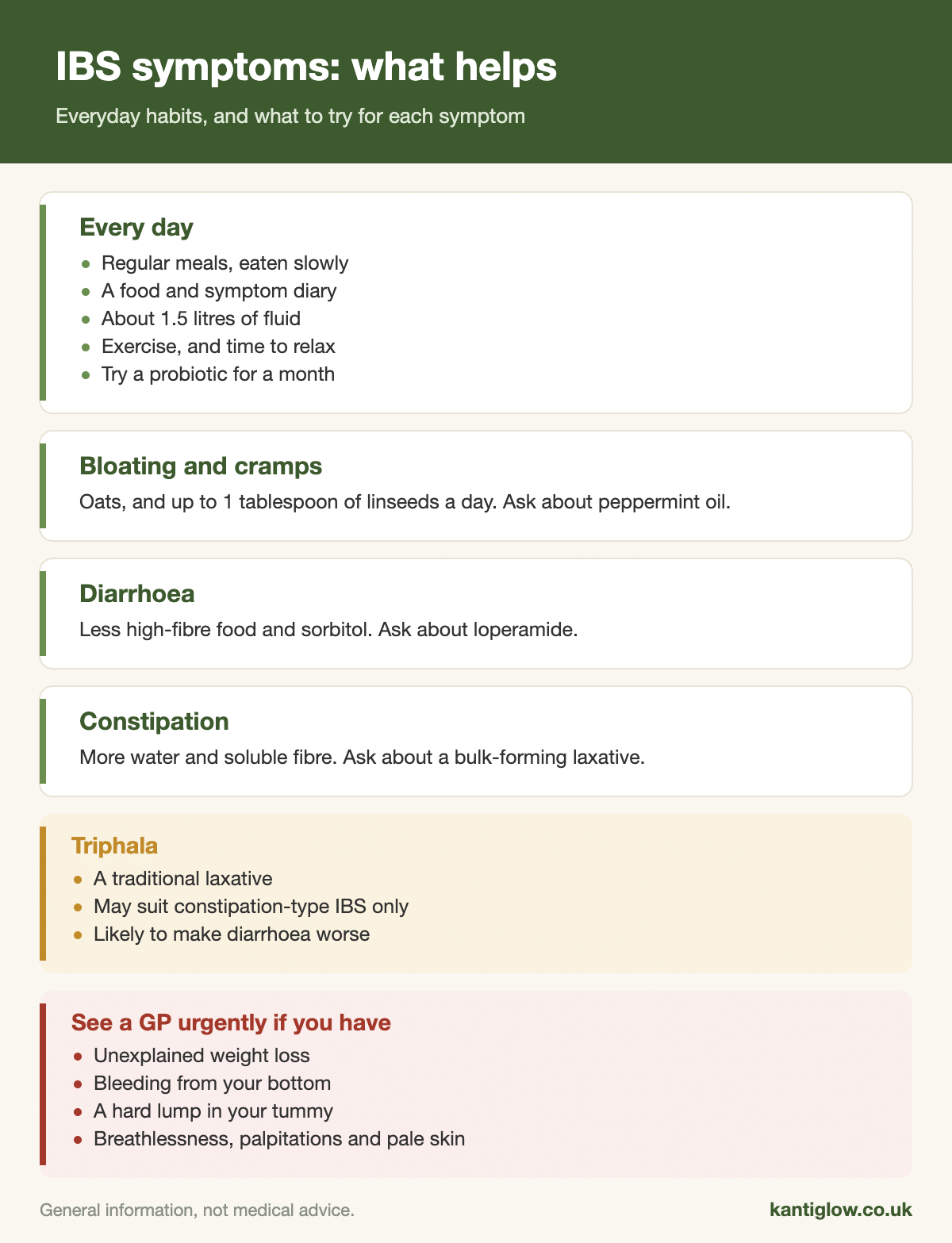
What helps IBS symptoms
Every day
- Cook and eat at home when you can, with fresh ingredients.
- Eat regular meals. Do not skip or delay them.
- Eat slowly.
- Keep a diary of what you eat and your symptoms for two to four weeks to spot triggers.
- Drink about 1.5 litres of water or other non-caffeinated fluid a day.
- Exercise regularly.
- Find ways to relax. Stress is a real and direct trigger for the gut.
- Try a probiotic for a month to see if it helps.
Cut down on
- Fatty, spicy and processed food.
- Fresh fruit beyond three portions a day.
- Tea and coffee beyond three cups a day.
- Alcohol and fizzy drinks.
By symptom
| Main symptom | Try | Ask a pharmacist about |
|---|---|---|
| Bloating, cramps and wind | Oats, such as porridge, regularly. Up to one tablespoon of linseeds a day. Avoid foods that are hard to digest, such as cabbage, broccoli, cauliflower, beans, onions and dried fruit. Avoid sorbitol | Peppermint oil capsules; antispasmodics such as mebeverine or hyoscine (Buscopan) |
| Diarrhoea | Cut down on high-fibre foods such as wholegrain bread, brown rice, nuts and seeds. Avoid sorbitol. Drink plenty of water | Loperamide (Imodium) |
| Constipation | Drink plenty of water. Increase soluble fibre: oats, pulses, carrots, peeled potatoes, linseeds | A bulk-forming laxative such as ispaghula husk (Fybogel) |
Indian food and IBS. Dal, chana, rajma, onion, garlic, cauliflower and cabbage are common triggers for bloating, as are rich, oily gravies and very hot chilli. Moong dal, rice, well-cooked vegetables, yoghurt, and cumin, fennel, ginger and asafoetida in cooking are usually better tolerated. Soaking and pressure-cooking pulses, and discarding the soaking water, reduces wind.
If these do not help
See a GP. Options include referral to a dietitian for a low FODMAP diet, a structured, temporary elimination diet that should be supervised; other medicines, including low-dose antidepressants that calm the gut’s nerves; and psychological therapies such as CBT or gut-directed hypnotherapy, which have good evidence in IBS.
Is triphala a good idea?
What it is. Triphala is a powder of three dried fruits, amla, haritaki and bibhitaki, used in Ayurveda as a bowel tonic. It comes as powder (churna), tablets and capsules.
What it does. It has a mild laxative effect, mostly from haritaki, and is astringent and rich in tannins. Small studies suggest it eases constipation. There are no good trials of triphala in IBS.
Who it might suit. People whose IBS is mainly constipation, who have tried fibre and fluid first, and who tolerate it without cramping.
Who should avoid it.
- People with diarrhoea-type or mixed IBS. A laxative is likely to make loose, urgent stools worse.
- Anyone who is pregnant or breastfeeding.
- People with unexplained tummy pain, bleeding or weight loss that has not been assessed.
- People with inflammatory bowel disease, unless their specialist agrees.
How to take it, if you do. Start with a quarter of a teaspoon of powder in warm water at bedtime, or one tablet, and increase only if needed, up to the label amount. Stop if you get cramps, urgency or loose stools. Take it two hours apart from medicines. It may lower blood sugar, so check with a pharmacist if you take diabetes medicines.
A better first choice for constipation-type IBS is ispaghula (isabgol) husk, which has good evidence and is gentler on cramps. Wheat bran, by contrast, often makes IBS worse.
Other remedies people ask about
| Remedy | What we know |
|---|---|
| Peppermint oil capsules | Good evidence for cramps and bloating |
| Probiotics | Help some people. Try one for a month |
| Isabgol (psyllium husk) | Good evidence, particularly for constipation |
| Fennel, cumin and ajwain tea | Traditional for wind. Pleasant and low risk |
| Ginger | May ease nausea |
| Asafoetida (hing) | Traditional for wind. Limited evidence |
| Aloe vera juice | Not shown to help. Can cause diarrhoea |
| Turmeric | Small, mixed studies |
| Activated charcoal | No good evidence |
| Bael (bilva) fruit, kutaj | Traditional for loose stools. Little research |
Living with IBS
Symptoms come and go, and most people find a combination of diet, routine and stress management that keeps them under control. It does not damage the bowel or raise the risk of bowel cancer. Tell your GP if your pattern changes.
IBS symptoms: frequently asked questions
What are the main IBS symptoms?
Stomach cramps, bloating, diarrhoea and constipation.
What causes IBS?
The cause is not fully known. It involves a sensitive gut, gut-brain signalling and sometimes a previous infection.
How is IBS diagnosed?
From your symptoms, after tests to rule out other conditions.
Is IBS serious?
It can be very disruptive but does not damage the bowel.
Does IBS go away?
It is usually long-term, with good and bad spells.
What triggers a flare-up?
Certain foods, alcohol, caffeine and stress.
What should I eat with IBS?
Regular, simple meals. Use a diary to find your own triggers.
Which foods cause bloating?
Beans, onions, cabbage, broccoli, cauliflower and sorbitol.
Is fibre good or bad for IBS?
Soluble fibre helps constipation. Too much insoluble fibre can worsen diarrhoea and bloating.
Do oats help?
Yes, for bloating and wind.
Do linseeds help?
Up to one tablespoon a day can.
Is fruit bad for IBS?
Limit fresh fruit to three portions a day.
Does caffeine make IBS worse?
It can. Limit to three cups a day.
Does alcohol make IBS worse?
Yes.
Is dal bad for IBS?
Some pulses cause wind. Moong dal is usually easiest.
Are onion and garlic triggers?
Often.
What is the low FODMAP diet?
A temporary, supervised elimination diet that reduces certain fermentable carbohydrates.
Should I go gluten-free?
Not before a coeliac test. Some people find less wheat helps.
Should I avoid dairy?
Only if it clearly triggers symptoms.
Do probiotics work?
They help some people. Try one for a month.
Does peppermint oil work?
Yes, for cramps and bloating.
What helps IBS diarrhoea?
Less high-fibre food and sorbitol, and loperamide when needed.
What helps IBS constipation?
Water, soluble fibre and a bulk-forming laxative.
Does stress cause IBS?
It triggers and worsens symptoms.
Does exercise help?
Yes.
Does CBT help IBS?
Yes.
What is triphala?
A powder of three dried fruits used as an Ayurvedic bowel tonic.
Does triphala help IBS?
There are no good trials. It may help constipation.
Can I take triphala with diarrhoea?
No. It is likely to make it worse.
How do I take triphala?
Follow the label, starting low, at bedtime with warm water.
What are the side effects of triphala?
Loose stools, cramps and wind.
Who should not take triphala?
Pregnant or breastfeeding women, and people with diarrhoea or unexplained bowel symptoms.
Is isabgol better than triphala for IBS?
It has stronger evidence and is gentler.
Does fennel tea help?
It is a traditional remedy for wind.
Does hing help?
It is traditionally used for wind. Evidence is limited.
Does ginger help?
It may ease nausea.
Can IBS cause tiredness?
Yes.
Does IBS cause cancer?
No.
When should I see a GP?
If symptoms have lasted more than four weeks.
When is it urgent?
With weight loss, bleeding, a lump, or breathlessness and pale skin.
Sources
- NHS: Irritable bowel syndrome (IBS), symptoms
- NHS: Irritable bowel syndrome (IBS), diet, lifestyle and medicines
- NHS: Herbal medicines
Related guides
This guide is general information, not medical advice. Herbal products and food supplements are not intended to diagnose, treat or cure any condition, including IBS. See a GP about bowel symptoms that last more than four weeks.