Quick answer: Some stiffness, slower recovery and lower stamina are common after 50, mostly because muscle is lost steadily from mid-life unless you use it. That loss is largely reversible at any age. The routine with the best evidence is simple: move every day, do strength and balance work at least twice a week, eat protein at every meal, get enough calcium and vitamin D, sleep well and keep up with health checks. Ayurvedic habits such as regular hours, warm cooked food and oil massage fit comfortably around that. If you take regular medicines, check with a pharmacist before adding any herbal product, because interactions are more likely. Tiredness that lasts weeks, or new symptoms, should be checked and not put down to age.
Key facts
- Adults lose muscle from their 30s onwards, and faster after 50, unless they do strength exercise.
- UK guidelines: be active every day, at least 150 minutes of moderate activity a week, and strength, balance and flexibility work on at least 2 days.
- The NHS Health Check is offered every 5 years to adults aged 40 to 74 in England without certain existing conditions.
- Vitamin B12 absorption falls with age and with some common medicines.
- Herbal medicines can interact with statins, blood pressure tablets, metformin, warfarin and antidepressants.
- Strength and balance exercise reduces the risk of falls.
What changes after 50?
- Muscle and strength decline, which is the main reason for feeling slower and tiring sooner.
- Joints stiffen after rest. A few minutes of morning stiffness is common; more than half an hour is not.
- Bones thin, faster in women after the menopause.
- Sleep gets lighter and more broken.
- Hormones change: the menopause in women, and a slow fall in testosterone in men.
- Metabolism: weight shifts to the middle, and blood pressure, cholesterol and blood sugar tend to rise.
- Nutrient absorption of vitamin B12 becomes less efficient, and skin makes less vitamin D.
- Medicines accumulate, and side effects become more likely.
None of these means decline is fixed. People who start strength training in their 60s, 70s and 80s still gain muscle.
A daily routine for your 50s, 60s and beyond
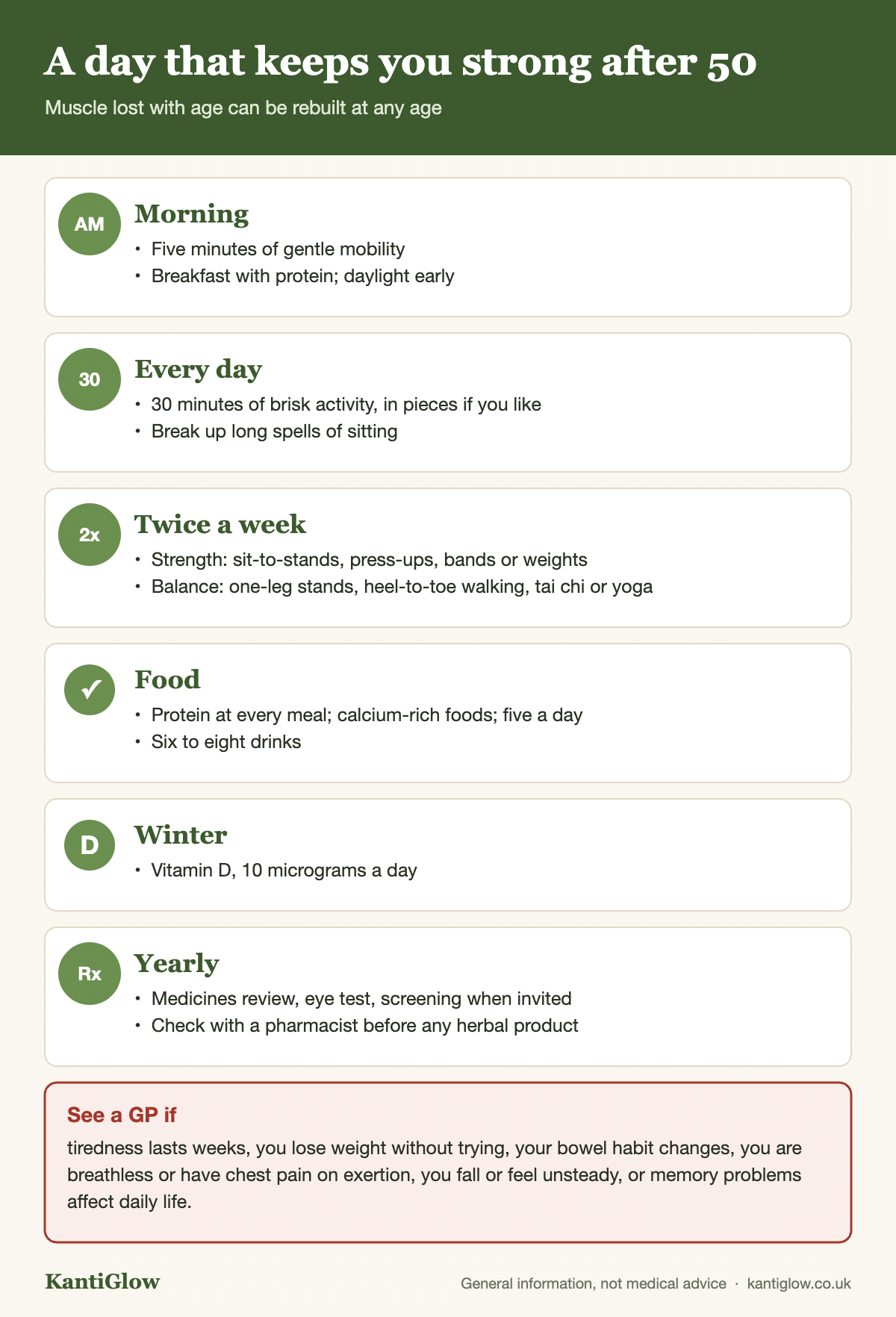
Morning
- Five minutes of gentle movement before you are fully up and about: ankle circles, knee bends, shoulder rolls, a few sit-to-stands from the bed. This eases stiffness.
- Breakfast with protein: eggs, yoghurt, dal, paneer or nut butter.
- Daylight within an hour or two of waking, to steady your body clock.
Every day
- Thirty minutes of activity that makes you a little warm and breathless: brisk walking, cycling, swimming, dancing, gardening. It can be in ten-minute pieces.
- Break up long spells of sitting. Stand and move for a couple of minutes every half hour.
At least twice a week
- Strength: sit-to-stands, wall or worktop press-ups, step-ups, carrying shopping, resistance bands or weights. Work until the last few repetitions are hard.
- Balance: standing on one leg while holding a worktop, heel-to-toe walking, tai chi or yoga.
Food
- Protein at every meal. Older adults need more protein than younger ones to maintain muscle.
- Calcium: milk, yoghurt, paneer, fortified plant milks, sesame, ragi, tinned fish with bones, greens.
- At least five portions of fruit and vegetables, wholegrains, pulses, and oily fish once a week if you eat fish.
- Six to eight drinks a day. Thirst signals weaken with age.
Evening
- A lighter, earlier supper, a fixed bedtime and a wind-down hour.
The Ayurvedic layer
Ayurveda describes later life as a time when dryness and irregularity increase, and advises warmth, regular hours, cooked and lightly spiced food, and daily oil massage. Warm sesame oil massage before a bath is pleasant for dry skin and stiff joints; take care on slippery floors. These are comforts that suit the routine above. They are not treatments.
Supplements: what is worth considering
| Supplement | Who it is for | Note |
|---|---|---|
| Vitamin D | Everyone in autumn and winter; all year if you are rarely outdoors or have dark skin | 10 micrograms a day |
| Vitamin B12 | Vegans, vegetarians, people on metformin or long-term acid-reducing tablets, if a test shows low levels | Ask your GP for a test |
| Calcium | People who cannot get enough from food | Food first |
| Protein supplement | People who struggle to eat enough | Not needed if meals contain enough protein |
Traditional Ayurvedic tonics often taken in later life include ashwagandha, amla, triphala and chyawanprash. Research on them is limited, and none can be sold as slowing ageing or restoring vitality. The more medicines you take, the more important it is to check first.
Herbs and your medicines
The NHS warns that herbal medicines can interact with prescribed medicines, including statins, antidepressants, metformin, ramipril, warfarin and the combined pill. They are also not advised for people with kidney or liver problems. Before starting any herbal product:
- Write a list of everything you take, including over-the-counter items.
- Show it to a pharmacist.
- Start one product at a time, at the label dose.
- Stop and seek advice if you notice anything new: bruising, dizziness, stomach pain, yellowing skin, a change in blood sugar or blood pressure readings.
- Tell your surgical team about herbal products before any operation.
Checks worth having
- NHS Health Check every five years from 40 to 74 in England: blood pressure, cholesterol, diabetes and kidney risk.
- Screening when invited: bowel, breast, cervical, and the aortic aneurysm scan for men at 65.
- Eye test every two years, and a hearing check if you are missing words.
- Medicines review with your GP or pharmacist once a year.
- Vaccines: flu each autumn from 65, plus others your surgery offers.
When to see a GP
See a GP about tiredness that has lasted a few weeks without a clear cause, unexplained weight loss, a change in bowel habit or blood in your stool, breathlessness or chest pain on exertion, joints stiff for more than 30 minutes each morning, a fall or new unsteadiness, memory problems that affect daily life, or any bleeding after the menopause.
Daily routine over 50: frequently asked questions
Is it normal to feel more tired after 50?
A little, but persistent tiredness should be checked.
Why am I so stiff in the morning?
Joints and muscles stiffen after rest. It should ease within minutes of moving.
Why am I losing strength?
Muscle is lost with age unless you do strength exercise.
Can I rebuild muscle after 50?
Yes, at any age.
How much exercise do I need?
At least 150 minutes of moderate activity a week, plus strength and balance work on two days.
What counts as strength exercise?
Weights, resistance bands, bodyweight exercises, heavy gardening and carrying shopping.
Is walking enough?
It is good for the heart and mood. Add strength work for muscles and bones.
Is it safe to lift weights at my age?
Yes for most people. Start light, and check with a GP if you have medical conditions.
How do I improve my balance?
Practise standing on one leg near a support, heel-to-toe walking, tai chi or yoga.
How much protein do I need?
A portion at each meal. Older adults need somewhat more than younger adults.
Do I need a protein shake?
Only if you cannot get enough from food.
Should I take vitamin D?
Yes in autumn and winter, and all year if you are rarely outdoors.
Should I take calcium?
Get it from food if you can. Supplements if your diet is short.
Should I take B12?
If a blood test shows you are low, or you are vegan.
Do multivitamins for over-50s help?
They can cover small gaps. They do not replace a good diet.
Why is my sleep worse?
Sleep becomes lighter with age. A fixed routine and daylight help.
Why am I gaining weight round the middle?
Hormone changes and muscle loss. Strength exercise helps.
Is joint pain inevitable?
No. Exercise and weight control reduce it.
How can I protect my bones?
Weight-bearing and strength exercise, calcium, vitamin D, not smoking and less alcohol.
How can I keep my memory sharp?
Stay active, social and mentally engaged, sleep well, and look after blood pressure and hearing.
What is the NHS Health Check?
A free check of heart, stroke, diabetes and kidney risk for people aged 40 to 74 in England.
How do I get an NHS Health Check?
You should be invited. If not, ask your GP surgery.
What screening am I due?
Bowel, breast and cervical screening by invitation, and an aneurysm scan for men at 65.
What is dinacharya?
The Ayurvedic daily routine of regular waking, meals, exercise and sleep.
Does oil massage help stiff joints?
Warmth and massage ease stiffness for a while. Research is limited.
Which oil should I use?
Sesame is traditional. Patch test first and take care not to slip.
Is ashwagandha suitable over 50?
Check with a pharmacist first, especially if you take thyroid, blood pressure, diabetes or sedative medicines.
Is triphala safe for older adults?
It has a mild laxative effect. Check first if you take regular medicines.
Is chyawanprash good for older people?
It is a traditional tonic. It is high in sugar and research is limited.
Does amla help with ageing?
It is a vitamin C-rich fruit. No supplement has been shown to slow ageing.
Does turmeric help ageing joints?
Small trials suggest a modest effect in knee osteoarthritis. Check interactions first.
Can herbs interact with statins?
Yes, some can. Ask a pharmacist.
Can herbs interact with blood pressure tablets?
Yes. Liquorice, for example, raises blood pressure.
Can herbs interact with warfarin?
Yes, several do. Always check.
Can I take herbs with metformin?
Some lower blood sugar further. Ask your diabetes team.
Should I stop herbs before surgery?
Tell your surgical team about everything you take.
How much water should I drink?
Six to eight glasses a day.
Is intermittent fasting safe over 50?
It can make it harder to eat enough protein. Discuss with a GP if you take diabetes medicine.
Does alcohol affect me more now?
Yes. The body processes it more slowly with age.
Am I at risk of falls?
Risk rises with age. Strength and balance exercise lowers it.
How do I make my home safer?
Clear clutter and loose rugs, use non-slip mats, and add rails where needed.
Should I have my medicines reviewed?
Yes, once a year.
Is tiredness a sign of something serious?
Usually not, but tiredness lasting weeks needs checking.
When should I see a GP?
For persistent tiredness, weight loss, bowel changes, breathlessness, falls or memory problems.
Sources
- NHS: Physical activity guidelines for older adults
- NHS: NHS Health Check
- NHS: Falls prevention
- NHS: Herbal medicines
- NHS: The Eatwell Guide
- NHS: Vitamin D
Shop this plan at KantiGlow
- The Joint & Mobility Kit
- Himalaya Organic Turmeric Tablets
- Himalaya Organic Ashwagandha 670mg
- Calcium + D3 + K2 Tablets
- Shallaki (Boswellia) Tablets
- Dabur Chyawanprakash Sugar Free
All products are authentic Indian and UK-labelled brands, sourced directly from India and dispatched within 24–72 hours (UK delivery typically 5–7 working days).
Related guides
Shop the products in this guide
- Organic India Turmeric Formula Capsules 60 — £5.99
- Dabur Ashwagandha Capsules 20 — £3.99
- Vitamin C + Zinc + Vitamin D3 Effervescent Tablets 15 — £9.99
- Dabur Amla Churna Powder — £2.99
Lab-tested, vegetarian, shipped from India. Food supplements should not replace a varied diet.
This guide is general information, not medical advice. Herbal products and food supplements are not intended to diagnose, treat or cure any condition. Speak to a GP about new or persistent symptoms, and to a pharmacist before taking a herbal product alongside medication.