
Quick answer: Poor concentration is usually caused by short sleep, stress, a phone within reach, skipped meals or too little water, and it usually improves within a week or two when those are fixed. The routine below is built around the things with the best evidence: a fixed wake-up time, the hardest task first, short timed work blocks with real breaks, caffeine only before early afternoon, a daily walk and seven to nine hours of sleep. Brahmi, the classic Ayurvedic herb for study, has some small trials suggesting a modest effect on memory after two to three months, so it will not rescue an exam next week. If poor memory or concentration is affecting your daily life, or has lasted for weeks, see a GP.
Key facts
- Stress, anxiety, low mood and poor sleep are the most common treatable causes of memory and concentration problems.
- Even mild dehydration causes tiredness and headaches. Drink enough that your pee stays pale.
- Long study sessions without breaks leave you tired and distracted. Short blocks work better.
- Up to about 400 mg of caffeine a day (roughly four mugs of coffee) is considered safe for most adults; 200 mg in pregnancy.
- No herb or supplement has an authorised UK health claim for concentration or exam performance. Some vitamins and minerals, such as iron and iodine, have claims for normal cognitive function.
- See a GP if memory or concentration problems are affecting your day-to-day life.
Why can’t I concentrate?
Everyday causes
- Too little sleep. The single biggest factor. One short night measurably reduces attention.
- Stress and worry. A mind busy with threat has little left for the task.
- Your phone. Each notification costs several minutes of refocusing, and having the phone in sight is enough to distract.
- Multitasking. Switching between tasks makes each one slower and less accurate.
- Food and water. Skipped meals, sugary snacks and not drinking enough all cause dips.
- Too much caffeine, or caffeine too late. Jitters by day, poor sleep by night.
- Alcohol. Even moderate drinking affects next-day focus.
- Sitting all day. Movement sharpens attention for an hour or two afterwards.
Medical causes worth knowing
Anaemia, an underactive thyroid, low vitamin B12, perimenopause, depression and anxiety, long Covid, sleep apnoea, and side effects of medicines such as some antihistamines, painkillers and sleeping tablets. Lifelong difficulty with attention, organisation and restlessness may be ADHD, which a GP can refer for assessment.
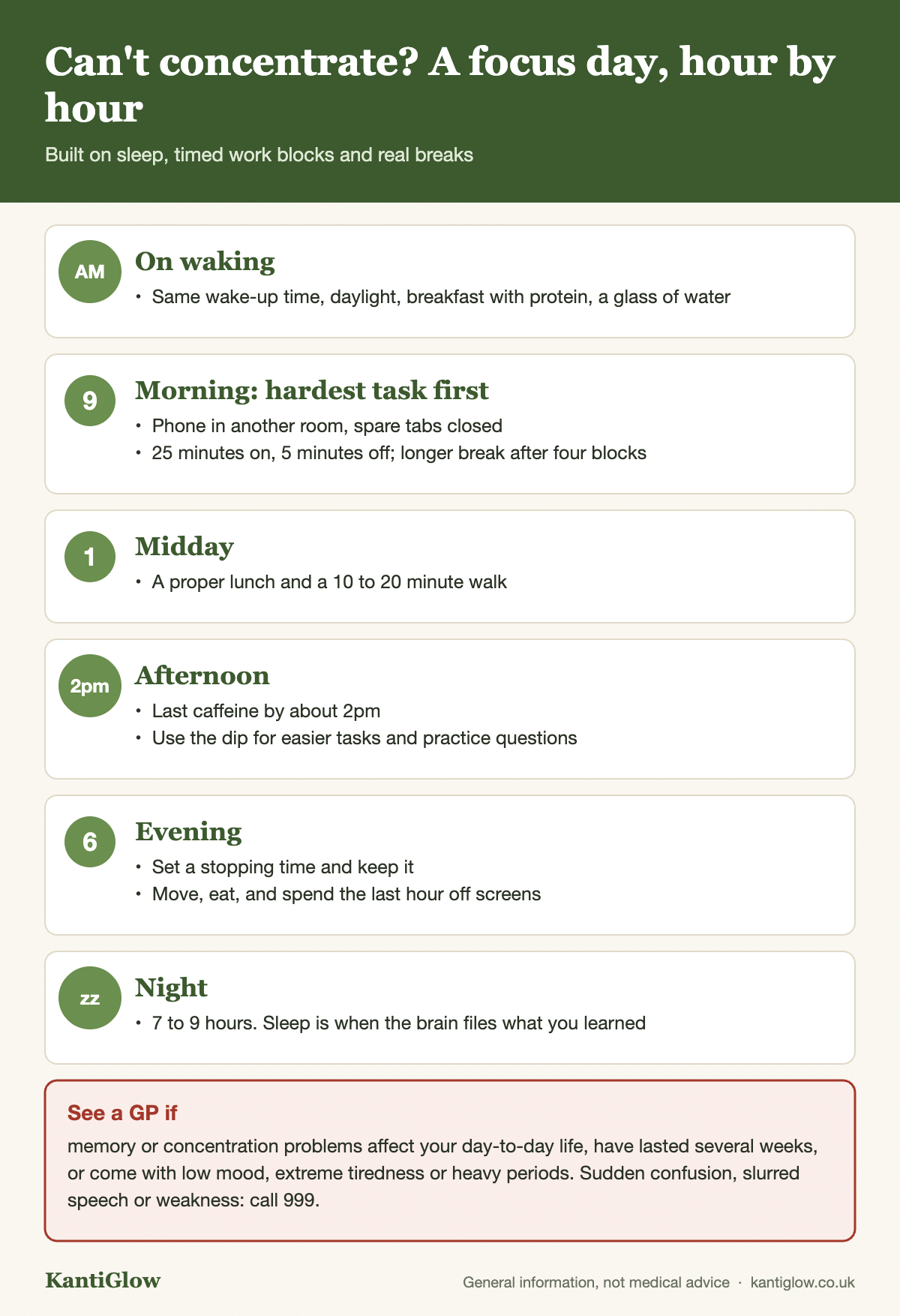
A daily focus routine
On waking. Get up at the same time every day. Open the curtains or step outside for a few minutes. Eat breakfast with some protein (eggs, yoghurt, dal, nut butter on toast) and drink a glass of water.
Morning: hardest task first. Attention is best in the first few hours. Put your phone in another room, close spare tabs, and write down the one thing you will finish.
Work in timed blocks. Twenty-five minutes on, five minutes off, and a longer break after four blocks. In the break, stand up and look away from screens. Scrolling is not a break.
Midday. Eat a proper lunch, not just a snack at the desk, and walk for 10 to 20 minutes.
Afternoon. Have your last caffeine by about 2pm. Use the afternoon dip for easier work: notes, admin, practice questions.
Evening. Set a stopping time and keep it. Move, eat, and spend the last hour away from work and bright screens.
Night. Seven to nine hours. Sleep is when the brain files what you learned. An all-nighter before an exam costs more marks than it gains.
Ayurveda’s version of this routine is close: rise early, eat regular warm meals, study in the morning, oil the scalp and feet before bed, and sleep early. The parts that match the evidence are the regular hours and the early night.
For exam weeks
- Make a realistic timetable and break subjects into small parts.
- Test yourself with past papers and flashcards. Recalling is far more effective than re-reading or highlighting.
- Space a topic over several days instead of cramming it into one.
- Take real breaks and reward yourself at the end of a session.
- Keep exercising, even if it is only a walk.
- On the day, eat a solid breakfast and take water in with you.
- If panic is taking over, tell a teacher, tutor or GP early.
Where brahmi and other herbs fit
| What it is | What the research says | Cautions | |
|---|---|---|---|
| Brahmi (Bacopa monnieri) | The traditional Ayurvedic herb for study and memory | Several small trials in adults report modest improvements on memory tests after 8 to 12 weeks. No immediate effect | Stomach upset, nausea, loose stools. Avoid in pregnancy. Check with a pharmacist if you take thyroid medicine, sedatives or medicines for the heart or bladder |
| Ashwagandha | Ayurvedic root traditionally taken as a tonic | Small trials suggest less stress; evidence for focus is thin | Not for pregnancy; check with thyroid, liver or autoimmune conditions |
| Lion’s mane | A culinary mushroom | Very small human studies; results mixed | Avoid with mushroom allergy |
| Caffeine with L-theanine (as in tea) | The combination found in green and black tea | Reasonable evidence for short-term alertness | Sleep disruption if taken late |
These are food supplements, not study aids with proven effects. Anyone under 18 should not take herbal supplements without medical advice. Never use someone else’s prescription stimulant medicine.
When to see a GP
See a GP if memory or concentration problems are affecting your day-to-day life, have lasted several weeks, or came on suddenly. Also go if they come with low mood, constant worry, extreme tiredness, heavy periods, loud snoring, or symptoms after a head injury. Sudden confusion, slurred speech, facial droop or weakness is an emergency: call 999.
Can’t concentrate: frequently asked questions
Why can’t I concentrate on anything?
Poor sleep, stress and constant phone interruptions are the usual reasons.
What is brain fog?
A general term for feeling mentally slow, forgetful and unable to think clearly. It is a symptom, not a diagnosis.
How long does brain fog last?
It usually lifts within days to weeks once sleep, stress or illness improves. See a GP if it persists.
Can lack of sleep cause poor concentration?
Yes. It is the commonest cause.
Can stress cause brain fog?
Yes. Stress, anxiety and low mood are common, treatable causes.
Can dehydration affect focus?
Yes. It causes tiredness, headaches and light-headedness.
How much water should I drink?
Enough that your pee stays pale. More in heat or when exercising.
Does breakfast help concentration?
For most people, yes, especially before an exam.
What foods help with focus?
Regular meals with protein, wholegrains, fruit, vegetables and nuts. No single food is a brain booster.
Does sugar help me concentrate?
It gives a brief lift followed by a dip.
How much caffeine is too much?
More than about 400 mg a day for most adults, or 200 mg in pregnancy.
When should I stop drinking coffee?
By early afternoon, so it does not affect your sleep.
Are energy drinks good for studying?
They are high in caffeine and sugar and often harm sleep. They are not recommended for under-16s.
Is tea better than coffee for focus?
Tea has less caffeine plus L-theanine, which some people find gives calmer alertness.
How long should I study before a break?
About 25 to 45 minutes, then five to ten minutes off.
Does the Pomodoro technique work?
Many people find timed blocks help them start and keep going.
Is multitasking bad for focus?
Yes. Switching tasks makes you slower and less accurate.
How do I stop my phone distracting me?
Put it in another room, or switch it off, while you work.
Does music help concentration?
Instrumental music helps some people with routine tasks. Lyrics tend to interfere with reading and writing.
Does exercise improve focus?
Yes, for an hour or two afterwards, and over the long term.
Is it better to study in the morning or at night?
Whenever you are most alert, as long as you still get enough sleep.
Should I pull an all-nighter before an exam?
No. Sleep is when memories are consolidated.
What is the best way to revise?
Test yourself, and spread topics over several days.
What is brahmi?
An Ayurvedic herb, Bacopa monnieri, traditionally used for memory and learning.
Does brahmi improve memory?
Small trials suggest a modest effect after 8 to 12 weeks.
How long does brahmi take to work?
At least two months in the trials that found an effect.
Is brahmi safe?
Usually well tolerated. The main side effects are nausea and loose stools.
Can students take brahmi?
Under-18s should not take herbal supplements without medical advice.
Is brahmi the same as gotu kola?
No. Both are sometimes called brahmi in India, but they are different plants.
Does ashwagandha help focus?
It may reduce stress in some adults. Evidence for concentration is limited.
Does lion’s mane work?
Human studies are very small and mixed.
Do omega-3 supplements help concentration?
Evidence in healthy adults is weak. Eating oily fish is still a good idea.
Do B vitamins help?
Only if you are low. B12 deficiency can cause memory problems.
Could low iron be the cause?
Yes. Iron deficiency causes tiredness and poor concentration, especially in women with heavy periods.
Could it be my thyroid?
An underactive thyroid can cause slowed thinking. A blood test will show it.
Could it be perimenopause?
Brain fog is a common symptom in the 40s. A GP can advise.
Could I have ADHD?
Possibly, if difficulty with attention has been lifelong and affects several parts of life. See a GP.
Can long Covid cause brain fog?
Yes. Speak to a GP if it has lasted more than a few weeks after infection.
Can medicines affect concentration?
Yes, including some antihistamines, painkillers and sleeping tablets. Ask a pharmacist.
Does alcohol affect focus the next day?
Yes, even without a hangover.
Do “smart drugs” work?
Prescription stimulants are for diagnosed conditions. Taking them without a prescription is risky and illegal to supply.
Does meditation help concentration?
Regular practice can improve attention. Ten minutes a day is a fair start.
When is forgetfulness a worry?
When it affects daily life or is steadily getting worse.
When should I see a GP?
If problems last several weeks, affect daily life, or come with other symptoms.
Sources
- NHS: Memory loss
- NHS: Tips on preparing for exams
- NHS: Insomnia
- NHS: Stress
- NHS: Dehydration
- NHS: Tiredness and fatigue
Shop this plan at KantiGlow
- Organic India Brahmi Capsules
- Sri Sri Tattva Shankhpushpi
- Brahmi + Shankhpushpi Tablets
- Tata 1mg Vegan Omega-3 Algal DHA
- HealthyHey L-Theanine
All products are authentic Indian and UK-labelled brands, sourced directly from India and dispatched within 24–72 hours (UK delivery typically 5–7 working days).
Related guides
Shop the products in this guide
- Sri Sri Tattva Brahmi 500mg Tablets 60 — £4.99
- Herb Essential Shankhpushpi Tablets 60 — £6.99
- Tata 1mg Omega-3 Algal DHA Capsules — £14.99
- Organic India Tulsi Capsules 250 — £7.99
Lab-tested, vegetarian, shipped from India. Food supplements should not replace a varied diet.
This guide is general information, not medical advice. Herbal products and food supplements are not intended to diagnose, treat or cure any condition. Speak to a GP about memory or concentration problems that persist, and to a pharmacist before taking a supplement if you take medication.