Quick answer: Most bloating after meals comes from one of five things: eating fast and swallowing air, constipation, a food your gut handles badly (often onions, garlic, beans, wheat or milk), fizzy drinks, or irritable bowel syndrome. Start with the free fixes the NHS recommends: slow down, eat smaller meals, walk after eating, and sort out constipation. Give each change a week so you can tell what worked. Ayurvedic kitchen remedies such as jeera or fennel tea, isabgol and triphala can sit alongside those steps, but they are not treatments, and bloating that lasts three weeks or keeps coming back needs a GP.
Key facts
- Bloating is very common and usually harmless, but the NHS says to see a GP if it lasts 3 weeks or more, or happens more than 12 times a month.
- Constipation is one of the most common causes, and the easiest to fix.
- A 10 to 15 minute walk after a meal helps gas move through.
- Adding fibre too quickly makes bloating worse before it gets better.
- Do not cut out gluten before a coeliac blood test. It can give a false negative.
- No herb or supplement is proven to cure bloating. Some help some people.
Why am I bloated after every meal?
Bloating is the feeling of a full, tight or swollen tummy. Two things cause it: extra gas in the gut, or a gut that is more sensitive to a normal amount of gas. The usual reasons are:
- Swallowed air. Eating quickly, talking while eating, chewing gum, drinking through a straw and fizzy drinks all push air into the stomach.
- Constipation. Stool sitting in the bowel slows everything behind it and gives gut bacteria longer to ferment food.
- Fermentable foods. Onions, garlic, beans, lentils, cabbage, wheat, apples and sweeteners ending in “-ol” are fermented by gut bacteria and produce gas. These are the foods grouped as FODMAPs.
- Lactose. Many adults, and most adults of South Asian, East Asian and African heritage, digest milk sugar poorly.
- Irritable bowel syndrome (IBS). Bloating with cramps and a changing bowel habit that comes and goes for months.
- Hormones. Many women bloat in the days before a period.
- Less common causes. Coeliac disease, and rarely something more serious such as ovarian cancer, which is why persistent bloating should be checked.
The 4-week plan
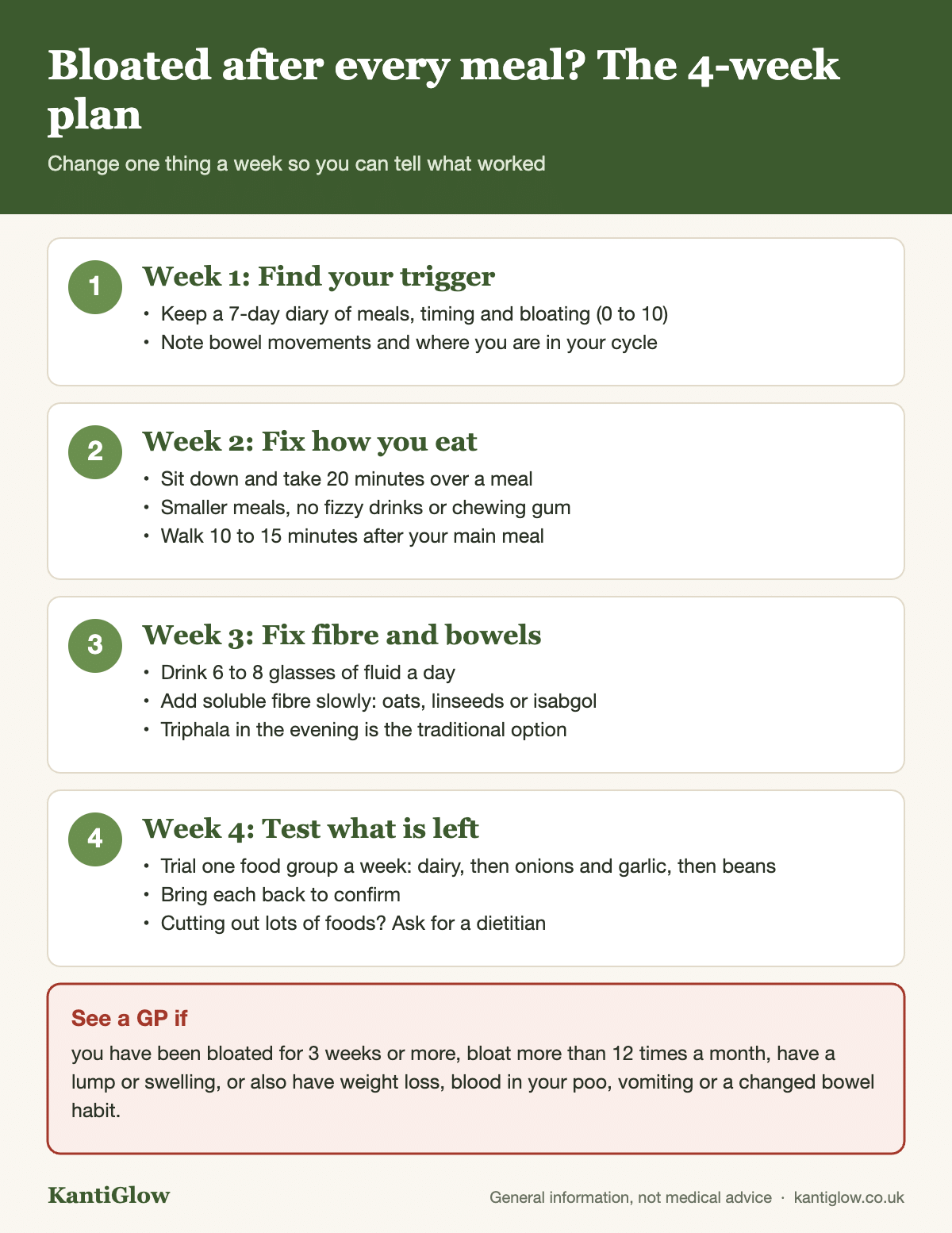
Change one thing at a time. If you change everything in week one you will never know what helped.
Week 1: Find your trigger
Keep a simple diary for seven days: what you ate, when, and how bloated you felt two hours later on a 0 to 10 scale. Note bowel movements too. Patterns usually show within a week: always after lunch at your desk, always after dal, always worse before a period.
Week 2: Fix how you eat
- Sit down, and take at least 20 minutes over a meal.
- Chew with your mouth closed and put the fork down between bites.
- Eat smaller meals more often instead of two large ones.
- Stop fizzy drinks and chewing gum for the week.
- Walk for 10 to 15 minutes after your main meal.
- Finish eating two to three hours before bed.
Ayurveda gives the same advice in different words: eat your main meal at midday when digestion (agni) is strongest, eat warm cooked food, and do not eat until the last meal has gone down.
Week 3: Fix fibre and bowels
If you are not going to the toilet most days, treat the constipation first. Drink six to eight glasses of fluid a day. Add soluble fibre slowly: oats, linseeds, or isabgol (psyllium husk). Start with one level teaspoon of isabgol in a full glass of water once a day, and stay there for several days before increasing. Bran and large amounts of raw vegetables tend to make gas worse.
Triphala is the traditional Ayurvedic choice at this stage, taken in the evening. It acts as a mild laxative for some people. Trials are small, so treat it as something to try, not a proven fix.
Week 4: Test what is left
If you are still bloated, test one suspect food group at a time for a week each: first milk and soft dairy (switch to lactose-free), then onions and garlic, then beans and lentils. Bring each back afterwards to confirm. If you find yourself cutting out many foods, stop and ask a GP for a dietitian referral. A full low FODMAP diet should be done with a dietitian, not alone.
Which Ayurvedic remedies are worth trying?
| Remedy | How it is used | What the evidence says |
|---|---|---|
| Jeera, fennel or CCF tea (cumin, coriander, fennel) | Sipped warm after meals | Traditional. Very little trial evidence, but warm fluid after food is harmless and many people find it soothing. |
| Ajwain and hing | A pinch cooked into dal and beans | Traditional way to make pulses easier to digest. Little human research. |
| Ginger | Fresh in food or tea | Reasonable evidence for nausea, weaker for bloating. |
| Isabgol (psyllium) | With a full glass of water | Good evidence for constipation, and soluble fibre is what NICE prefers for IBS. Can cause gas at first. |
| Triphala | Evening, tablet or powder | Small studies suggest a mild laxative effect. Not well studied. |
| Peppermint oil capsules | From a pharmacy | Not Ayurvedic, but has the best evidence of any over-the-counter option for IBS cramps and bloating. |
| Probiotics | Daily for four weeks | The NHS suggests trying one for a month and stopping if it does not help. |
What a pharmacist can offer
A pharmacist can suggest simeticone for wind, Buscopan or peppermint oil for cramps, and a laxative if you are constipated. You do not need an appointment.
When to see a GP
See a GP if you have felt bloated for three weeks or more, you bloat regularly (more than 12 times a month), diet changes have not helped, or you have a swelling or lump in your tummy. Also go if bloating comes with weight loss you cannot explain, blood in your poo, vomiting, diarrhoea or constipation that will not settle, or pain that stops you sleeping. Call 999 or go to A&E for sudden severe tummy pain, pain when you touch your tummy, vomiting blood, or if you cannot pass urine, stool or wind.
Who should not follow this plan without advice
If you are pregnant or breastfeeding, take regular medicines, have inflammatory bowel disease, or have had bowel surgery, speak to a pharmacist or GP before taking triphala, isabgol or any herbal product. Take isabgol at least two hours apart from medicines.
Bloated after eating: frequently asked questions
Why do I get bloated straight after eating?
Bloating within minutes is usually swallowed air or a sensitive gut reacting to the stomach stretching. Gas from fermented food takes a few hours to form.
Why am I bloated every evening but flat in the morning?
Gas and food build up through the day and clear overnight. This pattern is typical of harmless functional bloating and IBS.
How long does bloating last?
A single episode usually settles within a few hours to a day. Bloating that is there most days for three weeks should be checked by a GP.
What relieves bloating fast?
A short walk, a warm drink, and massaging your tummy from right to left can help gas move. Simeticone from a pharmacy is another option.
Does drinking water help bloating?
Yes, if constipation is part of the cause. Water also makes fibre work properly.
Does hot water with lemon reduce bloating?
There is no evidence lemon does anything specific. The warm fluid may help you feel more comfortable.
Is bloating a sign of something serious?
Usually not. Persistent bloating can occasionally be a sign of coeliac disease or ovarian cancer, which is why the three-week rule matters.
Can stress cause bloating?
Yes. The gut and brain are closely linked, and stress can make the gut more sensitive and change how fast food moves.
Why am I bloated before my period?
Hormone changes cause fluid retention and slow the bowel. It normally eases once the period starts.
Can constipation cause bloating?
Yes, it is one of the commonest causes. Treating the constipation often fixes the bloating.
Which foods cause the most bloating?
Onions, garlic, beans, lentils, cabbage, cauliflower, wheat, apples, fizzy drinks and sugar-free sweets are frequent culprits.
Does dal cause bloating?
It can. Soaking lentils, rinsing them well, cooking them thoroughly and adding hing, ginger or ajwain is the traditional way to reduce gas.
Does roti or bread cause bloating?
Wheat contains fermentable fructans, so some people bloat with it. That is not the same as coeliac disease.
Should I go gluten-free?
Not before a coeliac blood test. You need to be eating gluten for the test to be accurate.
Could it be lactose intolerance?
Possibly, especially if milk, ice cream or soft cheese set it off. Try lactose-free milk for a week and see.
Is chai making me bloated?
It might, because of the milk or because of caffeine on an empty stomach. Try it after food or with lactose-free milk.
What is CCF tea?
It is a tea of cumin, coriander and fennel seeds, a traditional Ayurvedic after-meal drink. Evidence is limited but it is safe for most adults.
Does jeera water help bloating?
Many people find it soothing. There is little research, so treat it as a comfort measure.
Does fennel help with gas?
Fennel seeds are traditionally chewed after meals for this. Trial evidence in adults is thin.
Does ginger help bloating?
Ginger has good evidence for nausea and may help the stomach empty. Evidence for bloating itself is weaker.
Does triphala help bloating?
It may help if constipation is behind it, because it has a mild laxative effect. It is not a proven bloating treatment.
When should I take triphala?
Traditionally in the evening with warm water. Follow the label and do not exceed the stated amount.
Can I take triphala every day?
Short-term use is the cautious choice. If you need a laxative daily for weeks, see a GP.
Does isabgol cause bloating?
It can for the first week or two. Start with a small amount and increase slowly.
How much water should I take with isabgol?
At least a full 250 ml glass with each serving, drunk straight away, and more fluid through the day.
Is isabgol better in the morning or at night?
Either works. Pick a time you will stick to and keep it two hours away from medicines.
Do probiotics help bloating?
Some people find they do. The NHS advice for IBS is to try one for a month and stop if there is no change.
Does apple cider vinegar help?
There is no good evidence it helps bloating, and it can irritate the stomach and damage tooth enamel.
Does peppermint tea help?
Peppermint oil capsules have decent evidence for IBS. Tea is much weaker, though it may feel soothing.
Can I take simeticone with herbal remedies?
Simeticone is not absorbed and has few interactions. Check with a pharmacist if you take other medicines.
Do I have IBS?
IBS is likely if you have had tummy pain, bloating and a changed bowel habit on and off for months. A GP diagnoses it after ruling out other causes.
What is the low FODMAP diet?
It is a short-term diet that removes fermentable carbohydrates and then reintroduces them. It should be supervised by a dietitian.
Does walking after meals help?
Yes. A 10 to 15 minute walk helps gas move through the gut.
Does eating late cause bloating?
Large late meals are a common trigger. Try to finish two to three hours before bed.
Can drinking with meals cause bloating?
Normal amounts of water do not. Fizzy drinks and gulping do.
Why is my stomach hard and swollen?
Gas and constipation are the usual reasons. A swelling or lump that does not go down needs a GP appointment.
Can antibiotics cause bloating?
Yes, they can disturb gut bacteria for a few weeks. It normally settles.
Can weight-loss injections cause bloating?
Bloating, constipation and nausea are known side effects of GLP-1 medicines. Tell your prescriber if they persist.
Is bloating common in menopause?
Yes, hormone changes affect the gut. New, persistent bloating after 50 should still be checked.
Can children follow this plan?
The eating habits are fine for children. Do not give triphala, isabgol or other herbal products to a child without medical advice.
Is bloating the same as weight gain?
No. Bloating comes and goes within hours and changes through the day.
How long should I try the plan before seeing a GP?
If you have already been bloated for three weeks, book now and follow the plan while you wait.
What tests will a GP do?
Often a blood test for coeliac disease and anaemia, sometimes a stool test, and for women a CA125 blood test if ovarian causes need ruling out.
Can I take hing tablets every day?
Small amounts of hing in food are fine. For tablets, follow the label and avoid them in pregnancy.
Sources
- NHS: Bloating
- NHS: Irritable bowel syndrome (IBS)
- NHS: Constipation
- NICE CG61: Irritable bowel syndrome in adults
- British Dietetic Association: IBS and diet food fact sheet
- Coeliac UK: Getting diagnosed
Shop this plan at KantiGlow
- The Digestion Kit (triphala + isabgol)
- Himalaya Triphala Capsules
- Organic India Sat Isabgol
- Health Veda Probiotics 50 Billion
- ZeroHarm Prebiotics + Probiotics
All products are authentic Indian and UK-labelled brands, sourced directly from India and dispatched within 24–72 hours (UK delivery typically 5–7 working days).
Related guides
Shop the products in this guide
- Organic India Sat Isabgol Psyllium Husk Capsules 100g — £7.99
- Ayurvedic Life Triphala Churna Powder 200g — £6.99
- Health Veda Probiotics CFU 50Billion Capsules — £16.99
- KantiGlow Selection Hing Goli — £3.99
Lab-tested, vegetarian, shipped from India. Food supplements should not replace a varied diet.
This guide is general information, not medical advice. Food supplements and herbal products are not intended to diagnose, treat or cure any condition. Speak to a GP or pharmacist about symptoms that persist, and before taking a supplement if you are pregnant, breastfeeding or on medication.