Quick answer: The things that make the biggest visible difference to skin are on the outside: sunscreen every day, not smoking, a retinoid at night and a plain moisturiser. Sleep and diet come next. Collagen supplements come last. Some trials show small improvements in skin hydration and elasticity after 8 to 12 weeks, but most were funded by manufacturers, and the effect shrinks in independent studies. Amla is a good food source of vitamin C, which your body needs to make its own collagen, but most people already get enough vitamin C from food. If you want to try collagen, give it 12 weeks alongside the basics and judge honestly.
Key facts
- Sun exposure is the main cause of visible skin ageing. Use SPF 30 or higher with at least 4-star UVA protection.
- In the UK the sun is strongest between 11am and 3pm from March to October.
- Smoking ages skin. So do sunbeds.
- Vitamin C contributes to normal collagen formation for the normal function of skin. Adults need 40 mg a day, which a varied diet provides.
- Collagen supplements are digested into amino acids and small peptides. They are not delivered whole to your skin.
- Collagen is made from animal sources (cattle, fish, chicken). There is no true vegan collagen.
Why does skin look dull or older?
- Sun. Ultraviolet light breaks down collagen and causes uneven pigment, years before lines appear.
- Dryness. Central heating, hot showers, harsh cleansers and cold wind strip the skin’s barrier, so it reflects less light.
- Slower cell turnover. With age, dead cells stay on the surface longer.
- Smoking and alcohol.
- Short sleep and stress.
- Hormones. Skin gets drier and thinner around the menopause.
- Diet. Too little protein, fruit and vegetables.
- Medical causes. Anaemia, an underactive thyroid and eczema can all make skin look pale, dry or rough.
What works, ranked by evidence
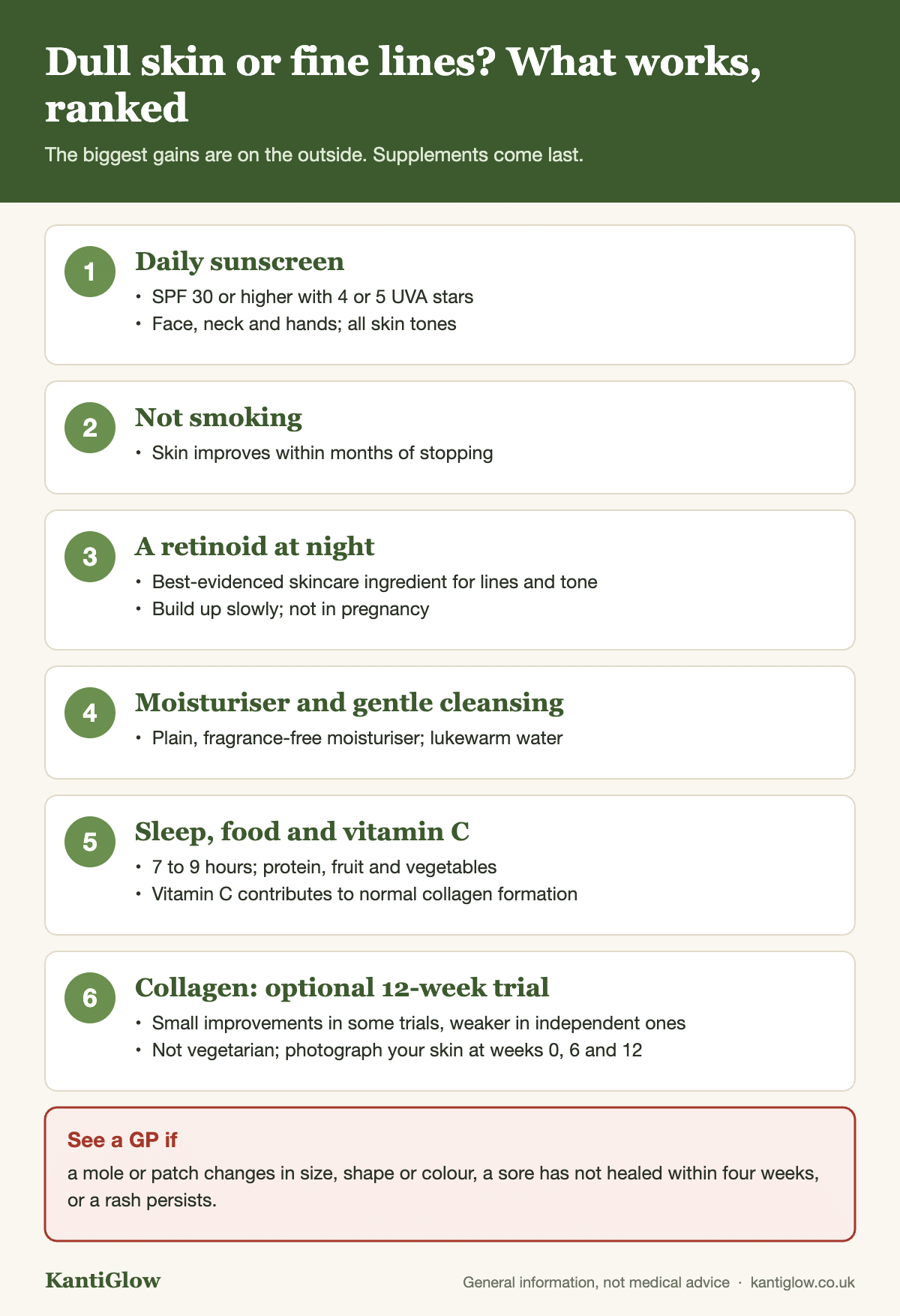
1. Daily sunscreen. SPF 30 or higher with 4 or 5 UVA stars, on face, neck and hands, every morning from March to October and on bright winter days. This applies to brown and black skin too: it burns less easily but still develops dark patches and uneven tone from sun.
2. Not smoking. Stopping improves skin within months.
3. A retinoid at night. Retinol, which you can buy, or tretinoin on prescription, has the best evidence of any skincare ingredient for fine lines and uneven tone. Start two nights a week and build up, because it can irritate. Do not use retinoids if you are pregnant or trying to conceive.
4. Moisturiser and gentle cleansing. A plain, fragrance-free moisturiser makes skin look better within days. Wash with lukewarm water and a mild cleanser. Exfoliate gently, at most once or twice a week.
5. Sleep, food and vitamin C. Seven to nine hours of sleep. Protein at each meal, plenty of fruit and vegetables, oily fish or nuts and seeds. A vitamin C serum in the morning has reasonable evidence for brightening.
6. Collagen supplements. Optional. See below.
Do collagen supplements work?
Collagen is the main structural protein in skin, and the body makes less of it with age. Supplements contain hydrolysed collagen: collagen broken into small peptides so it dissolves.
- What trials show. Pooled results of many small trials report modest improvements in skin hydration and elasticity after 8 to 12 weeks of 2.5 to 10 g a day.
- The catch. Most trials were paid for by companies that sell collagen. Analyses that look separately at independently funded, higher-quality trials find the benefit gets much smaller or disappears.
- How it might work. Collagen peptides are digested like any protein. The theory is that certain peptides signal skin cells to make more collagen. That is not proven in people.
- Safety. Generally well tolerated. Some people get bloating or a bad taste. Marine collagen is unsuitable if you have a fish allergy.
- Diet. Bovine and marine collagen are not vegetarian. “Vegan collagen” products contain vitamin C and amino acids, not collagen.
A fair summary: collagen might help a little, it will not hurt most people, and it does much less than sunscreen.
Where amla fits
Amla (Indian gooseberry) is one of the richest fruit sources of vitamin C and is used in Ayurveda as a rejuvenating food. Vitamin C is needed for the body to form collagen, and that is an authorised claim. Two caveats: adults need only 40 mg a day, which a portion of fruit or vegetables covers, and the vitamin C in dried amla powder varies and falls with processing and storage. Human trials of amla for skin are few and small.
Eat amla, or take it as powder or tablets, as part of a diet rich in fruit and vegetables. Do not expect it to act as a skin treatment. Taking more than 1,000 mg of vitamin C a day from supplements can cause stomach pain and diarrhoea.
A 12-week routine
| When | What |
|---|---|
| Every morning | Gentle cleanse, vitamin C serum if you use one, moisturiser, sunscreen |
| Every night | Cleanse, retinoid (build up slowly), moisturiser |
| Daily | Protein at each meal, five portions of fruit and vegetables, enough water, 7 to 9 hours of sleep |
| Daily, optional | Collagen 2.5 to 10 g, and amla as food or supplement |
| Weeks 0, 6 and 12 | Photograph your face in the same light, without make-up |
Skin cells take about a month to turn over, and collagen changes take longer, so twelve weeks is a fair trial. Compare the photos, not your memory.
Traditional Ayurvedic skin care adds oil massage, a gram flour and turmeric cleansing paste, and a diet of fresh, cooked food. These are pleasant and mostly harmless. Turmeric can stain, and any home paste can irritate sensitive skin, so patch test first.
When to see a GP
See a GP about a mole or patch that changes in size, shape or colour, a sore that does not heal within four weeks, a rash that persists, or skin that has become very dry or pale along with tiredness or feeling cold. A pharmacist can advise on dry skin, mild eczema and which products to try.
Dull skin: frequently asked questions
Why does my skin look dull?
Usually dryness, a build-up of dead surface cells, sun damage and too little sleep.
How can I brighten my skin?
Sunscreen daily, moisturiser, gentle exfoliation once or twice a week and enough sleep.
At what age does skin start ageing?
Collagen production slows from the mid-20s. Sun exposure determines how soon it shows.
What is the single best anti-ageing product?
Sunscreen.
Do I need sunscreen in a UK winter?
The risk is lower from October to March, but UVA still reaches skin on bright days and through glass.
Do people with brown or black skin need sunscreen?
Yes. It helps prevent dark patches and uneven tone as well as sun damage.
What SPF should I use?
At least SPF 30 with 4 or 5 UVA stars.
What is retinol?
A form of vitamin A used on the skin that speeds cell turnover and supports collagen.
Is retinol safe?
For most adults, yes. It can cause dryness and peeling at first. Do not use it in pregnancy.
Does drinking water improve skin?
Only if you are dehydrated. Moisturiser does more for dry skin.
Does sleep affect skin?
Yes. Poor sleep makes skin look paler and more tired.
Does sugar age skin?
A very high-sugar diet may contribute. The evidence in people is limited.
Does smoking age skin?
Yes, markedly.
What is collagen?
The main structural protein in skin, bones and tendons.
Do collagen supplements work?
Some trials show small improvements, but independent studies are less positive.
How long does collagen take to work?
Trials that found an effect ran for 8 to 12 weeks.
How much collagen should I take?
Trials used 2.5 to 10 g a day. Follow the label.
Is marine collagen better than bovine?
There is no good evidence that one is better.
Powder, tablets or liquid?
It makes no difference to the effect. Powders make it easier to reach a full dose.
When should I take collagen?
Any time of day, with or without food.
Are there side effects?
Occasionally bloating, heartburn or an unpleasant taste.
Is collagen vegetarian or halal?
It is not vegetarian. Halal-certified bovine and marine collagen products exist; check the label.
Is there vegan collagen?
No. Vegan products supply vitamin C and amino acids instead.
Can I take collagen in pregnancy?
There is little safety data. Ask your midwife or GP.
Does collagen help joints or hair?
Evidence for both is limited.
Do collagen creams work?
Collagen molecules are too large to penetrate skin. Such creams work as moisturisers.
Can I get collagen from food?
Bone broth and meat with skin contain collagen, but the body breaks it down like any protein.
What is amla?
Indian gooseberry, a sour fruit rich in vitamin C.
Is amla good for skin?
It supplies vitamin C, which the body needs to make collagen. Direct evidence for skin is limited.
Should I take amla with collagen?
Vitamin C is needed for collagen formation, but most diets already provide enough.
Amla juice, powder or tablets?
All supply vitamin C in varying amounts. Juice may contain added sugar.
How much vitamin C do I need?
40 mg a day for adults.
Can I take too much vitamin C?
More than 1,000 mg a day can cause stomach pain and diarrhoea.
Do vitamin C serums work?
They have reasonable evidence for brightening and uneven tone.
Does hyaluronic acid help?
On the skin it holds water and plumps temporarily.
Does turmeric brighten skin?
It is a traditional ingredient in face packs. Evidence is limited, and it can stain.
Is a besan (gram flour) face pack good?
It works as a gentle cleanser for some people. Stop if it dries or irritates your skin.
Does facial massage or oiling help?
It feels good and adds moisture. It will not reverse lines.
Are skin-lightening creams safe?
Many sold informally contain steroids, hydroquinone or mercury and can cause serious harm. Avoid them.
Does menopause affect skin?
Yes. Falling oestrogen makes skin drier and thinner.
Do facials or peels work?
Professional peels can help tone and texture. Results depend on the practitioner and product.
How long before I see results from a routine?
Moisturiser works in days. Retinoids and sunscreen take three to six months.
Can diet alone fix my skin?
A good diet helps, but sun protection matters more.
When should I see a GP about my skin?
For changing moles, sores that do not heal, or persistent rashes.
Sources
- NHS: Sunscreen and sun safety
- NHS: Vitamin C
- Great Britain nutrition and health claims register
- NHS: Tiredness and fatigue
Shop this plan at KantiGlow
- Japanese Marine Collagen Powder
- Tata 1mg Marine Collagen + Grape Seed
- UC-II Undenatured Type II Collagen
- Organic India Amla Powder 200g
- The Skin & Hair Kit
All products are authentic Indian and UK-labelled brands, sourced directly from India and dispatched within 24–72 hours (UK delivery typically 5–7 working days).
Related guides
Shop the products in this guide
- Nutrabud Multi Collagen Complex Powder — £12.99
- Organic India Amalaki Capsules 60 — £7.99
- Elecious Neem Powder 200g — £5.99
- Organic India Turmeric Formula Capsules 60 — £5.99
Lab-tested, vegetarian, shipped from India. Food supplements should not replace a varied diet.
This guide is general information, not medical advice. Food supplements are not intended to diagnose, treat or cure any condition and are not a substitute for a varied diet. See a GP about moles that change or skin problems that persist.
Pingback: 8-Week Ayurvedic Hair & Scalp Routine (UK Guide) | KantiGlow