Quick answer: Greens powders do not replace vegetables and do not count towards your five a day. A portion is 80 g of fruit or vegetables, and a teaspoon of powder is a few grams of dried leaf or algae with most of the fibre, water and bulk of a real portion missing. As a top-up they can add some nutrients: moringa and spirulina supply a little iron and protein, wheatgrass supplies vitamin K, and sea moss supplies iodine, sometimes far too much. Each has people who should avoid it. The cheaper and better fix is to make vegetables easier: frozen veg, tinned tomatoes, dal and fruit with breakfast get most people to five without any powder.
Key facts
- One portion is 80 g of fresh, frozen or tinned fruit or vegetables, or 30 g of dried fruit.
- Beans and pulses count once a day, however much you eat. So do juice and smoothies, limited to 150 ml.
- Potatoes do not count. Sweet potatoes, parsnips, swedes and turnips do.
- Greens powders are not listed among foods that count towards five a day.
- Adults need 140 micrograms of iodine a day, and the NHS says supplements of 0.5 mg or less are unlikely to cause harm. Seaweed products can exceed that.
- “Superfood” has no legal or scientific definition.
Why powders are not a substitute
- Amount. A level teaspoon of powder weighs about 3 to 5 g. Even allowing for the water removed in drying, that is a fraction of an 80 g portion.
- Fibre. Vegetables fill you up and feed gut bacteria. A teaspoon of powder provides a gram or two of fibre at most.
- Variety. The benefit of five a day comes from eating many different plants. A single powder is one plant.
- Evidence. The studies linking fruit and vegetables with lower rates of heart disease and cancer are about whole foods. Powders have not been tested that way.
- Cost. Per gram of actual plant, powders are among the most expensive ways to buy vegetables.
They are not useless. Think of them as a seasoning with some nutrients, not as a vegetable.
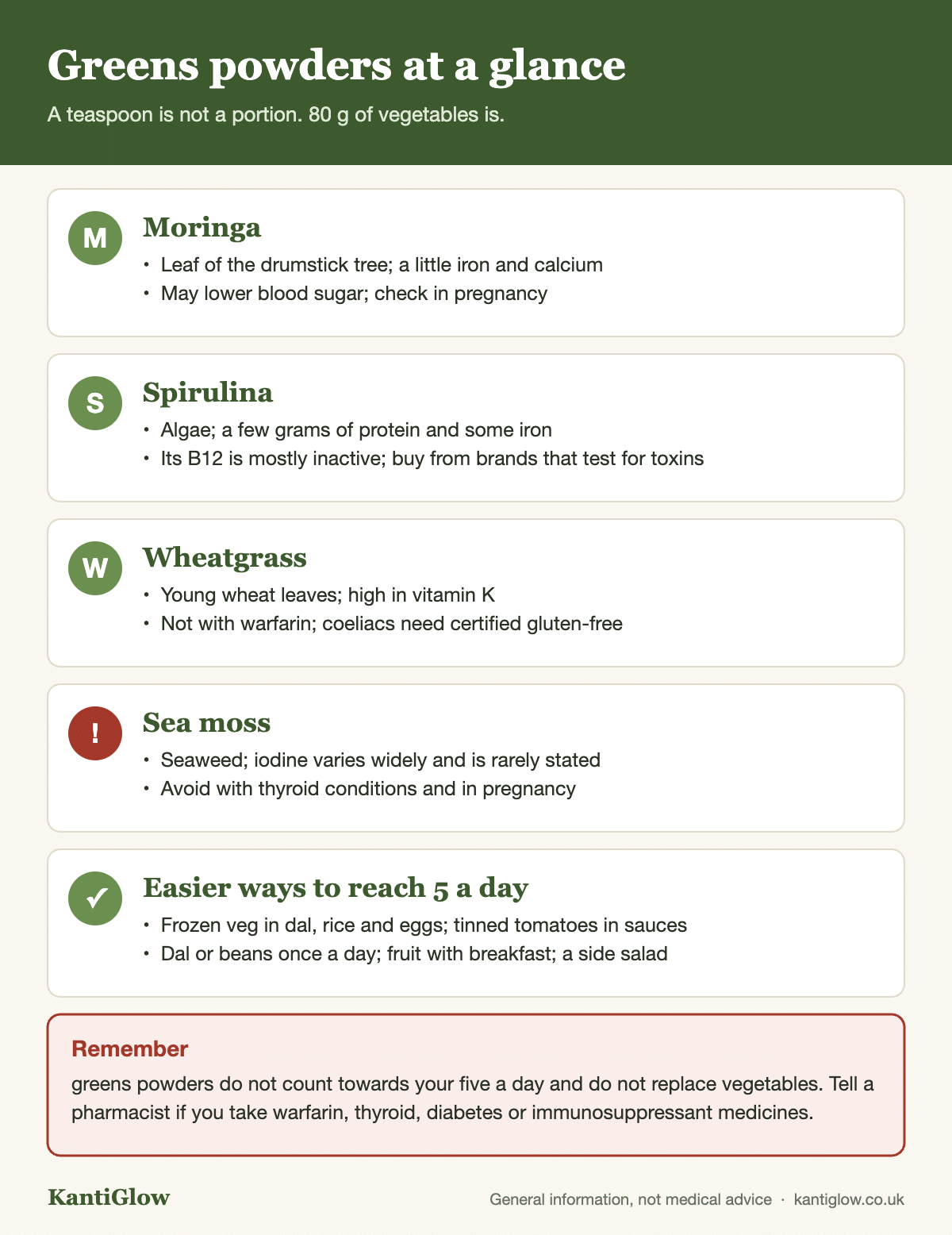
The four powders compared
| Moringa | Spirulina | Wheatgrass | Sea moss | |
|---|---|---|---|---|
| What it is | Dried leaves of the drumstick tree | A blue-green algae | Young shoots of the wheat plant | A red seaweed (Irish moss) |
| Tradition | Eaten as a vegetable across India and Africa; used in Ayurveda | Modern supplement | Modern juice-bar staple | Caribbean and Irish folk food |
| What a teaspoon adds | A little iron, calcium, vitamin A and protein | About 2 to 3 g of protein, some iron | Vitamin K, a little iron | Iodine, in amounts that vary widely |
| Common claims that do not hold up | “Cures” anything; blood sugar treatment | A reliable source of vitamin B12 (most of it is an inactive form) | “Detoxes” or “alkalises” the body | “92 minerals”, thyroid cure, immunity |
| Who should avoid or check first | Pregnancy (avoid root and bark; check before leaf supplements); people on diabetes, blood pressure or thyroid medicines | People with phenylketonuria, autoimmune conditions or gout; those on blood thinners or immunosuppressants | People on warfarin; people with coeliac disease unless certified gluten-free | Anyone with a thyroid condition or on thyroid medicine; pregnancy; children |
| Quality concerns | Generally low | Can be contaminated with toxins from other algae and with heavy metals. Buy from a brand that tests | Possible gluten cross-contamination; can cause nausea | Heavy metals, and iodine content is rarely stated |
Moringa
Moringa leaves are a real vegetable, eaten fresh in dal and curries. The dried powder is a reasonable way to add a little iron and calcium to food, and it suits vegetarian diets. Small studies suggest it can lower blood sugar slightly, which matters only if you take diabetes medicine. Start with half a teaspoon in dal, soup or a smoothie. Large amounts can cause loose stools.
Spirulina
Spirulina is around 60% protein by weight, but a teaspoon still gives only a few grams. It contains iron. The vitamin B12 on many labels is largely pseudo-B12, which the body cannot use, so vegans should not rely on it. Because it is grown in open water, quality control matters more than with the others.
Wheatgrass
Wheatgrass is the leaf of the wheat plant, harvested before the grain forms, so pure wheatgrass contains no gluten. Cross-contamination is common, though, so people with coeliac disease should only use products certified gluten-free. It is high in vitamin K, which works against warfarin. There is no evidence it detoxifies or alkalises anything.
Sea moss
Sea moss is the one to be most careful with. Seaweeds concentrate iodine, the amount varies enormously between batches, and labels rarely state it. Too much iodine over time can disturb thyroid function, the opposite of what many sellers claim. Seaweed can also contain arsenic, cadmium and lead. If you take it at all, keep to small amounts, not every day, and avoid it if you have a thyroid condition or are pregnant.
Easier ways to reach five a day
- Frozen vegetables. Peas, spinach, sweetcorn, mixed veg and okra are as nutritious as fresh, cheap, and need no chopping. Add a handful to dal, rice, eggs or noodles.
- Tinned tomatoes in every curry or sauce.
- Dal or beans once a day.
- Fruit with breakfast: a banana, berries on porridge, or an orange.
- A side salad or kachumber with your main meal: cucumber, tomato, onion and lemon.
- Vegetable-heavy sabzi. Make the vegetable dish the largest thing on the plate.
- Soup. A bowl of vegetable soup is one to two portions.
- Snack on fruit, carrot sticks or a small handful of dried fruit.
- One 150 ml glass of juice counts once.
- Keep a bag of spinach in the freezer and stir it into anything hot.
Ayurveda’s own advice here is simple: eat freshly cooked, seasonal vegetables with spices that aid digestion. Moringa leaves and amla were foods long before they were powders.
If you still want to use a greens powder
- Choose a single-ingredient product from a brand that publishes heavy-metal test results for each batch.
- Start with half a teaspoon a day mixed into food.
- Do not use it to replace meals or vegetables.
- Tell your pharmacist if you take warfarin, thyroid medicine, diabetes medicine or immunosuppressants.
- Avoid giving powders to children as a substitute for vegetables.
- Skip products that promise detox, weight loss or disease cures.
When to see a GP
A poor diet rarely needs a doctor, but see a GP if you are very tired, pale or breathless (possible anaemia), have a persistently sore mouth or tongue, have lost weight without trying, or find eating difficult because of pain, swallowing problems or low mood. Stop any supplement and seek advice if you develop a rash, palpitations, swelling in the neck, or yellowing of the skin.
Greens powders: frequently asked questions
Do greens powders count towards 5 a day?
No. They are not among the foods that count, and a serving is far smaller than a portion.
Can greens powders replace vegetables?
No.
How much is one portion of veg?
80 g, roughly three heaped tablespoons of cooked vegetables.
Do frozen vegetables count?
Yes.
Do tinned vegetables count?
Yes. Choose ones in water with no added salt or sugar.
Does dal count?
Yes, as one portion a day.
Do potatoes count?
No. Sweet potatoes do.
Does juice count?
One 150 ml glass counts once a day.
Are greens powders worth the money?
For most people, vegetables are better value.
Are greens powders safe?
Most are in small amounts, but each has groups who should avoid it.
What is moringa?
The leaf of the drumstick tree, eaten as a vegetable in India.
Is moringa good for you?
It is a nutritious leaf. A teaspoon adds small amounts of iron and calcium.
Does moringa lower blood sugar?
Small studies suggest a slight effect. Check first if you take diabetes medicine.
Is moringa safe in pregnancy?
Avoid the root and bark, and ask your midwife before taking leaf supplements.
How do I use moringa powder?
Stir half a teaspoon into dal, soup or a smoothie.
Does moringa help with iron deficiency?
It adds a little iron. It will not correct anaemia on its own.
What is spirulina?
A blue-green algae sold as powder or tablets.
Is spirulina a good source of protein?
It is protein-rich by weight, but a serving gives only a few grams.
Does spirulina contain B12?
Mostly an inactive form. Vegans should use a proper B12 supplement.
Is spirulina safe?
From a tested source, for most adults. Contaminated products can be harmful.
Who should avoid spirulina?
People with phenylketonuria, autoimmune conditions or gout, and those on blood thinners.
What is the difference between spirulina and chlorella?
Both are algae. Chlorella is a green alga with a tough cell wall; nutritionally they are similar.
What is wheatgrass?
The young leaves of the wheat plant.
Is wheatgrass gluten-free?
Pure wheatgrass is, but contamination is common. Look for certification.
Does wheatgrass detox the body?
No.
Can I take wheatgrass with warfarin?
Not without advice. It is high in vitamin K.
Does wheatgrass cause nausea?
It can, especially on an empty stomach.
What is sea moss?
A red seaweed, also called Irish moss.
Is sea moss good for the thyroid?
It contains iodine, but too much iodine can harm the thyroid.
How much iodine is in sea moss?
It varies widely and is rarely stated on the label.
Can I take sea moss every day?
It is better not to, because of the iodine and heavy metal content.
Does sea moss have 92 minerals?
That claim has no reliable basis.
Who should avoid sea moss?
People with thyroid conditions, pregnant women and children.
Which greens powder is best?
None replaces vegetables. Moringa is the closest to a traditional food.
Can I mix several greens powders?
You can, but cautions add up.
Do greens powders give you energy?
Not unless they correct a deficiency.
Do greens powders help digestion?
There is little evidence. Whole vegetables provide far more fibre.
Do greens powders alkalise the body?
No. The body controls its own pH.
Are greens powders tested for heavy metals?
Good brands test each batch. Ask to see results.
Can children have greens powders?
It is better to offer vegetables in different forms.
How can I get my children to eat vegetables?
Offer small amounts often, blend them into sauces, and eat together.
What is the cheapest way to eat more vegetables?
Frozen veg, tinned tomatoes, carrots, cabbage, onions and dried pulses.
Do I need a multivitamin if I don’t eat vegetables?
It can cover some gaps but does not replace fibre and plant variety.
When should I see a GP?
If you are very tired, pale or losing weight, or find eating difficult.
Sources
- NHS: 5 A Day, what counts?
- NHS: The Eatwell Guide
- NHS: Iodine
- NHS: Vitamin K
- NHS: Iron deficiency anaemia
- NHS: Herbal medicines
Shop this plan at KantiGlow
- Jiva Ayurveda Moringa Powder 200g
- Organic India Moringa Capsules
- Sunova Spirulina Tablets
- Organic India Wheatgrass Powder
- Sea Moss, Bladderwrack & Burdock Complex
- Super Greens Powder (Spirulina + Wheatgrass)
All products are authentic Indian and UK-labelled brands, sourced directly from India and dispatched within 24–72 hours (UK delivery typically 5–7 working days).
Related guides
Shop the products in this guide
- Organic India Moringa 60 Veg Capsules 60 — £7.99
- Sunova Spirulina Tablets — £9.99
- Zespo Sea Moss with Bladderwrack & Burdock Capsules 60 — £11.99
- Organic India Wheatgrass Powder 100g — £9.99
Lab-tested, vegetarian, shipped from India. Food supplements should not replace a varied diet.
This guide is general information, not medical advice. Food supplements are not intended to diagnose, treat or cure any condition and are not a substitute for a varied diet. Speak to a pharmacist before taking a greens powder if you are pregnant, have a thyroid condition or take medication.