Quick answer: Soreness that starts a day after hard or unfamiliar exercise and peaks at two to three days is delayed onset muscle soreness (DOMS). It is normal, it is not an injury, and it fades within about five days. You recover faster by sleeping enough, eating enough protein and carbohydrate, increasing training gradually, and moving gently on the days after. Among supplements, creatine has the strongest evidence for training performance, and protein powder is simply a convenient food. Electrolyte drinks matter only for long or very sweaty sessions. Shilajit and ashwagandha have a few small trials and are optional extras. Severe pain with dark, cola-coloured urine is an emergency.
Key facts
- DOMS peaks 24 to 72 hours after exercise and settles within about 5 days.
- It is caused by tiny amounts of muscle damage from unfamiliar or lowering (eccentric) movements, not by lactic acid.
- The same session causes much less soreness the second and third time.
- UK guidelines advise at least 150 minutes of moderate or 75 minutes of vigorous activity a week, and muscle-strengthening on at least 2 days.
- Creatine increases physical performance in successive bursts of short-term, high-intensity exercise, at 3 g a day. That is an authorised health claim.
- Drink enough that your urine stays pale.
Why am I so sore?
DOMS follows exercise your muscles are not used to: a new programme, a longer run, heavier weights, or anything with a lot of lowering under load, such as downhill running, squats and lunges. The muscle fibres sustain microscopic damage and the repair process causes tenderness and stiffness a day or two later.
You are more likely to be sore for days if you did too much too soon, are sleeping badly, are not eating enough (especially if you are dieting), or went from nothing to a hard session.
DOMS or injury? DOMS is a dull ache on both sides, in the muscles you worked, that eases as you warm up. Suspect an injury if the pain is sharp, sudden, one-sided, in a joint, came with a pop, or comes with swelling or bruising.
What speeds recovery, in order of importance
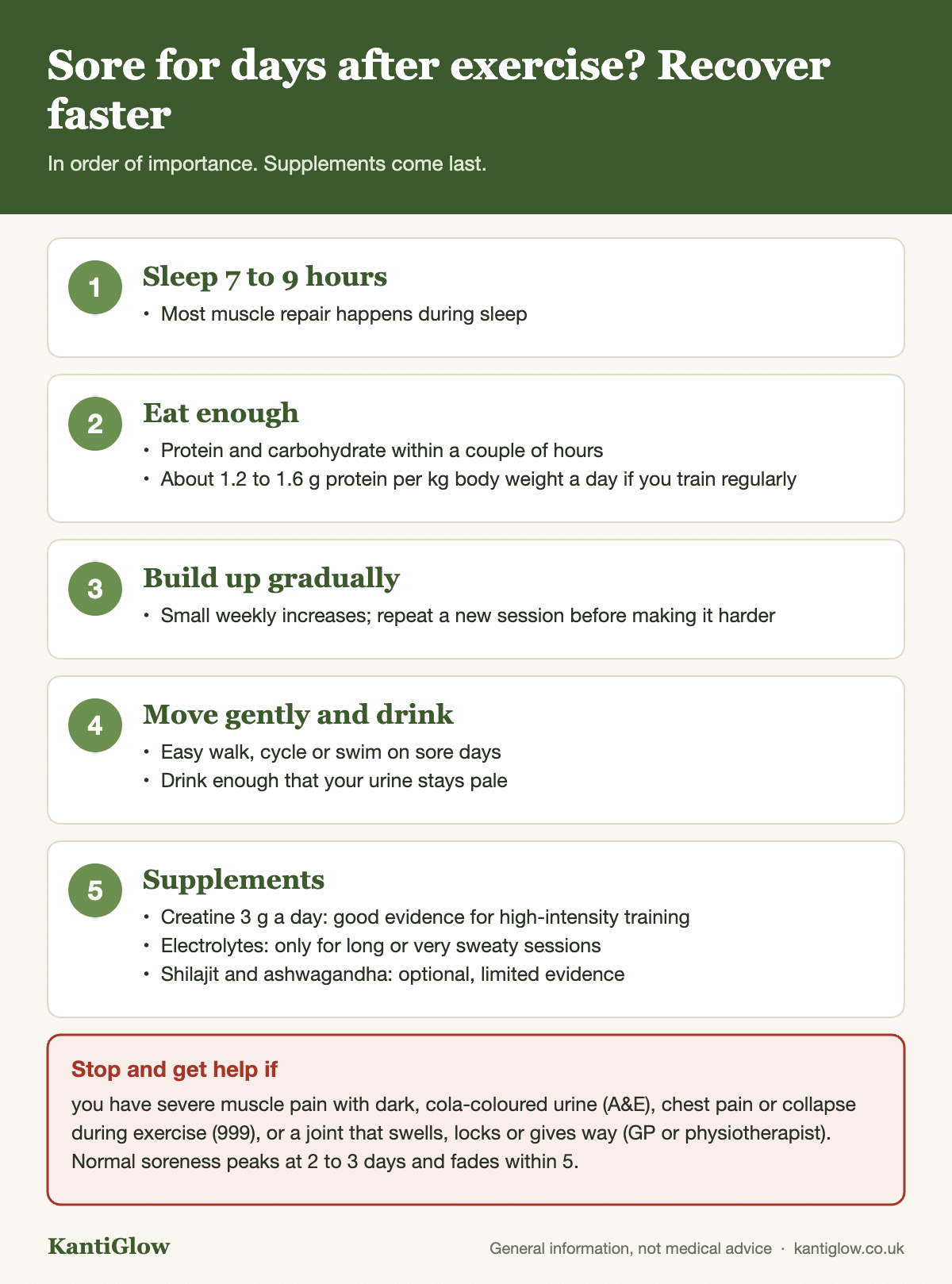
1. Sleep. Seven to nine hours. Most muscle repair happens during sleep, and one short night noticeably worsens next-day soreness and performance.
2. Enough food. After training, eat a meal with protein and carbohydrate within a couple of hours: dal and rice, eggs on toast, chicken and potatoes, yoghurt with fruit and oats. People who train regularly need roughly 1.2 to 1.6 g of protein per kilogram of body weight a day, spread across meals. Carbohydrate refills muscle fuel. Under-eating is the commonest reason for slow recovery.
3. Build up gradually. Increase weight, distance or sessions by small steps each week. Repeat a new session a few times before making it harder.
4. Move gently. A walk, an easy cycle or a swim on sore days increases blood flow and eases stiffness. You can train with mild DOMS, working different muscles or at lower intensity.
5. Fluids. Drink to thirst and check your urine is pale.
6. Warm up with five to ten minutes of easy movement before hard efforts.
Things with modest or mixed evidence
| Method | What we know |
|---|---|
| Massage and foam rolling | Reduce soreness a little for a short time |
| Heat (warm bath) | Eases stiffness |
| Cold water immersion | Slightly reduces soreness, but regular use after strength training may blunt muscle gains |
| Stretching | Does not prevent or reduce DOMS |
| Ibuprofen | Eases pain but is not advised routinely for training soreness |
| Compression garments | Small effect at best |
Ayurveda’s traditional approach to exercise includes warm sesame oil massage before bathing, eating a proper meal afterwards, and exercising to about half your capacity in hot weather or when run down. Massage and adequate food are consistent with the evidence above.
Which supplements are worth it?
| Supplement | Evidence | How it is used | Cautions |
|---|---|---|---|
| Creatine monohydrate | Strong for repeated high-intensity efforts and strength training | 3 g a day, every day. No loading needed | Causes 1 to 2 kg of water weight. Check with a GP if you have kidney disease |
| Protein powder | A convenient way to reach protein needs. No better than food | One serving when meals fall short | Not needed if you eat enough protein |
| Electrolytes | Useful for sessions over 60 to 90 minutes, heavy sweating or hot conditions | In water during or after | Most contain sodium; check if you have high blood pressure. Unnecessary for short sessions |
| Caffeine | Good evidence for performance | Before training | Poor sleep if taken late |
| Tart cherry juice | Some trials show slightly less soreness | Around hard events | Sugar content |
| Ashwagandha | Small trials report modest gains in strength alongside training | Daily for 8 to 12 weeks | Not for pregnancy; check with thyroid, liver or autoimmune conditions |
| Shilajit | Very little human research on exercise | As labelled | Buy only purified, lab-tested products; raw shilajit can contain heavy metals |
| BCAAs | No benefit if total protein is adequate | — | — |
If you compete in tested sport, use only products that are batch-tested under a scheme such as Informed Sport, because supplements can be contaminated with banned substances.
A simple training-day plan
- 2 to 3 hours before: a normal meal with carbohydrate and some protein.
- Before: water, a warm-up, and coffee or tea if you use caffeine.
- During: water. Add electrolytes and carbohydrate only if you are going longer than about 60 to 90 minutes.
- Within 2 hours after: a meal with protein and carbohydrate.
- Daily: creatine if you take it, at any time.
- Evening: a warm bath or easy stretch if you like, and a full night’s sleep.
- Next day: easy movement.
When to stop and get help
Go to A&E or call 999 for severe muscle pain and swelling with dark, tea- or cola-coloured urine or passing very little urine. This can be rhabdomyolysis, a serious breakdown of muscle. Also for chest pain, severe breathlessness or collapse during exercise.
See a GP or physiotherapist for a joint that swells, locks or gives way, pain that is sharp or one-sided, pain that lasts more than a week or two, or soreness after every light session together with unusual tiredness.
Sore muscles after exercise: frequently asked questions
What is DOMS?
Delayed onset muscle soreness: aching and stiffness a day or two after unfamiliar exercise.
How long does DOMS last?
It peaks at two to three days and fades within about five.
Why am I more sore on day two?
The repair process peaks 24 to 72 hours after exercise.
Is soreness a sign of a good workout?
No. You can make progress without being sore.
Is DOMS caused by lactic acid?
No. Lactate clears within an hour of exercise.
Should I train when I am sore?
Yes, lightly, or train different muscles.
How do I get rid of soreness fast?
Gentle movement, warmth, sleep and food. There is no instant fix.
Does stretching prevent soreness?
No.
Does a warm-up help?
It prepares you for hard efforts and may reduce injury risk.
Does foam rolling work?
It reduces soreness slightly for a short time.
Are ice baths worth it?
They ease soreness a little. Regular use after strength training may reduce gains.
Is a hot bath good after exercise?
Yes, it eases stiffness.
Should I take ibuprofen for sore muscles?
Not routinely. Use it only for short periods if needed.
How much protein do I need?
About 1.2 to 1.6 g per kilogram of body weight a day if you train regularly.
Do I need protein straight after training?
Within a couple of hours is fine. Total daily intake matters more.
Is protein powder necessary?
No. It is a convenience.
What should I eat after a workout?
A meal with protein and carbohydrate.
Do I need carbs to recover?
Yes, especially for running and frequent training.
How much water should I drink?
Enough that your urine stays pale.
Do I need electrolytes?
Only for long, hot or very sweaty sessions.
What is creatine?
A compound found in meat and fish, and made by the body, that helps muscles produce energy for short efforts.
Does creatine work?
Yes, for repeated high-intensity efforts and strength training.
How much creatine should I take?
3 g a day.
Do I need a loading phase?
No. Daily 3 g reaches the same level in about four weeks.
When should I take creatine?
Any time. Consistency matters more than timing.
Is creatine safe?
For healthy adults, yes. Check first if you have kidney disease.
Does creatine cause weight gain?
One to two kilograms of water in the muscles.
Does creatine cause hair loss?
One small study raised the question. It has not been confirmed.
Is creatine suitable for vegetarians?
Yes, and vegetarians may benefit more because their diet contains little.
Is creatine useful for runners?
Mainly for sprints and strength work, less for steady endurance.
Should women take creatine?
It works in women as well as men.
What is shilajit?
A mineral-rich resin from Himalayan rocks, used in Ayurveda as a tonic.
Does shilajit help recovery?
There is very little human evidence.
Does ashwagandha help in the gym?
Small trials suggest modest strength gains alongside training.
Does turmeric reduce muscle soreness?
A few small trials suggest a slight effect.
Does tart cherry juice work?
It may slightly reduce soreness after hard events.
Are BCAAs worth taking?
Not if you eat enough protein.
Does magnesium help sore muscles or cramps?
Evidence is weak unless you are low in magnesium.
Do Epsom salt baths work?
The warm water helps. Magnesium absorption through skin is not established.
Does alcohol affect recovery?
Yes. It impairs sleep and muscle repair.
How many rest days do I need?
At least one or two a week, and 48 hours before training the same muscles hard again.
Why do I never seem to recover?
Check sleep, food, total training load and stress. See a GP if tiredness persists.
What is rhabdomyolysis?
A serious breakdown of muscle after extreme exertion, with severe pain and dark urine. It is an emergency.
When should I see a physiotherapist?
For pain that is sharp, one-sided, in a joint, or lasts more than a week or two.
Sources
- NHS: Physical activity guidelines for adults aged 19 to 64
- NHS: Dehydration
- NHS: The Eatwell Guide
- NHS: Insomnia
- Great Britain nutrition and health claims register
Shop this plan at KantiGlow
- Kapiva Original Himalayan Shilajit Resin 20g
- Himalaya Shilajit Gold Capsules
- MuscleBlaze Micronised Creatine Monohydrate
- Fast&Up Reload Electrolytes
- Himalaya Organic Ashwagandha 670mg
- The Men’s Foundation Kit
All products are authentic Indian and UK-labelled brands, sourced directly from India and dispatched within 24–72 hours (UK delivery typically 5–7 working days).
Related guides
Shop the products in this guide
- Man Matters Shilajit Gummies 30 — £11.99
- Ashwagandha Gummies 30 — £8.99
- KantiGlow Selection Hing Goli — £3.99
Lab-tested, vegetarian, shipped from India. Food supplements should not replace a varied diet.
This guide is general information, not medical advice. Food supplements are not intended to diagnose, treat or cure any condition and are not a substitute for a varied diet. Speak to a GP before starting vigorous exercise if you have a medical condition, and seek urgent help for the warning signs above.
Pingback: Men’s Foundation Plan: Shilajit, Gokshura, Ashwagandha | KantiGlow