
Quick answer: In most men, low energy, low sex drive and fading strength in the 40s and 50s come from poor sleep, stress, weight gain round the middle, alcohol and too little strength exercise, not from a hormone deficiency. Testosterone does fall with age, but only by about 1% a year, and that alone rarely causes problems. Start with sleep, lifting weights twice a week, your waistline and alcohol. If symptoms persist, or you have erection problems that keep happening, see a GP: they can check blood pressure, blood sugar and testosterone. Shilajit, gokshura and ashwagandha are traditional Ayurvedic tonics. The evidence that they raise testosterone or strength is thin, and none is a treatment.
Key facts
- The NHS calls “male menopause” an unhelpful term. Testosterone falls gradually, not suddenly.
- True testosterone deficiency (late-onset hypogonadism) is uncommon. It is more likely with obesity or type 2 diabetes.
- It is diagnosed with blood tests, and treated with prescribed testosterone if confirmed.
- Erection problems are very common over 40 and can be an early sign of high blood pressure, high cholesterol or diabetes.
- Losing weight, stopping smoking, exercising daily and keeping alcohol under 14 units a week all help.
- Do not buy testosterone or erection medicines from unregulated websites.
What is going on?
Men in their late 40s and early 50s often notice low mood, less interest in sex, erection problems, irritability, loss of muscle, a bigger waist, low energy, poor sleep and poor concentration. The usual drivers are:
- Sleep. Short or broken sleep lowers energy, mood and testosterone. Loud snoring with daytime sleepiness may be sleep apnoea.
- Stress and low mood. Work, money, relationships and ageing parents all peak at this age. Depression in men often shows as tiredness and irritability.
- Weight round the middle. Abdominal fat lowers testosterone and raises the risk of diabetes.
- Alcohol and smoking.
- Too little strength exercise. Muscle is lost from the mid-30s unless you use it.
- Medical causes. Type 2 diabetes, thyroid problems, anaemia, heart disease and the side effects of some medicines.
Only when those do not explain the symptoms is a hormone problem likely.
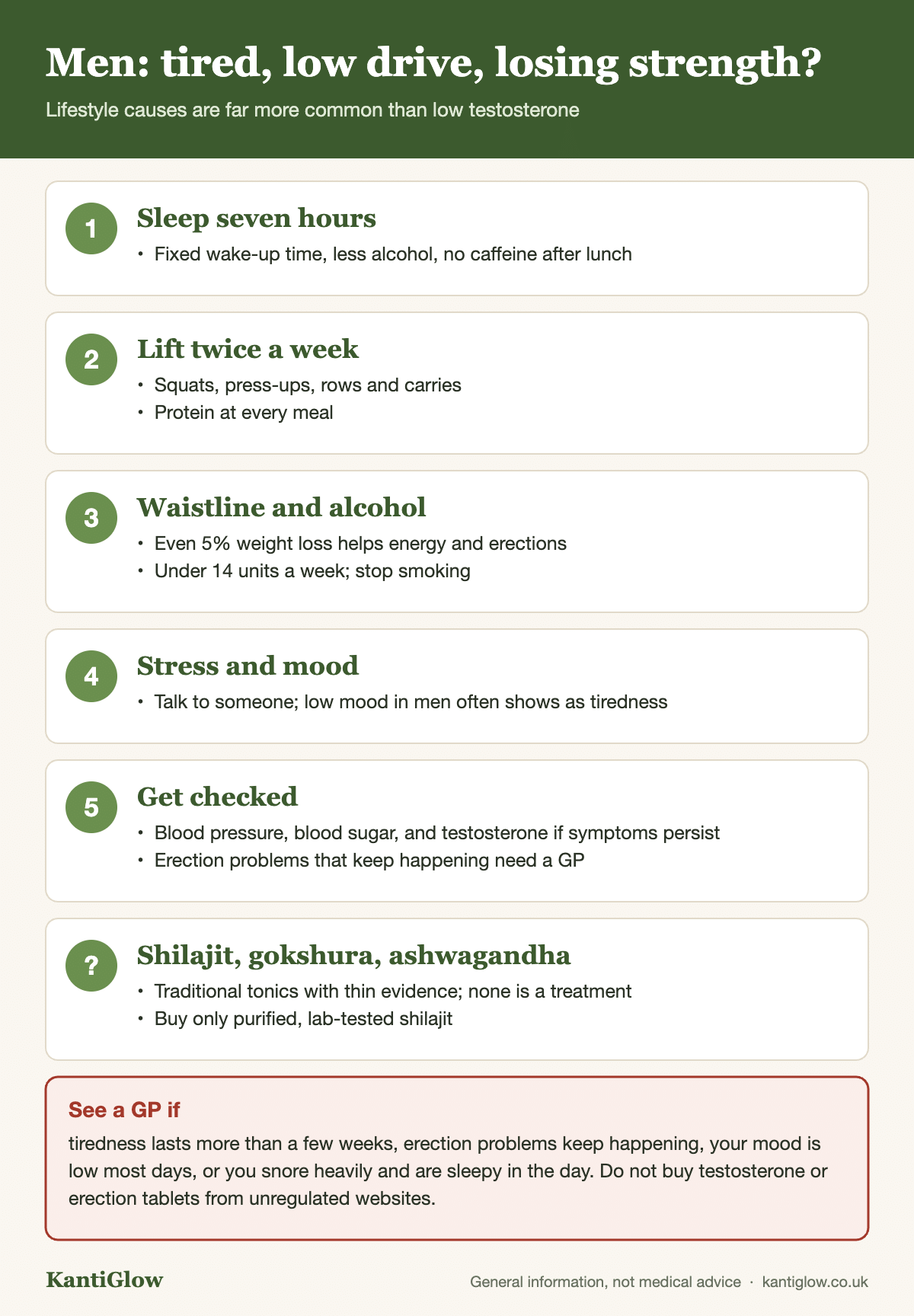
The foundation plan
1. Sleep seven hours. Fixed wake-up time, no caffeine after lunch, less alcohol. Most testosterone is made during sleep. Our guide Can’t Sleep or Waking at 3am? has the routine.
2. Lift twice a week. UK guidelines advise strength exercise on at least two days a week, on top of 150 minutes of moderate activity. Squats, press-ups, rows, deadlifts and carries, at home or in a gym. Add a little weight or a few repetitions each week.
3. Eat enough protein. Include a portion at each meal: eggs, dal, paneer, yoghurt, fish, chicken, beans, nuts.
4. Bring your waist down. Even a 5% weight loss improves energy, blood sugar and erections.
5. Keep alcohol under 14 units a week and stop smoking.
6. Deal with stress. Talk to someone. Our guide Stressed and Wired All the Time? covers what helps.
7. Take vitamin D in autumn and winter. It contributes to normal muscle function.
8. Get checked if nothing has improved after six to eight weeks.
Should I get my testosterone tested?
Ask a GP if you have several of these that are not explained by lifestyle: persistently low sex drive, fewer morning erections, erection problems, loss of muscle, low mood and constant tiredness. The test is a morning blood sample, usually repeated to confirm. If a deficiency is found you may be referred to a hormone specialist, and testosterone gel or injections may be offered.
Home finger-prick tests and private “TRT” clinics are widely advertised. A single borderline result is not a diagnosis. Testosterone treatment you do not need can reduce fertility and has other risks. Start with your GP.
Erection problems are worth mentioning
They are very common, usually treatable, and sometimes the first sign of a circulation problem. If they keep happening, see a GP or a sexual health clinic. Sildenafil is available from pharmacies after a conversation with the pharmacist. Do not buy tablets from unregulated websites: many are fake.
Shilajit, gokshura and ashwagandha: what they can and cannot do
| Shilajit | Gokshura (tribulus) | Ashwagandha | |
|---|---|---|---|
| What it is | A mineral-rich resin from Himalayan rock | Fruit of Tribulus terrestris | Root of Withania somnifera |
| Traditional use | Rejuvenating tonic | Men’s tonic, urinary health | Strength and stamina tonic |
| Evidence | One or two small trials of purified shilajit reported higher testosterone. Not confirmed independently | Trials in healthy men generally show no rise in testosterone or strength | Small trials in men doing resistance training report modest gains in strength and testosterone. Short and mostly industry funded |
| Cautions | Raw or unpurified shilajit can contain heavy metals. Buy only purified, lab-tested products. Avoid with gout or haemochromatosis | Stomach upset. Check first if you take diabetes or blood pressure medicine, or have prostate problems | Thyroid, liver and autoimmune conditions; sedatives; rare liver injury |
| Verdict | Quality matters more than with any other product here | Weakest evidence | Best studied of the three, still modest |
None of these has an authorised health claim in the UK. They cannot be sold as raising testosterone, improving erections or building muscle. Zinc is different: it has an authorised claim that it contributes to the maintenance of normal testosterone levels in the blood. That matters only if your zinc intake is low.
If you want to try one: choose a single product, train and sleep properly alongside it, review at eight to twelve weeks, and stop if you see no difference. Tell your GP what you are taking, because some supplements affect blood tests and medicines.
When to see a GP
See a GP if tiredness has lasted a few weeks without a clear reason, if erection problems keep happening, if your mood is low most days, or if you snore heavily and feel sleepy in the day. Also go if you are very thirsty and passing urine often, have lost weight without trying, or have breast swelling. Chest pain or breathlessness on exertion needs urgent assessment.
Low energy in men: frequently asked questions
Why am I always tired?
Poor sleep, stress, weight gain, alcohol and inactivity are the usual reasons. A GP can check for medical causes.
Is the male menopause real?
Not in the way the name suggests. Testosterone falls slowly, about 1% a year from around 30 to 40.
What are the symptoms of low testosterone?
Low sex drive, erection problems, fewer morning erections, tiredness, low mood and loss of muscle.
At what age does testosterone drop?
It declines gradually from the 30s. A sudden drop is not normal.
How is low testosterone diagnosed?
With morning blood tests, usually repeated, alongside your symptoms.
Can I get a testosterone test on the NHS?
Yes, if your GP thinks your symptoms warrant it.
Are home testosterone kits reliable?
They can be inaccurate and one result is not a diagnosis. Discuss any result with a GP.
What is TRT?
Testosterone replacement therapy, prescribed as a gel or injection for confirmed deficiency.
Is TRT safe?
For men with a confirmed deficiency, under medical supervision. It can reduce fertility and needs monitoring.
Can I raise testosterone naturally?
Sleeping well, losing excess weight, strength training and drinking less all help.
Does lifting weights raise testosterone?
It gives a short-term rise and improves body composition, which helps over time.
Does sleep affect testosterone?
Yes. A week of short sleep measurably lowers it.
Does belly fat lower testosterone?
Yes. Losing weight raises it.
Does alcohol lower testosterone?
Heavy drinking does.
Does stress lower sex drive?
Yes, it is one of the commonest causes.
Why has my sex drive gone?
Tiredness, stress, low mood, relationship strain, alcohol, some medicines and sometimes low testosterone.
Are erection problems normal at my age?
They are very common over 40. If they keep happening, get checked.
Can erection problems be a warning sign?
Yes. They can point to high blood pressure, high cholesterol or diabetes.
Can I buy Viagra over the counter?
Sildenafil is available from pharmacies after a pharmacist consultation.
Is it safe to buy erection tablets online?
Only from a pharmacy registered with the GPhC. Many websites sell fakes.
Why am I losing muscle?
Muscle declines with age unless you do strength exercise and eat enough protein.
How much protein do I need?
Roughly a palm-sized portion at each meal suits most men. Those training hard need more.
How often should I train?
Strength work at least twice a week, plus 150 minutes of moderate activity.
What is shilajit?
A tar-like substance that seeps from Himalayan rocks, used in Ayurveda as a tonic.
Does shilajit increase testosterone?
One small trial of a purified extract suggested so. It has not been confirmed.
Is shilajit safe?
Purified, tested products appear to be tolerated. Raw shilajit can contain heavy metals.
How do I know shilajit is genuine?
Look for a purified product with batch lab test results for heavy metals.
Who should avoid shilajit?
People with gout, haemochromatosis or kidney disease, unless a doctor agrees.
What is gokshura?
The fruit of Tribulus terrestris, a traditional men’s tonic.
Does gokshura boost testosterone?
Trials in healthy men have not shown that it does.
Does gokshura help libido?
A few small studies report a benefit in men with low desire. Evidence is weak.
Does ashwagandha increase testosterone?
Small trials report modest increases. They are short and need confirming.
Does ashwagandha build muscle?
In small trials of men who were also weight training, it added a little to their gains.
Can I take shilajit, gokshura and ashwagandha together?
Combination products exist. Starting one at a time lets you see what helps and what causes side effects.
How long before I notice anything?
Trials that found effects ran for eight to twelve weeks.
Does zinc boost testosterone?
Zinc contributes to the maintenance of normal testosterone levels. Extra zinc does not raise it if you already get enough.
Does vitamin D help?
It contributes to normal muscle function. Take 10 micrograms a day in autumn and winter.
Does safed musli or kaunch beej work?
Both are traditional men’s tonics with very limited human research.
Are testosterone boosters worth it?
Most have little evidence. Sleep, training and weight loss do more.
Could it be depression?
Yes. Tiredness, irritability and loss of interest are common signs in men. See a GP.
Could it be diabetes?
Tiredness, thirst and passing urine often suggest it. A blood test will tell.
Could snoring be the problem?
Loud snoring with daytime sleepiness may be sleep apnoea, which causes tiredness and low libido.
Does cycling affect erections?
Cycling more than three hours a week can. Adjust your saddle or cut back.
When should I see a GP?
If symptoms last more than a few weeks, or erection problems keep happening.
Sources
- NHS: The “male menopause”
- NHS: Erectile dysfunction
- NHS: Tiredness and fatigue
- NHS: Vitamin D
- NHS: Sleep apnoea
- Great Britain nutrition and health claims register
Shop this plan at KantiGlow
- The Men’s Foundation Kit
- Kapiva Himalayan Shilajit Resin 20g
- Kapiva Gokshura Capsules
- Himalaya Gokshura Capsules
- Kapiva KSM-66 Ashwagandha
- Safed Musli Extract 500mg
All products are authentic Indian and UK-labelled brands, sourced directly from India and dispatched within 24–72 hours (UK delivery typically 5–7 working days).
Related guides
Shop the products in this guide
- Baidyanath Shilajit Capsules 50 — £7.99
- Himalaya Gokshura Capsules 60 — £7.99
- Baidyanath Ashwagandhadi Churna Powder 100g — £4.99
- Himalayan Organics Liposomal Vitamin C with Amla & Zinc Tablets 120 — £14.99
Lab-tested, vegetarian, shipped from India. Food supplements should not replace a varied diet.
This guide is general information, not medical advice. Herbal products and food supplements are not intended to diagnose, treat or cure any condition. Speak to a GP about symptoms that persist, and to a pharmacist before taking a supplement if you have a medical condition or take medication.
Pingback: Ayurvedic Gift Guide 2026: Diwali & Christmas (UK) | KantiGlow