Quick answer: Constant stress is best tackled at the source: work out what is driving it, move your body most days, protect your sleep, and talk to someone. Those do more than any supplement. If you want to try one as well, magnesium is the lower-risk choice and is most likely to help if your diet is short of it. Ashwagandha has small trials suggesting it can modestly lower stress scores over 6 to 12 weeks, but it is not suitable for everyone and has no authorised health claim in the UK. Neither treats anxiety or depression. If you are struggling to cope, see a GP or refer yourself to NHS Talking Therapies.
Key facts
- Stress shows up in the body (headaches, tight muscles, stomach trouble, racing heart), the mind (worry, poor concentration) and behaviour (irritability, poor sleep, drinking more).
- Exercise, time for yourself, breathing exercises and talking to someone are the NHS’s first suggestions.
- In England you can refer yourself to NHS Talking Therapies without seeing a GP.
- Magnesium contributes to normal psychological function and the normal functioning of the nervous system. It has no authorised claim for stress relief.
- 400 mg or less a day of magnesium from supplements is unlikely to cause harm, according to the NHS.
- Ashwagandha should be avoided in pregnancy and breastfeeding, and checked with a GP if you have a thyroid, liver or autoimmune condition.
How do I know it is stress?
Stress is the body’s response to pressure. A short burst is useful. It becomes a problem when it does not switch off. Signs include:
- Body: headaches, dizziness, tense shoulders and jaw, stomach problems, a pounding heart, loss of interest in sex
- Mind: constant worrying, feeling overwhelmed, trouble concentrating or making decisions, forgetfulness
- Behaviour: being snappy, sleeping too little or too much, eating more or less, avoiding people, drinking or smoking more
The same symptoms can come from an overactive thyroid, anaemia, too much caffeine, perimenopause, anxiety or depression. If they have gone on for weeks, get checked.
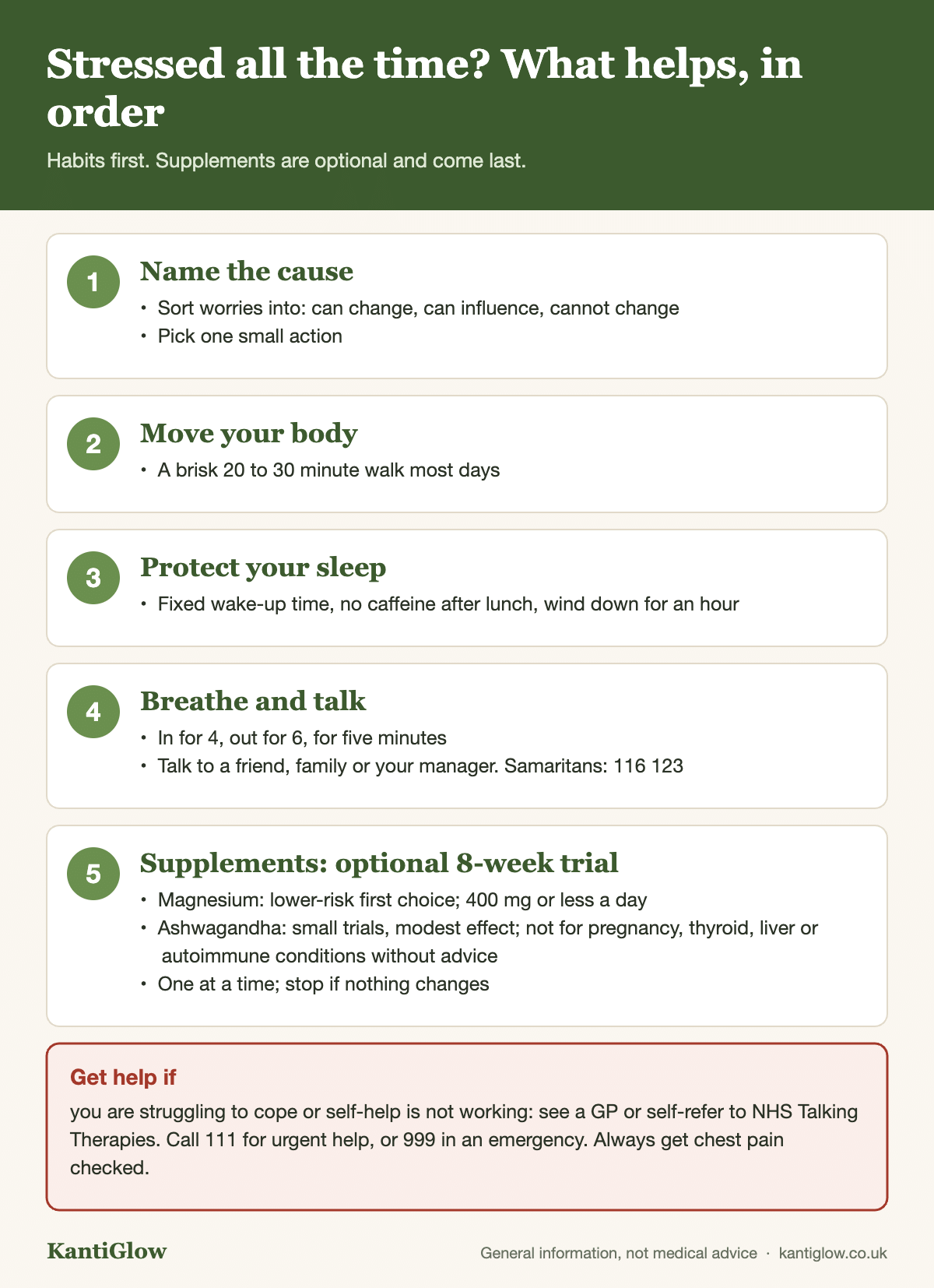
What helps, in order
1. Name the cause. Write down what is weighing on you and sort it into things you can change, things you can influence and things you cannot. Pick one small action for the first group. Trying to fix everything at once makes stress worse.
2. Move your body. Any exercise you will do counts. A brisk 20 to 30 minute walk most days is enough to make a difference.
3. Protect your sleep. Keep a fixed wake-up time, stop caffeine after lunch and wind down for an hour before bed. Our guide Can’t Sleep or Waking at 3am? covers this.
4. Breathe, and talk. Slow breathing calms the body within minutes: in through the nose for a count of four, out for a count of six, for five minutes. Talk to a friend, a relative or your manager. If you need someone now, Samaritans answer on 116 123 at any hour.
5. Cut the props. Alcohol, nicotine and extra coffee feel like they help and make the next day harder.
6. Supplements, if you choose. See below.
Ayurveda’s approach to a restless, overworked mind is routine: regular meal times, warm cooked food, oil massage, time outdoors, and an early night. Those habits fit comfortably with the steps above.
Ashwagandha or magnesium?
| Magnesium | Ashwagandha | |
|---|---|---|
| What it is | An essential mineral | Root of an Ayurvedic herb |
| What can be said in the UK | Contributes to normal psychological function, normal nervous system function, and reduction of tiredness and fatigue | No authorised health claim |
| Evidence for stress | Limited and mixed. Most likely to help if intake is low | Several small trials show modest drops in stress scores over 6 to 12 weeks. Many were industry funded |
| How soon | Days to weeks | 4 to 8 weeks |
| Main side effects | Loose stools at higher doses | Drowsiness, stomach upset. Rare reports of liver injury |
| Who should avoid or check first | Kidney disease. Space from thyroid tablets and some antibiotics | Pregnancy, breastfeeding, thyroid, liver or autoimmune conditions, sedatives, immunosuppressants, diabetes or blood pressure medicine |
| Verdict | The lower-risk first choice | An option for healthy adults for a limited trial |
Who is short of magnesium?
Magnesium comes from green vegetables, nuts, seeds, pulses and wholegrains. People who eat few of these, drink heavily, or take certain medicines long term (including some acid-reducing tablets and water tablets) are more likely to run low. Food first: a handful of almonds or pumpkin seeds, spinach, dal, wholemeal roti.
If you try a supplement
- Start one product, not both.
- Keep to the label amount. For magnesium, 400 mg or less a day.
- Rate your stress out of 10 each week.
- Review at eight weeks. If nothing has changed, stop.
- Stop ashwagandha and seek advice if you notice yellowing skin or eyes, dark urine, itching or a racing heart.
Our guide Is Ashwagandha Safe? explains the cautions in full.
When to get help
See a GP if you are struggling to cope, self-help is not working, or stress is affecting your work, relationships or health. You can also refer yourself to NHS Talking Therapies if you are 18 or over (16 in some areas). Call 111 if you need urgent help but it is not an emergency. Call 999 or go to A&E if you or someone else is in immediate danger or has seriously harmed themselves. Chest pain should always be checked urgently and not put down to stress.
Stressed all the time: frequently asked questions
What are the signs of too much stress?
Headaches, tense muscles, poor sleep, irritability, constant worry and trouble concentrating are the common ones.
Can stress make you physically ill?
Yes. It can cause headaches, stomach trouble, raised blood pressure and more frequent infections.
What is the difference between stress and anxiety?
Stress is a response to a pressure and eases when it passes. Anxiety persists without a clear cause and may need treatment.
What is burnout?
Exhaustion, detachment and reduced performance caused by long-term work stress. It needs rest and changes at work, not a supplement.
Why do I feel tired but wired?
Stress hormones keep the body alert even when you are exhausted. A wind-down routine and less caffeine help.
How can I calm down quickly?
Slow your breathing: in for four, out for six, for five minutes. Step outside if you can.
Does exercise really reduce stress?
Yes. It is one of the most reliable ways to lower stress and improve sleep.
Does caffeine make stress worse?
It can raise heart rate and jitteriness. Try cutting back for two weeks.
Does alcohol help stress?
It relaxes you briefly, then worsens sleep and mood.
What foods help with stress?
Regular balanced meals. Skipping meals and relying on sugar makes energy and mood swing.
What is ashwagandha?
A root used in Ayurveda for centuries as a tonic, also called Withania somnifera.
Does ashwagandha reduce stress?
Small trials suggest a modest effect. Larger independent studies are needed.
Does ashwagandha lower cortisol?
Some trials report lower cortisol. What that means for health is not established.
How long does ashwagandha take to work?
Trials that found an effect reported it after four to eight weeks.
How much ashwagandha should I take?
There is no official UK dose. Follow the label and do not exceed it.
Is KSM-66 better than ordinary ashwagandha?
It is a standardised root extract used in several trials. It has not been shown to be superior in head-to-head studies.
Can I take ashwagandha every day?
Trials lasted up to about three months. Long-term safety is not well studied, so take breaks.
What are the side effects of ashwagandha?
Drowsiness, stomach upset and loose stools. Rarely, liver injury.
Who should not take ashwagandha?
Pregnant or breastfeeding women, and people with thyroid, liver or autoimmune conditions unless a doctor agrees.
Can I take ashwagandha with antidepressants?
Ask your GP or pharmacist first.
Does ashwagandha affect the thyroid?
It may raise thyroid hormone levels. Avoid it if you have a thyroid condition unless your doctor agrees.
Does magnesium help stress?
It may if you are low in magnesium. Evidence in people with normal levels is weak.
Which magnesium is best for stress?
Glycinate is gentle on the stomach. No form is proven better for stress.
How much magnesium should I take?
Keep to 400 mg or less a day from supplements.
When should I take magnesium?
Any time. Many people take it in the evening.
Can I get enough magnesium from food?
Most people can, from greens, nuts, seeds, pulses and wholegrains.
What are the signs of low magnesium?
Tiredness, muscle cramps and twitching, though these have many other causes. A blood test is not always reliable.
Can I take ashwagandha and magnesium together?
There is no known interaction. Start them separately.
Which should I try first?
Magnesium, because it has fewer cautions.
Is ashwagandha or magnesium better for sleep?
Neither is a proven sleep treatment. Habits matter more.
Does tulsi tea help with stress?
It is a traditional calming tea. Research is limited.
Does brahmi help?
It is traditionally used for the mind. Evidence for stress is limited.
Do B vitamins help with stress?
Several B vitamins contribute to normal psychological function. Extra amounts have not been shown to reduce stress in well-nourished people.
Does meditation work?
Mindfulness has reasonable evidence for reducing stress. Ten minutes a day is a fair start.
Can stress cause chest pain?
It can, but never assume. Chest pain needs urgent medical assessment.
Can stress cause stomach problems?
Yes, including bloating, cramps and changes in bowel habit.
Can stress cause hair loss?
Severe stress can trigger shedding two to three months later.
Can stress stop my periods?
It can make them irregular. See a GP if you miss three in a row.
Should I tell my employer?
If work is the cause, yes. Employers have a duty to assess and reduce work-related stress.
What is NHS Talking Therapies?
A free service offering therapies such as CBT. You can refer yourself online.
When should I see a GP about stress?
When you are struggling to cope or self-help has not worked.
Can teenagers take ashwagandha?
It is not recommended for under-18s without medical advice.
Sources
- NHS: Stress
- NHS: NHS Talking Therapies
- NHS: Vitamins and minerals, others (magnesium)
- Great Britain nutrition and health claims register
- NHS: Insomnia
Shop related products at KantiGlow
- Himalaya Organic Ashwagandha 670mg Tablets
- Kapiva KSM-66 Ashwagandha Capsules
- Dabur Ashwagandha Capsules
- The Evening Wind-Down Kit
All products are authentic Indian brands, sourced directly from India and dispatched within 24–72 hours (UK delivery typically 5–7 working days).
Related guides
Shop the products in this guide
Lab-tested, vegetarian, shipped from India. Food supplements should not replace a varied diet.
This guide is general information, not medical advice. Food supplements are not intended to diagnose, treat or cure any condition. If you are struggling to cope, speak to a GP. Check with a GP or pharmacist before taking a supplement if you are pregnant, breastfeeding, have a medical condition or take medication.
Pingback: KSM-66 vs Sensoril vs Ashwagandha Root – UK Guide | KantiGlow
Pingback: Magnesium + Ashwagandha Evening Wind-Down Plan (UK) | KantiGlow