Quick answer: Start with habits, not products. The core of everyday Ayurveda is routine: regular waking and sleeping times, a main meal at midday, warm cooked food with a few kitchen spices, daily movement and a calm evening. Those cost nothing, overlap with standard health advice, and can be tried over a week using the plan below. You do not need to know your dosha or buy any herbs to begin. If you later want to try a herbal product, choose one at a time from a seller that shows batch test results, and check with a pharmacist first if you are pregnant, have a health condition or take medication. Ayurveda should sit alongside your GP’s care, never replace it.
Key facts
- Ayurveda is the traditional system of health from the Indian subcontinent, around 3,000 years old.
- Its everyday advice centres on routine (dinacharya), digestion (agni) and living with the seasons.
- Doshas (vata, pitta, kapha) are a traditional framework. They are not a medical diagnosis and have not been validated scientifically.
- Evidence for individual herbs is mostly limited to small trials.
- The NHS advises that children, pregnant or breastfeeding women, and people with kidney or liver problems should not take herbal medicines without advice, and that herbs can interact with prescribed medicines.
- Never stop or reduce a prescribed medicine in favour of a herbal product.
What Ayurveda is, in plain terms
Ayurveda means “knowledge of life”. It treats health as a balance kept up by daily habits: when you wake, what and when you eat, how you move, how you rest. It also has a large pharmacy of herbs and formulas, and specialist treatments given by practitioners.
For a beginner, it helps to separate three layers:
- Daily habits. Free, low risk, and where most of the benefit is likely to be.
- Food and kitchen spices. Ginger, cumin, coriander, fennel, turmeric, black pepper, ghee. Safe as food.
- Herbal supplements and treatments. Where the cautions apply.
What the evidence says
Being honest about this is part of starting well.
- The habits line up closely with mainstream advice: regular sleep, daylight, movement, unhurried meals, more home-cooked food.
- Some herbs have small clinical trials suggesting modest effects, for example ashwagandha on stress scores, turmeric on knee pain, and psyllium husk for constipation, which has good evidence. Most others have little human research.
- Doshas, detoxing and “balancing” are traditional ideas. They are not supported by clinical evidence, and “detox” claims have no scientific basis.
- In the UK, Ayurvedic practitioners are not regulated by law, and most Ayurvedic products are sold as food supplements, which cannot claim to treat or cure anything.
Do I need to know my dosha?
No. Online dosha quizzes are fun but give inconsistent answers, and the starter habits are the same for everyone. If the idea interests you, read about it as a way some people think about temperament and season. Do not use it to diagnose symptoms.
The 7-day starter plan
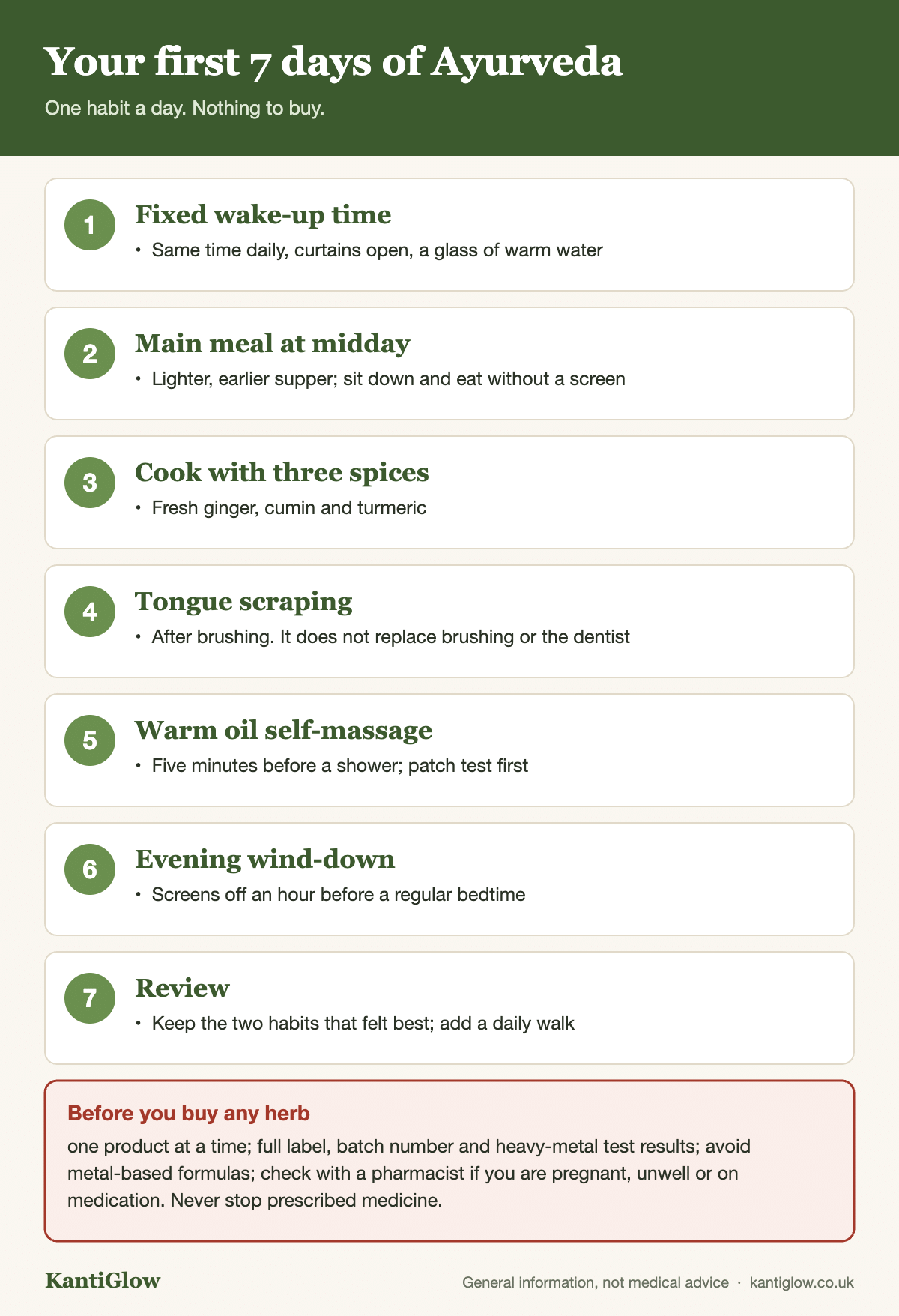
Add one habit a day and keep the earlier ones going. Nothing here requires a purchase.
Day 1: A fixed wake-up time. Get up at the same time, open the curtains, and drink a glass of warm water. A steady wake-up time anchors sleep, appetite and energy.
Day 2: Main meal at midday. Make lunch your largest meal and supper lighter and earlier, finishing two to three hours before bed. Sit down and eat without a screen.
Day 3: Cook with three spices. Add fresh ginger, cumin and turmeric to something you cook: dal, soup, eggs or vegetables. Try a cup of cumin, coriander and fennel tea after lunch.
Day 4: Tongue scraping. After brushing your teeth in the morning, draw a tongue scraper gently from back to front a few times. It freshens breath. It does not replace brushing, flossing or dental check-ups. Oil pulling is another tradition; it is harmless but is not a substitute for toothpaste.
Day 5: Warm oil self-massage. Before your shower, rub a little warm sesame or coconut oil into arms, legs and feet for five minutes. Patch test first, and take care on a slippery floor.
Day 6: An evening wind-down. Screens off an hour before bed, lights low, a warm caffeine-free drink, and bed at a regular time.
Day 7: Review. Which habits felt good and were easy to keep? Choose two to continue for the next month. Add a daily 20 to 30 minute walk if you are not already active.
Thinking of trying a herb? Read this first
- Decide what you want it for, and check whether that needs a GP instead.
- Start with one product. If you take three and feel better or worse, you will not know why.
- Common beginner choices are kitchen-level products: triphala, amla, tulsi tea, ashwagandha and isabgol. Our individual guides cover each.
- Check who should avoid it. Pregnancy, breastfeeding, children, kidney or liver problems and regular medication are the main flags.
- Buy carefully. Look for a full ingredients list, a batch number, a named manufacturer, and heavy-metal test results for the batch. Avoid products containing bhasma or other metal- or mineral-based ingredients, and anything that claims to cure a disease.
- Keep to the label amount and review after eight weeks.
- Tell your GP and pharmacist what you take.
Our guide Is Ayurveda Safe? goes through heavy metals and buying safely in detail.
What to avoid as a beginner
- Stopping or cutting down prescribed medicines.
- Fasts, purges or “detox” programmes.
- Products bought from informal sellers, social media or abroad with no English label.
- Taking several new herbs at once.
- Giving herbal products to children.
- Using Ayurveda to treat serious symptoms without a diagnosis.
When to see a GP
See a GP about any symptom that is new, persistent or worrying before trying to manage it with diet or herbs: unexplained weight loss, lasting tiredness, a change in bowel habit, bleeding, chest pain, breathlessness or low mood. Stop any herbal product and seek advice if you notice yellowing of the skin or eyes, dark urine, a rash, stomach pain or palpitations.
How to start Ayurveda: frequently asked questions
What is Ayurveda?
A traditional system of health from India based on daily routine, diet and herbs.
How do I start Ayurveda?
With daily habits: regular hours, a main meal at midday, warm cooked food and an evening wind-down.
Do I need to buy anything to begin?
No.
Does Ayurveda work?
Its lifestyle advice matches standard health guidance. Evidence for most herbs is limited.
Is Ayurveda scientifically proven?
Some individual herbs have small trials. The system as a whole has not been proven.
Is Ayurveda safe?
The habits and kitchen spices are. Herbal products need the same care as any supplement.
What are doshas?
Vata, pitta and kapha: three traditional types used to describe temperament and tendencies.
How do I find my dosha?
Quizzes exist, but results vary and you do not need one to begin.
What is dinacharya?
The Ayurvedic daily routine.
What is agni?
The traditional idea of digestive strength.
Why warm water in the morning?
It is a gentle, traditional way to start the day. There is no special effect beyond hydration.
Why eat the main meal at midday?
Tradition holds that digestion is strongest then. A lighter evening meal also tends to improve sleep.
Do I have to become vegetarian?
No.
Do I have to give up tea and coffee?
No. Keeping caffeine to the morning helps sleep.
What is CCF tea?
A tea of cumin, coriander and fennel seeds.
Is ghee healthy?
It is a saturated fat. Small amounts in cooking are fine as part of a balanced diet.
What does tongue scraping do?
It removes coating from the tongue and freshens breath.
Does oil pulling work?
It may reduce plaque slightly. It does not replace brushing.
What is abhyanga?
Self-massage with warm oil.
Which oil is best for massage?
Sesame is traditional. Coconut suits warmer weather. Patch test first.
What is the best first herb?
There is no single answer. Many beginners start with tulsi tea or triphala.
Should I take ashwagandha?
Only if it is suitable for you. It is not for pregnancy, and needs checking with thyroid, liver or autoimmune conditions.
What is triphala?
A blend of three dried fruits, traditionally taken in the evening for digestion.
What is chyawanprash?
A spiced herbal jam based on amla.
Can I take Ayurvedic herbs with my medication?
Check with a pharmacist first. Interactions are possible.
Can I take herbs in pregnancy?
Not without advice from your midwife or GP.
Can children take Ayurvedic products?
Not without medical advice.
How do I know a product is safe?
Look for a full label, a batch number and heavy-metal test results, and avoid metal-based ingredients.
What is bhasma?
A traditional preparation made from metals or minerals. Beginners should avoid these.
What does “AYUSH” on a label mean?
It refers to India’s ministry for traditional medicine. It is not a UK approval.
Are Ayurvedic products regulated in the UK?
Most are sold as food supplements under food law. A few herbal medicines hold a traditional herbal registration.
Should I see an Ayurvedic practitioner?
You can, but the profession is not regulated by law in the UK. Tell your GP about any treatment.
What is panchakarma?
A set of intensive cleansing treatments. It is not for beginners and carries risks.
Do I need to detox?
No. Your liver and kidneys do that.
Can Ayurveda help me lose weight?
Regular meals and more home cooking can help. No herb causes weight loss on its own.
Can Ayurveda cure diabetes or other diseases?
No. Do not stop prescribed treatment.
How long before I notice a difference?
Routine changes often help sleep and digestion within a couple of weeks.
Can I combine Ayurveda with yoga?
Yes. They are traditionally practised together.
Is Ayurveda religious?
It developed alongside Indian philosophy but its daily practices are not religious.
What should I avoid as a beginner?
Stopping medicines, detoxes, unlabelled products and taking many herbs at once.
Is an Ayurvedic routine expensive?
The core habits are free.
Where should I buy Ayurvedic products in the UK?
From sellers that provide full labelling and batch test results.
What if I feel worse?
Stop what you started and speak to a pharmacist or GP.
When should I see a GP instead?
For any new, persistent or worrying symptom.
Sources
- NHS: Herbal medicines
- NHS: The Eatwell Guide
- NHS: Physical activity guidelines for adults aged 19 to 64
- NHS: Insomnia
- MHRA: Herbal medicines granted a traditional herbal registration
Shop this plan at KantiGlow
- The Ayurvedic Foundation Kit
- Himalaya Triphala Capsules
- Himalaya Organic Ashwagandha 670mg
- Organic India Tulsi Capsules
- Himalaya Tulasi (Holy Basil) Tablets
All products are authentic Indian and UK-labelled brands, sourced directly from India and dispatched within 24–72 hours (UK delivery typically 5–7 working days).
Related guides
Shop the products in this guide
- Dabur Ashwagandha Capsules 20 — £3.99
- Himalaya Tulsi Tablets 60 — £7.99
- Dabur Triphala Churna Powder 120g — £3.99
- KantiGlow Selection Hing Goli — £3.99
Lab-tested, vegetarian, shipped from India. Food supplements should not replace a varied diet.
This guide is general information, not medical advice. Herbal products and food supplements are not intended to diagnose, treat or cure any condition. Do not stop prescribed medication, and speak to a GP or pharmacist before taking a herbal product if you are pregnant, breastfeeding, have a medical condition or take medication.
Pingback: Ayurvedic Gift Guide 2026: Diwali & Christmas (UK) | KantiGlow
Pingback: Moringa vs Spirulina vs Wheatgrass vs Sea Moss (UK) | KantiGlow