Quick answer: Premenstrual syndrome (PMS) is the group of physical and emotional symptoms that appear in the week or two before a period and lift once it starts. Most women get it at some point. Regular exercise, balanced meals eaten little and often, enough sleep, stress relief, and less alcohol all help, and a symptom diary kept for two cycles shows the pattern and is the most useful thing to take to a GP. If self-help is not enough, treatments include hormonal contraception, CBT and antidepressants. Shatavari is the classical Ayurvedic tonic for women, but there is very little research on it in PMS, so treat it as a traditional option, not a remedy. See a GP if symptoms affect your daily life, and urgently if you have very low mood or suicidal thoughts before your period.
Key facts
- PMS symptoms include mood swings, irritability, anxiety, tiredness, trouble sleeping, bloating, cramps, breast tenderness, headaches, spots and changes in appetite.
- Symptoms can vary from month to month.
- Exercise, a balanced diet, sleep and stress reduction are the recommended first steps.
- A diary of symptoms over at least two cycles helps a GP.
- Premenstrual dysphoric disorder (PMDD) is a much more severe form affecting a small number of women.
- There is not much evidence that vitamin B6, calcium, vitamin D or magnesium supplements help PMS.
Is it PMS?
The clue is timing. PMS symptoms start after ovulation, in the one to two weeks before your period, and ease within a few days of bleeding starting. You then have a clear spell until mid-cycle. If symptoms are there all month and simply worse before a period, something else, such as depression, anxiety or a thyroid problem, may be underneath.
| Emotional | Physical |
|---|---|
| Mood swings | Bloating and tummy cramps |
| Irritability or anger | Breast tenderness |
| Feeling low, anxious or tearful | Headaches |
| Tiredness, poor sleep | Spots, greasy hair |
| Poor concentration | Food cravings, appetite changes |
PMDD. A small number of women have symptoms severe enough to disrupt work and relationships: intense anxiety, anger or depression, sometimes with suicidal feelings, alongside physical symptoms. PMDD needs medical treatment. It is not something to manage alone.
Why it happens
The cause is not fully understood. It is linked to the rise and fall of oestrogen and progesterone after ovulation, and some women appear to be more sensitive to those shifts. Hormone levels themselves are usually normal, which is why blood tests rarely help. Stress, poor sleep, alcohol and a lack of exercise make symptoms worse.
What helps PMS
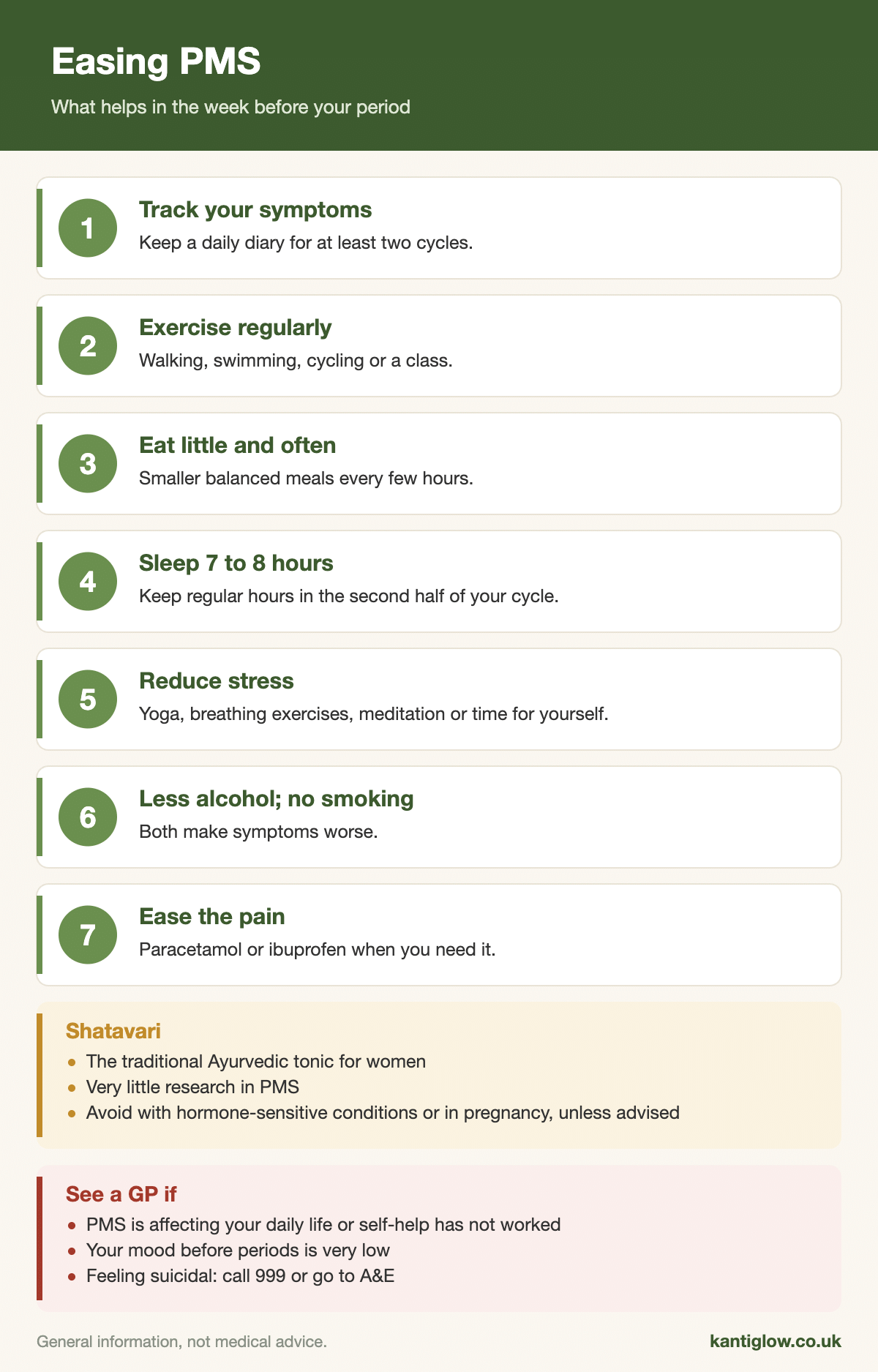
1. Keep a diary. Note symptoms daily for at least two cycles, on paper or in a period-tracking app. Seeing the pattern helps you plan around bad days and confirms the diagnosis.
2. Exercise regularly. Brisk walking, swimming, cycling or a class. It is one of the best-supported measures for both mood and bloating.
3. Eat balanced meals, little and often. Smaller meals every two to three hours, with wholegrains, protein, vegetables and fruit, steady energy and cravings better than three large meals.
4. Sleep. Aim for seven to eight hours and keep regular hours in the second half of your cycle.
5. Reduce stress. Yoga, breathing exercises, meditation or simply protected time for yourself.
6. Cut down on alcohol and do not smoke.
7. Ease the physical symptoms. Paracetamol or ibuprofen for pain; a well-fitted bra for breast tenderness; less salt and fewer fizzy drinks if you bloat.
8. Go easy on caffeine if you are anxious or sleeping badly.
9. Plan around it. Move demanding commitments away from your worst days where you can, and tell the people close to you what is going on.
What a GP can offer
- Hormonal medicine, such as the combined contraceptive pill.
- Cognitive behavioural therapy (CBT).
- Antidepressants, which can be taken all month or only in the second half of the cycle.
- Referral to a specialist if symptoms persist.
Take your symptom diary with you.
Where shatavari fits
What it is. Shatavari (Asparagus racemosus) is a climbing asparagus whose root is the principal women’s tonic in Ayurveda, traditionally used from the first period through to menopause. It is sold as powder (churna), tablets, capsules and granules.
What research shows. Studies in people are few and small, and most concern breastfeeding or menopause, not PMS. Laboratory work shows the root contains plant compounds called steroidal saponins. Whether these affect premenstrual symptoms has not been properly tested. It is honest to say the use is traditional.
How it is taken. Classically, half to one teaspoon of powder in warm milk, once or twice a day. Follow the amount on your product’s label.
Choosing one.
| Form | Notes |
|---|---|
| Root powder | Traditional and inexpensive. Mildly sweet, slightly bitter |
| Tablets or capsules | Convenient. Check the amount per tablet and whether it is root powder or extract |
| Granules (kalpa) | Powder with sugar and flavouring. High in sugar |
Look for the botanical name, the part used (root), a batch number and a best-before date.
Cautions.
- Avoid if you are allergic to asparagus.
- Because of possible hormone-like activity, avoid it if you have had breast, womb or ovarian cancer, endometriosis or fibroids, unless your doctor agrees.
- Do not take it in pregnancy without medical advice.
- It may have a mild diuretic effect. Check with a pharmacist if you take lithium or water tablets.
- It can cause wind or loose stools in some people.
If you try it, give it two to three cycles alongside the steps above, keep the diary going, and stop if nothing changes.
Other supplements people ask about
| Supplement | What we know |
|---|---|
| Calcium, vitamin D, vitamin B6, magnesium | Not much evidence they help. High-dose B6 over long periods can damage nerves |
| Agnus castus (chasteberry) | Some trials suggest benefit. Can interact with hormonal contraception; ask a pharmacist |
| Evening primrose oil | Trials do not show benefit for PMS |
| St John’s wort | Interacts with many medicines, including the pill. Do not take without advice |
| Ashwagandha | Small stress trials only |
| Saffron | A few small trials |
| Ginger, fennel | Used for cramps. Limited evidence |
Check with a GP or pharmacist before taking supplements alongside other medicines.
When to see a GP
See a GP if lifestyle changes have not helped or PMS is affecting your daily life. Go promptly if your mood before periods is very low, or if symptoms do not clear after your period. If you are feeling suicidal, call 999 or go to A&E.
PMS relief: frequently asked questions
What is PMS?
Symptoms in the week or two before a period that ease when it starts.
What are the symptoms?
Mood swings, irritability, tiredness, bloating, breast tenderness and headaches.
How common is it?
Most women have it at some point.
What causes PMS?
Sensitivity to hormone changes after ovulation. The exact cause is unclear.
When does PMS start?
Usually one to two weeks before a period.
How long does it last?
Until a few days into the period.
How do I know it is PMS and not depression?
PMS clears after your period and returns before the next. A diary shows this.
What is PMDD?
A severe form with intense mood symptoms. It needs treatment.
Can PMS get worse with age?
It often does in the late 30s and 40s, towards perimenopause.
Does exercise help?
Yes.
Does diet help?
Balanced meals, eaten little and often, help.
Does cutting salt help bloating?
It can.
Does caffeine make PMS worse?
It can worsen anxiety, sleep and breast tenderness.
Does alcohol make it worse?
Yes.
Why do I crave sugar?
Appetite changes are part of PMS. Regular meals help.
Why am I so tired?
Hormone changes and poorer sleep.
Why can’t I sleep before my period?
It is a common symptom. Keep regular hours and limit caffeine.
What helps mood swings?
Exercise, sleep, stress relief, and treatment from a GP if needed.
What helps breast tenderness?
A supportive bra and simple pain relief.
Does the pill help?
It helps some women. A GP can advise.
Do antidepressants help?
Yes, for more severe PMS and PMDD.
Does CBT help?
Yes.
Do I need a blood test?
Usually not. Diagnosis is based on the pattern of symptoms.
What is shatavari?
The root of Asparagus racemosus, a traditional Ayurvedic tonic for women.
Does shatavari help PMS?
It has not been properly tested for PMS.
Does shatavari balance hormones?
That has not been shown in people.
How do I take shatavari?
Traditionally as powder in warm milk. Follow the label.
How long does it take?
Allow two to three cycles before judging.
Is shatavari safe?
It is generally well tolerated. Some people should avoid it.
Who should not take shatavari?
People with asparagus allergy or hormone-sensitive conditions, and pregnant women, without advice.
Can I take shatavari with the pill?
There is no established interaction. Ask a pharmacist.
Can I take shatavari while trying to conceive?
Ask your GP first.
Powder or tablets?
Either. Powder is cheaper.
Does vitamin B6 help?
There is not much evidence, and high doses can harm nerves.
Does magnesium help?
There is not much evidence.
Does evening primrose oil help?
Trials do not show benefit.
Does agnus castus help?
Some trials suggest so. Check for interactions.
Can I take St John’s wort?
Not without advice. It interacts with the pill and other medicines.
Should I track my cycle?
Yes, for at least two cycles.
When should I see a GP?
If PMS affects your daily life or self-help has not worked.
Sources
Shop the products in this guide
- Organic India Shatavari Capsules 60 — £7.99
- Her Health Shatavari with Dashmool Capsules 60 — £12.99
- ZEROHARM Shatavari Tablets — £15.99
- Dabur Shatavari Tablets 60 — £4.99
Lab-tested, vegetarian, shipped from India. Food supplements should not replace a varied diet.
This guide is general information, not medical advice. Herbal products and food supplements are not intended to diagnose, treat or cure any condition. Speak to a GP about PMS that affects your daily life.
Pingback: Kapiva vs Himalaya vs Dabur – Which Brand? UK Guide | KantiGlow
Pingback: Shatavari Women’s Monthly Routine (UK Guide) | KantiGlow