Quick answer: Counterfeit and substandard supplements do circulate, mostly through anonymous marketplace listings, social media sellers and suitcase imports, and the popular brands are the ones most copied. You can check a product in a few minutes: look for an intact seal, sharp printing, a batch number and dates printed on the pack, any hologram or QR code the brand uses, an English label with full ingredients, a named UK seller, and a price in the normal range. A seller who can show test results for the batch is the strongest reassurance. If a product looks wrong, do not take it. If you have taken something and feel unwell, stop, keep the packaging and speak to a pharmacist or GP.
Key facts
- Food supplements are not checked or approved by a regulator before they go on sale. The business selling them is responsible for safety and labelling.
- A UK supplement label must show a business name and address, an ingredients list, a daily amount, a date mark and standard warnings.
- The NHS advises against buying unlicensed herbal medicines online.
- A THR mark and MHRA product code show that a herbal medicine is registered in the UK.
- Some products sold informally have been found to contain undeclared pharmaceutical drugs or heavy metals.
- Suspected side effects and fake medicines can be reported to the MHRA through the Yellow Card scheme.
Fake, substandard or simply unsuitable?
| Type | What it is | Main risk |
|---|---|---|
| Counterfeit | A copy of a real brand’s product | Unknown contents |
| Adulterated | A real or own-brand product with undeclared ingredients, such as steroids, painkillers or erectile dysfunction drugs | Drug side effects and interactions |
| Substandard | Genuine brand, but expired, badly stored or contaminated | Reduced quality; microbes; heavy metals |
| Grey import | Genuine product made for the Indian market, sold without a UK-compliant label | Missing information and consumer protection |
| Unsuitable | Genuine and legal, but not right for you | Interactions, pregnancy, medical conditions |
All five matter, and only some can be seen from the outside. That is why the seller is as important as the pack.
Where fakes turn up
- Marketplace listings from sellers with no name, address or history.
- Social media and messaging-app sellers.
- Market stalls and unlabelled goods under the counter.
- Websites with prices far below every other retailer.
- Products carried back from abroad and sold on.
- “Special” versions of a famous product that the manufacturer does not list.
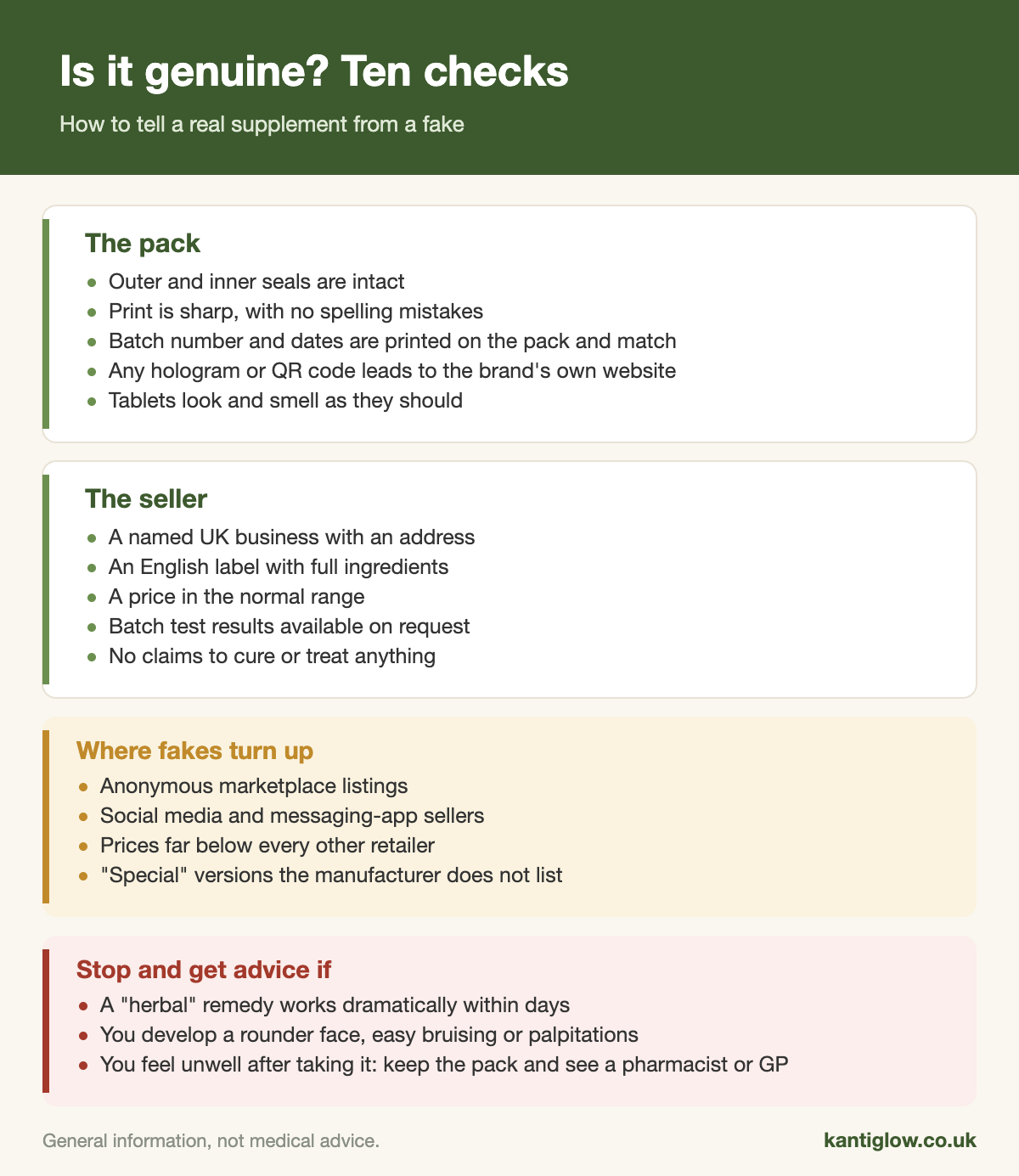
Ten checks for a genuine product
The pack
- The seal. The outer shrink-wrap or tamper band and the inner foil seal are intact.
- The print. Text is sharp, colours are even, and there are no spelling mistakes or odd fonts. Compare it with pictures on the manufacturer’s own website.
- Batch number and dates. Printed or embossed on the pack itself, legible, and consistent between the box and the bottle. Be wary of dates on a loose sticker or scratched out.
- Security features. Many Indian brands use a hologram, a scratch code or a QR code that links to their own domain. Check where the QR code actually takes you.
- The product itself. Tablets of even colour and size, no unusual smell, no damp or clumping, and the right number in the pack.
The seller
- A named business with a UK address, contact details and a returns policy.
- An English label with full ingredients, a daily amount and warnings, added for the UK market.
- A realistic price. A product at half the usual price has a reason.
- Batch test results for heavy metals and microbes, supplied when you ask.
- Honest claims. No promises to cure, reverse or treat a condition.
If you are unsure, email the manufacturer with the batch number and a photograph. Established brands will usually confirm whether a batch is theirs.
What makes a brand “authentic”?
The word is used loosely. In practice it means the product was made by the manufacturer named on the pack, in a licensed facility, and has reached you through a supply chain that can be traced. Long-established Indian houses include Dabur, Himalaya, Baidyanath, Zandu, Organic India, Kottakkal Arya Vaidya Sala, Kerala Ayurveda, Charak and Dhootapapeshwar, alongside newer brands such as Kapiva. Being on that list says who made a product. It does not say every product in a range is right for you, and several of these companies also make classical mineral-based formulas that should be taken only with qualified advice.
Signs a product may be adulterated
- It works dramatically within days, especially for pain, weight loss, sexual performance or blood sugar.
- You feel jittery, flushed, unusually energetic or have palpitations.
- Your face becomes rounder, you bruise easily or gain weight on a “herbal” arthritis or asthma remedy. These suggest steroids.
- The seller cannot tell you what is in it.
Stop taking it and speak to a doctor. Do not stop suddenly if you have taken an unlabelled remedy for months and feel unwell without it; tell your GP, because hidden steroids need to be reduced under supervision.
If you think you have a fake
- Do not take any more.
- Keep the product, packaging and proof of purchase.
- Contact the seller and ask for a refund.
- Report it: fake or suspect medicines and side effects to the MHRA Yellow Card scheme; other problems to Trading Standards through Citizens Advice; and the listing to the marketplace.
- See a pharmacist or GP if you have symptoms. Take the pack with you.
Buying safely
- Buy from a UK business you can identify.
- Prefer single herbs and simple blends over complex formulas.
- Avoid mineral or metal-based ingredients unless you have qualified advice.
- Pay by card for purchase protection.
- Check with a pharmacist if you are pregnant, breastfeeding, have a medical condition, take medication or are buying for a child.
Fake supplements: frequently asked questions
Are fake supplements common?
They exist, mainly through anonymous online sellers. Popular brands are copied most.
How do I know if my supplement is genuine?
Check the seal, print, batch number, security features and the seller.
What does a genuine seal look like?
An unbroken outer band or wrap and an intact inner foil.
Should the batch number be printed on the pack?
Yes, and it should match between box and bottle.
Is a sticker over the label a bad sign?
A UK information sticker is normal. A sticker over the date or batch number is not.
Do Indian brands use holograms?
Many do. Compare with the manufacturer’s website.
Can I trust a QR code?
Only if it leads to the brand’s own domain.
Can I verify a batch with the manufacturer?
Often, yes. Email them the batch number and a photo.
Why is it so much cheaper on some sites?
It may be counterfeit, expired, or a grey import.
What is a grey import?
A genuine product intended for another market, sold without UK labelling.
Are grey imports dangerous?
Not necessarily, but they lack UK labelling and protection.
Is it safe to buy on marketplaces?
Only from a named business with an address and a record.
Is it safe to buy on social media?
No.
Is it safe to bring products back from India?
For personal use it is your choice, but labels may be incomplete and you have no recourse.
What is an adulterated supplement?
One containing undeclared ingredients, sometimes prescription drugs.
Which products are most often adulterated?
Those sold for weight loss, sexual performance, pain and blood sugar.
How would I know if a product contains steroids?
Rapid, dramatic relief, weight gain, a rounder face and easy bruising are warning signs.
What should I do if I suspect steroids?
See your GP. Do not stop abruptly after long use.
Can fake supplements contain heavy metals?
Yes. So can poorly made genuine ones.
What is a certificate of analysis?
A lab report for a batch showing test results.
Will a seller give me one?
A good one will.
Which Indian brands are long established?
Dabur, Himalaya, Baidyanath, Zandu, Organic India and Kottakkal, among others.
Does a famous brand guarantee safety?
No. It tells you who made the product.
What does “authentic” mean?
Made by the named manufacturer and supplied through a traceable chain.
Are Ayurvedic products regulated in the UK?
Most are sold as food supplements and are not approved before sale.
What should a UK label include?
Ingredients, daily amount, warnings, a date and a business address.
What is a THR mark?
UK registration of a herbal medicine.
Does AYUSH on the label prove it is genuine?
No. Counterfeits copy the label, licence numbers included.
The tablets look different from last time. Is that a problem?
Natural products vary a little. Large differences deserve a query to the seller.
The product smells odd. Should I take it?
No.
It has passed its date. Is it safe?
Do not take it.
I have already taken some. What now?
Stop, keep the pack, and see a pharmacist or GP if you feel unwell.
Who do I report a fake to?
The MHRA Yellow Card scheme, Trading Standards and the marketplace.
Can I get my money back?
Ask the seller, then your card provider.
Are capsules easier to fake than tablets?
Any format can be copied.
Are sealed products always genuine?
No. Seals are copied too. Use all the checks together.
Does organic certification help?
It concerns farming. It does not prove authenticity.
Should I avoid buying online altogether?
No. Buy from an identifiable UK business.
Who should take extra care?
Anyone pregnant, breastfeeding, on medication, or buying for a child.
What is the safest approach?
A simple, single-herb product from a UK seller who can show batch testing.
Sources
- NHS: Herbal medicines
- Food Standards Agency: Food supplements, guidance for businesses
- MHRA: Herbal medicines granted a traditional herbal registration
- MHRA: Yellow Card scheme
Shop the products in this guide
- Baidyanath Shilajit Capsules 50 — £7.99
- Patanjali Ashwagandha Capsules — £1.99
Lab-tested, vegetarian, shipped from India. Food supplements should not replace a varied diet.
This guide is general information, not medical or legal advice. Herbal products and food supplements are not intended to diagnose, treat or cure any condition. If you are worried about a product you have taken, stop it and speak to a pharmacist or GP.
Pingback: Is Ayurveda Safe? UK Guide to Testing & Novel Foods | KantiGlow
Pingback: Triphala UK Guide: Tablets vs Churna, How to Take It | KantiGlow
Pingback: Kapiva vs Himalaya vs Dabur – Which Brand? UK Guide | KantiGlow